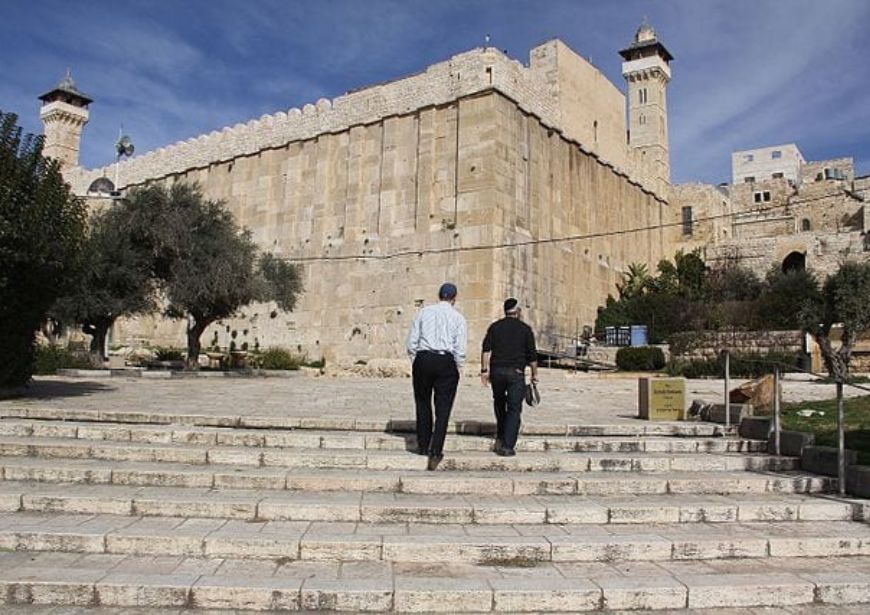
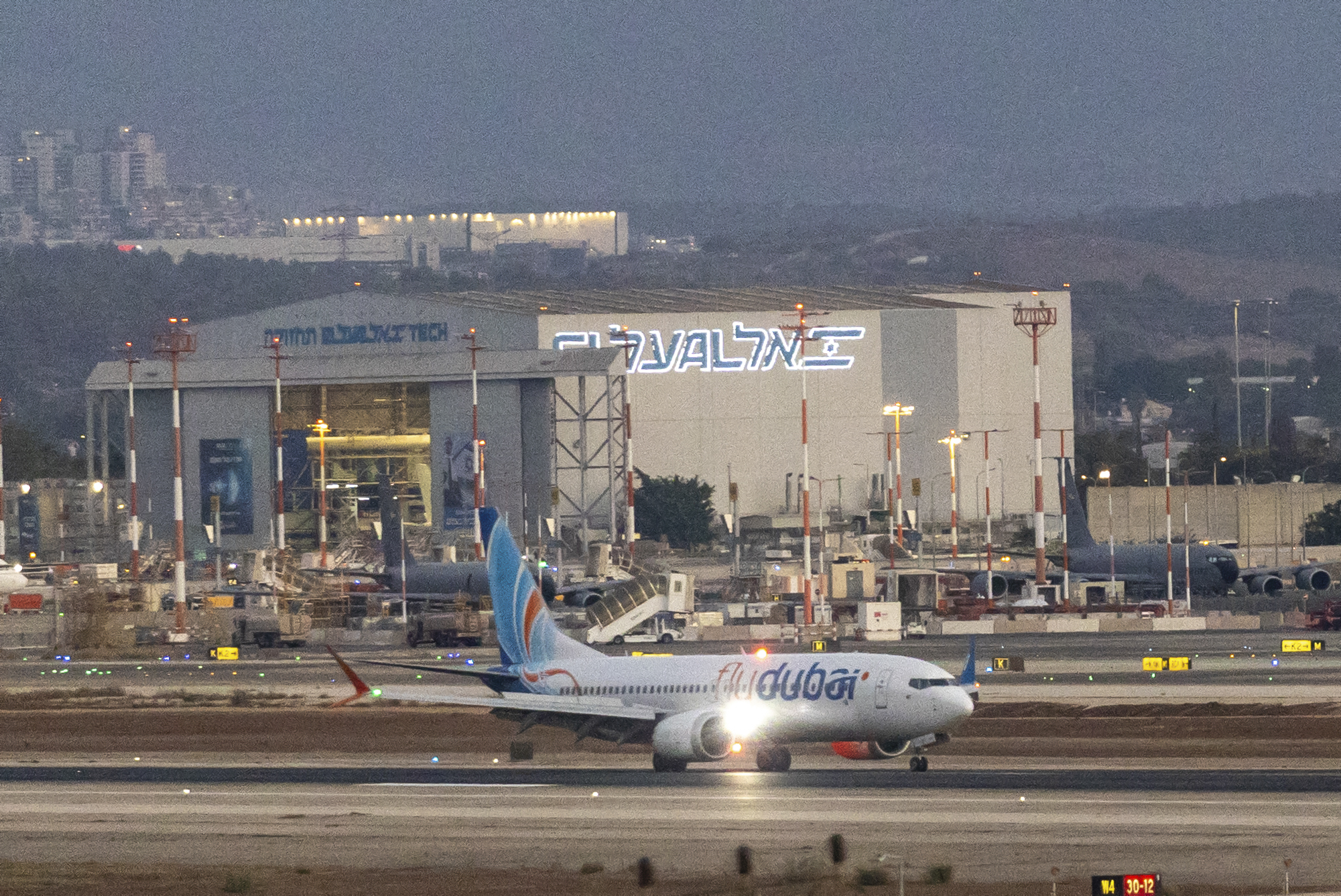
The Cave of the Patriarchs has become a central prayer site during the intermediate days of Sukkot. Tens of thousands of worshippers have already arrived at the site during the holiday, and security forces are doing everything to ensure their safety. Here’s how the special operation by Israeli forces at the holy site looks.
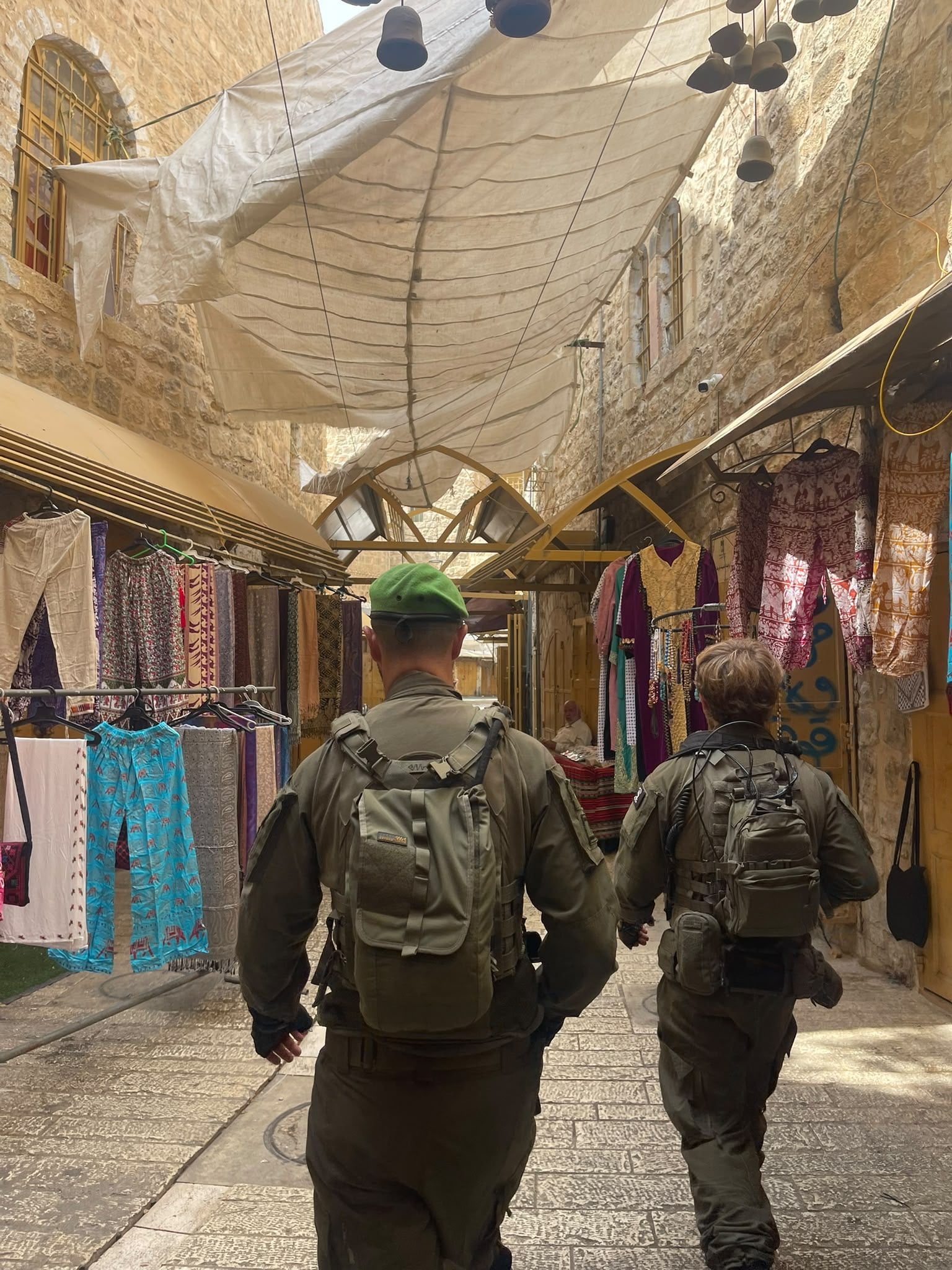
A comprehensive security operation is being carried out by Israeli forces throughout the intermediate days of Sukkot. Its goal is to secure the tens of thousands of worshippers and visitors who have come to the Cave of the Patriarchs and various settlement events across the Judea sector. As part of the special deployment, forces in the field have been significantly reinforced, and a dedicated command center has been opened under the command of the Judea Brigade commander, coordinating the operational picture and enabling continuous command and rapid response to any development.
Credit: None
Alongside securing the celebrants and visitors, security forces continue routine operational activity to thwart terror and strengthen the defensive line in the area. Since the start of the holiday, heavy traffic has been recorded with over 50,000 worshippers already visiting the Cave of the Patriarchs. The forces deployed in the sector are expected to continue their heightened activity throughout the holiday to ensure all events proceed as planned without unusual incidents.
The Judea Brigade commander, Lt. Col. D., emphasized the importance of the mission and the deployment in the field: “We continue in full readiness. Tens of thousands of worshippers have arrived here, and several additional events have been secured. Our mission is to enable the events during the intermediate days of Sukkot and ensure that citizens can arrive and feel safe and calm.”
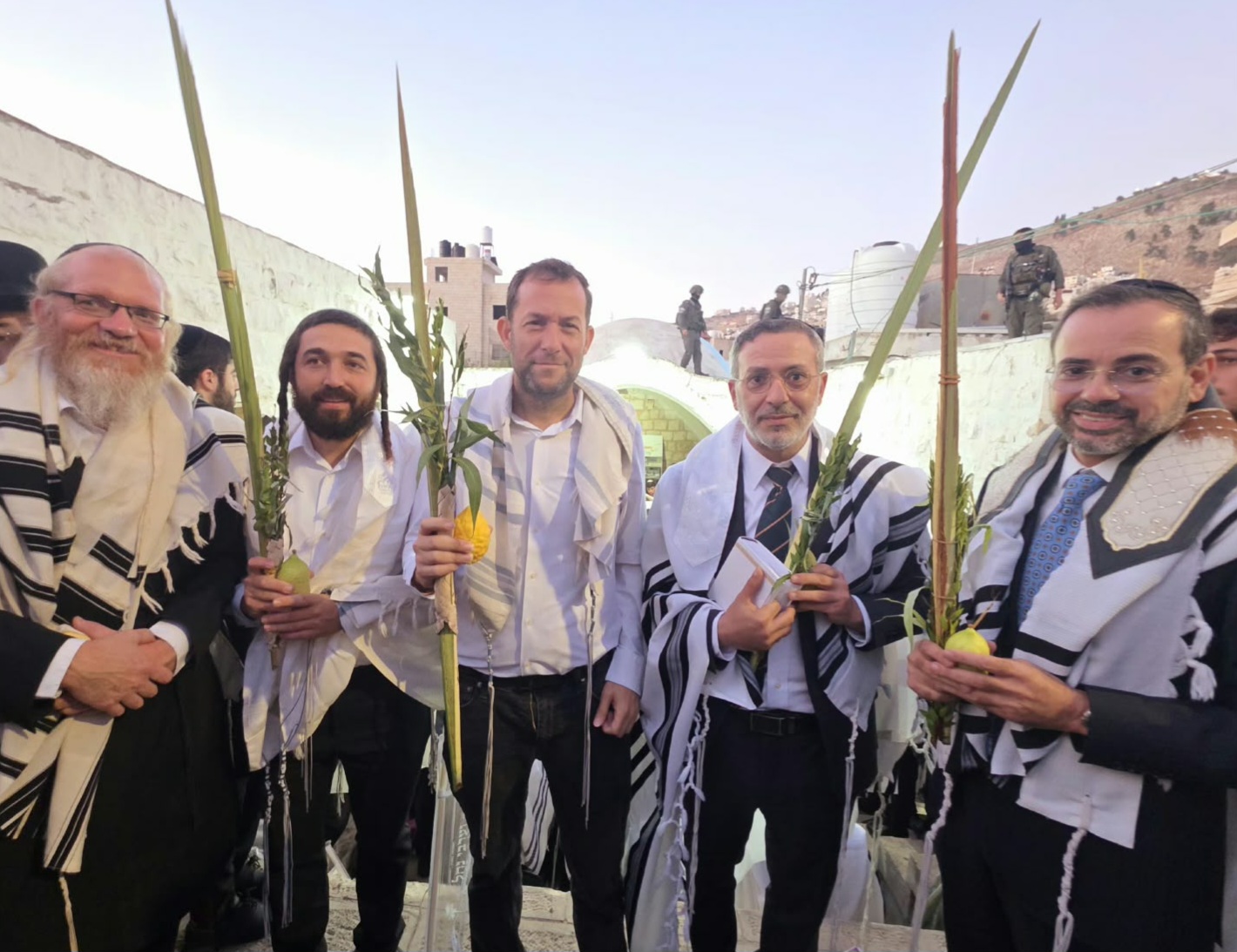
The Samaria Regional Council announced that thousands of worshippers entered the Joseph’s Tomb compound in the city of Shechem Thursday morning and held a mass morning prayer service with the Four Species for the first time in decades. The visit took place on the day of the ushpizin of Joseph the Righteous, a foundational figure in Jewish tradition.
The entry took place in daylight in two rounds, organized by the council with the help of volunteers from the Joseph’s Tomb and Holy Sites Administration, and accompanied and approved by the IDF and security forces.
The daytime entry came following Defense Minister Israel Katz’s decision to expand visiting hours at the site, part of a long-running effort led by Samaria Governor Yossi Dagan and MK Tzvi Sukkot, together with Rabbi Dudu Ben Natan, father of soldier Shuval Ben Natan who fell in battle in southern Lebanon. Shuval worked extensively to restore the compound, and after his death his father continued to advance the effort. The expanded hours are part of a plan for a permanent return to Joseph’s Tomb and the restoration of the Od Yosef Chai yeshiva to activity at the site.
Participants in the event included MKs Erez Malul and Uriel Bosso, Central Command chief Maj. Gen. Avi Bluth, Judea and Samaria Division commander Brig. Gen. Kobi Heller, Border Police commander Chief Superintendent Yitzhak Brick, Border Police Judea and Samaria commander Deputy Chief Superintendent Nisu Guata and Israel Prison Service commissioner Brig. Gen. Kobi Yaakovi. During the prayer, those present held a special thanksgiving prayer for the rescue of the passenger plane from Dubai, and Dagan thanked the administration volunteers and all security forces who accompanied and secured the entry.
Dagan said: “There is a moving and especially symbolic moment here. Precisely on Sukkot, on the night of the ushpizin of Joseph the Righteous, thousands of Jews come to pray at his tomb, and this morning we merit to reach it again with our heads held high and in daylight. This is exactly the change we fought for. For 25 years the people of Israel did not give up on Joseph’s Tomb and did not forget this holy place. We are advancing step by step, and will continue until a full and permanent return to Joseph’s Tomb. We expect the government of Israel to give approval, to return the Od Yosef Chai yeshiva here fully, to raise the flag of Israel here, and to return to hold this holy place. We ask on behalf of everyone to send blessings of strength and courage to our heroic brothers who acted with bravery on the plane and saved hundreds of people from the insane attack that could have been here in Israel. Sending blessings of strength and courage to IDF soldiers, Border Police, Israel Police and all security forces.”
MK Tzvi Sukkot noted: “We merit to make more history at Joseph’s Tomb. For the first time since the abandonment, a mass Hallel prayer and thousands of Jews until 9 in the morning in the plaza of Joseph the Righteous’s tomb. This is another step on the path to full return. The Samaria Council is ready to set up all the infrastructure, the Od Yosef Chai yeshiva is waiting for the order to return and I call from here to the prime minister – give the order even before the elections to carry out this historic correction. To return to Joseph’s Tomb.”
MK Erez Malul said: “Happy holidays to all the people of Israel. We are here praying at the tomb of Joseph the Righteous to merit all the people of Israel, to protect the soldiers and the Torah scholars, and that we should live with God’s help in unity. Amen.”
MK Uriel Bosso added: “A great privilege today for the people of Israel, on the day of the ushpizin of Joseph, to truly come to the tomb of Joseph the Righteous. Joseph the Righteous, who was in exile and in the end reached the kingship of kingships. There is no doubt that this day symbolizes, when the people of Israel in their masses are here in daylight in Shechem, at the tomb of Joseph the Righteous, our hold here in the Holy Land, in the Land of Israel. May it be God’s will that we merit true redemption and complete unity, that we merit to sit in the sukkah of the skin of the Leviathan. We thank the security forces who are securing this massive event, with thousands of people coming here today, with reinforced forces, and giving people the ability to pray at the tomb of Joseph the Righteous at this time.”
Rabbi Yossi Elitzur, head of the Od Yosef Chai yeshiva, concluded: “Great thanks to all those engaged in the work. Joseph the Righteous unites the brothers. When there are crises, when there are difficulties, here we see how all the crises become small and all the family can be united. We hope that all the people of Israel will sit in one sukkah and in great joy, from this holy place, to complete redemption soon. Certainly we are ready every day to return here. We expect and hope to return and be here day by day, in the place that has been waiting for us so many years.”
In a much-ridiculed and self-defeating move, the Netherlands is tightening procedures for importing products originating from certain areas in Judea and Samaria and East Jerusalem, and is expanding the list of areas subject to restrictions. Among other things, the guidelines include areas like Modi’in-Maccabim-Re’ut, where logistics centers operate and market products that also reach overseas markets. The implication for Israelis is that the restrictions no longer apply only to importers and trading companies, but may also be relevant to products inside personal luggage.
Photo: Shutterstock
So if you’re planning a flight to the Netherlands, before you pack a bottle of wine, food product, cosmetics or gift you bought in Israel, there are a few things you need to know: what’s prohibited, whether there’s an exemption for personal use items, what happens if the product was purchased before the restrictions took effect, and what you should do if you’re simply not sure of the product’s origin.
Not a Ban on All Israeli Products
The first important point to clarify is that the restrictions don’t categorically ban bringing in products from Israel. According to Dutch customs guidelines, the ban refers to products obtained or produced, in whole or in part, in “settlements” subject to the restrictions. So the mere fact that a product was purchased in Israel isn’t enough to determine whether it’s allowed into the Netherlands—you also need to check its origin.
Your Personal Luggage Is Included Too
The rules aren’t just for shipping containers, importers or trading companies. Even a private traveler arriving in the Netherlands with a product in their personal luggage needs to take the restrictions into account. In other words, if you bought a product for yourself, brought it as a souvenir or plan to give it as a gift to hosts in the Netherlands, personal use doesn’t automatically create an exemption from the ban.
What About Wine, Food or Cosmetics?
The restrictions don’t apply to just one type of product. So before packing a bottle of wine, food product, dates, olive oil, almonds, cosmetics or another item, check its origin. If the product itself or part of it originates from an area subject to the ban, it may be prohibited from entry to the Netherlands, even if it’s a small item in personal luggage.
Even Part of the Product Can Be Significant
Another point worth knowing is that the inspection isn’t limited only to products whose entire production process occurred in the relevant area. According to the guidelines, the ban can also apply when the product was obtained or produced in part in an area subject to restrictions. So in a case where the product was packaged or completed elsewhere, but part of it originates from the relevant area, you need to check its origin before traveling.
Did You Buy the Product Before the Ban Took Effect?
The purchase date doesn’t grant an exemption either. If you bought a product before September 22, 2026, but you’re entering the Netherlands with it after the arrangement took effect, the restrictions may still apply to it. Simply put, it’s not enough to look at the date on the receipt—you need to check the rules in effect when the product enters the Netherlands.
What If You’re Arriving Via Another European Country?
Even a connecting flight or travel through another EU country doesn’t bypass the restrictions. A traveler entering the Netherlands after being in another European country still needs to comply with Dutch entry rules. So even if you landed first in Germany, France or another country and continued from there to the Netherlands, check the origin of the products you’re carrying in advance.
Photo: Shutterstock
How Can You Know a Product’s Origin?
Dutch customs recommends checking the information on the product or packaging, and keeping documents that can help identify its origin. A receipt, invoice, label, original packaging or document from the manufacturer or store can be useful in case of inspection. When a product’s origin isn’t clear, you can contact the seller or manufacturer and request additional information before the flight.
What If the Product Is Marked Only With a City Name?
Here the issue can be more complicated for Israeli travelers. It’s not always clear at first glance whether an address on packaging is the production location, packaging location or address of a logistics center. So if an address or marking appears on the product that raises doubt about its origin, don’t rely only on the city name or on the fact that the product was sold in Israel. It’s recommended to check the product’s origin with the manufacturer or distributor before the flight.
What Will Happen If Customs Finds a Prohibited Product?
Dutch customs is authorized to inspect luggage and request information about the origin of products inside it. If a product subject to the ban is found, customs can confiscate it. In such cases a report may also be filed, and further handling depends on the circumstances of the case and the decision of Dutch authorities.
So What Should You Do Before the Flight?
The simplest way to avoid a problem is to check in advance the origin of products you plan to take with you. If you don’t have a clear way to verify where the product came from, especially when it’s a product that could be included in the restrictions, it’s better to leave it at home and not take an unnecessary risk at the border crossing.
Most Important for Israeli Travelers
The fact that it’s a product you bought yourself, in small quantity, for personal use or as a gift isn’t enough to exempt it from the rules. Before flying to the Netherlands, check the product’s origin, keep the packaging and relevant documents, and in case of doubt—clarify in advance with Dutch customs. That way you can arrive at the airport knowing what’s in your suitcase and what could cause a problem entering the country.
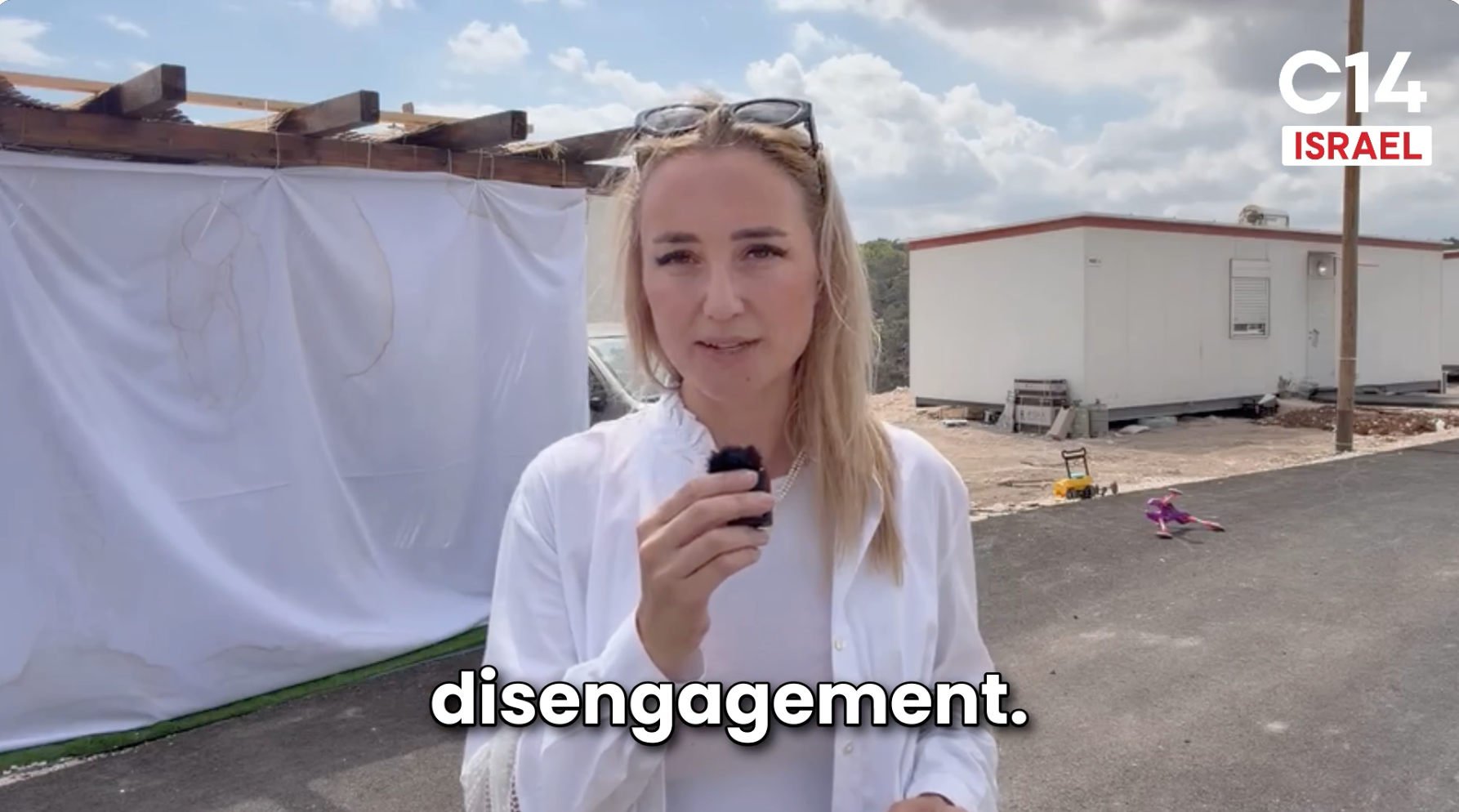
In the hills of northern Samaria, a palpable sense of renewal fills the air. For the first time in over two decades, the Jewish communities of Ganim and Kadim are alive with the sounds of celebration, the warmth of welcoming hosts, and the striking sight of temporary dwellings newly nestled against caravans, which suddenly look more permanent by contrast. It has been exactly twenty-one years since the 2005 disengagement—a deeply controversial government maneuver that resulted in a collective trauma – the uprooting and expulsion of four thriving communities in this specific region: Homesh, Sa-Nur, Ganim, and Kadim. Today, however, that historical narrative is being rewritten as families return to reclaim and rebuild the land they once called home.
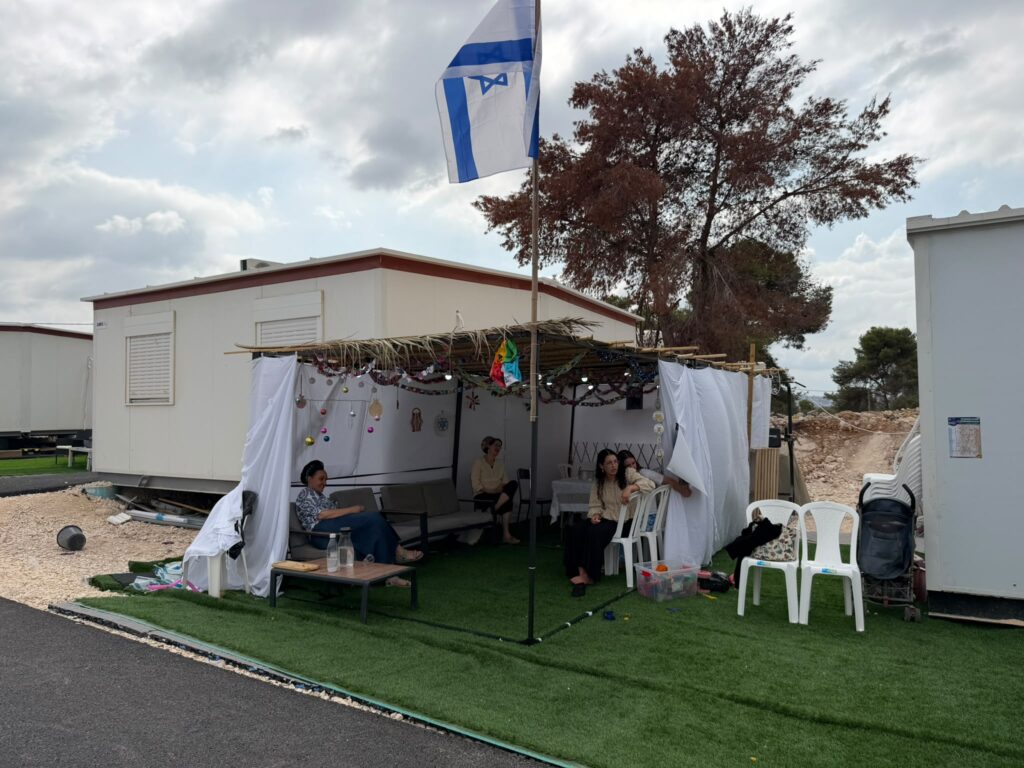
Families in the Jewish community of Kadim celebrate Sukkot, with a temporary Sukkah next to their mobile homes, which will soon become permanent buildings | Sophia Tupolev
Just two months ago, life officially returned to Ganim. Families who were once forced to leave have begun moving back, putting down fresh roots in the very locations from which they were previously expelled. The timing of this grassroots restoration is particularly poignant, coinciding beautifully with the joyous Jewish festival of Sukkot. Across these newly re-established communities, a highly festive and vibrant atmosphere has taken hold. Residents have proudly put up traditional, temporary sukkahs alongside their recently placed mobile homes, opening their doors to host visitors traveling from every corner of Israel.
The celebration of Sukkot—a holiday intrinsically linked to temporary dwellings, gratitude, and faith—perfectly mirrors the current daily reality of these returning families. They are currently living in modest mobile homes, yet the temporary nature of their physical homes stands in stark contrast to the permanence of their long-term vision. Walking through Ganim and Kadim, one can easily feel a profound, unifying energy. Residents note that the sudden influx of guests has transformed the quiet hills into a nationwide celebration. Visitors, regardless of their personal political affiliations, are sharing in the unbridled joy of the return, rejoicing alongside the families who have waited twenty-one years for this exact moment.
For the people who have made this pioneering journey back, the emotional resonance is profound. There is a deep, prevailing sentiment echoing throughout the caravans: we are back home. The residents describe a remarkably homey environment fueled by an extraordinary community spirit. Here, neighbors are entirely present for one another, creating a tight-knit, supportive network that turns the everyday challenges of frontier living into shared triumphs. Living in Ganim today means waking up with the distinct, empowering feeling of being part of something vastly larger than oneself—a historic restoration of life in a place that sat completely desolate for over two decades.
Samaria Governor Yossi Dagan sounded characteristically optimistic regarding the future of these rebuilt towns, telling me, “Now we have caravans. After one or two years Godwilling, we are going to build here apartments and buildings, big city in northern Samaria.”
While the present landscape is defined by mobile homes and festive sukkahs, the collective gaze of the community is fixed firmly on a highly ambitious future. The caravans are universally viewed as merely the first step. Within the next year or two, these temporary structures are slated to be replaced by permanent architecture. Residents are already speaking enthusiastically of laying foundations for larger, robust houses. Their ultimate vision stretches far beyond mere survival; they are looking toward a horizon where modern apartments, sprawling buildings, and significant infrastructure transform this newly reclaimed land into a flourishing, big city in northern Samaria. For now, they celebrate their long-awaited return, firmly anchored by the belief that they are not just building houses, but restoring a legacy.
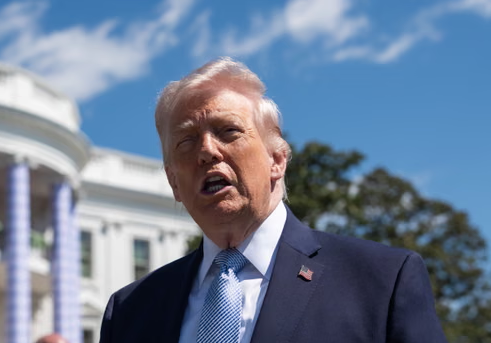
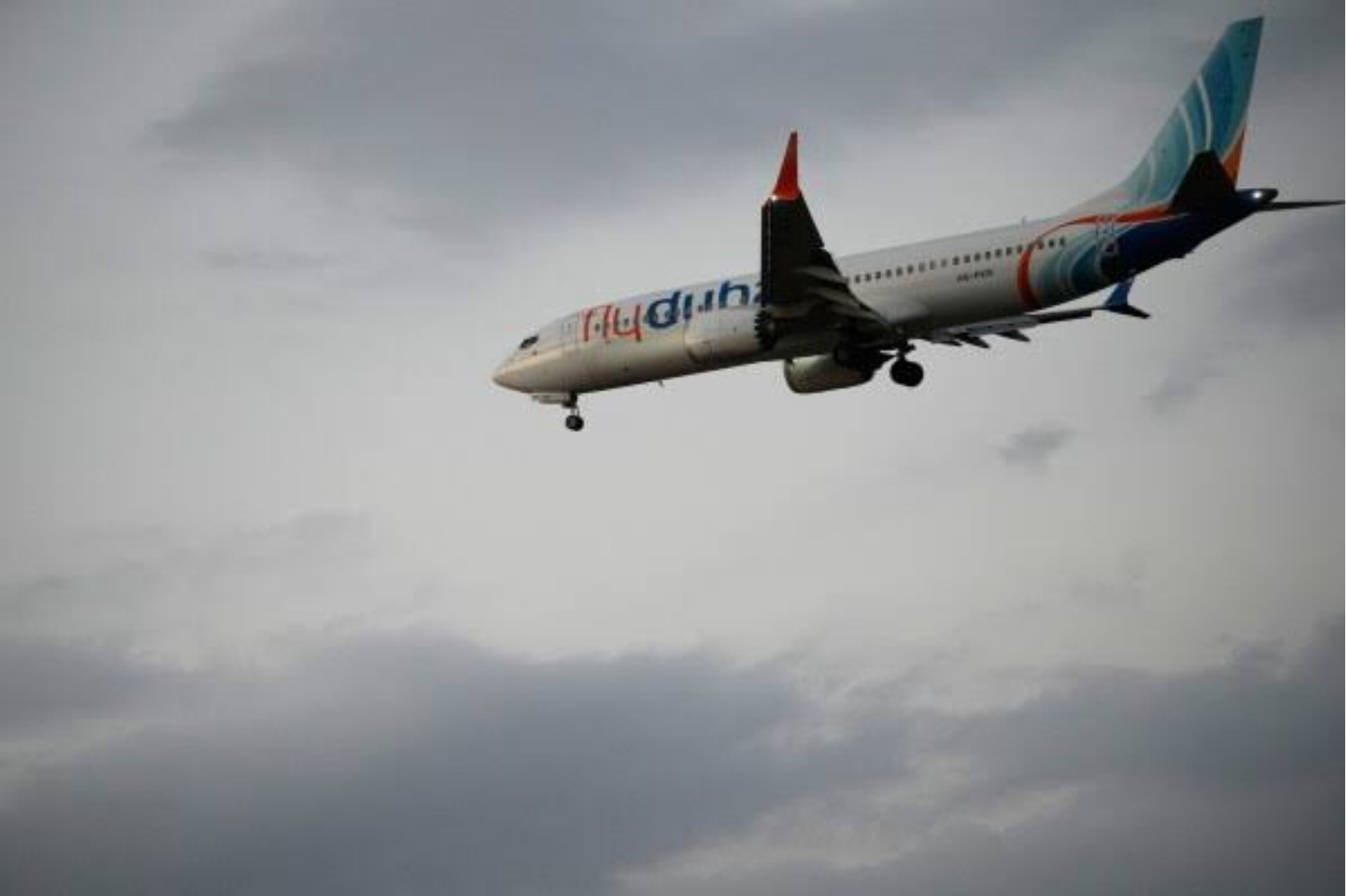
U.S. President Donald Trump dramatically escalated his rhetoric toward Tehran Thursday evening, saying information reaching him indicates Iran may have been involved in the suspected terror attack aboard Flydubai flight FZ1073 — and issuing a direct threat of severe retaliation if the connection is established.
FlyDubai Plane | Photo: AP
Asked whether Tehran was involved in the suspected attempt to bring down the Boeing aircraft carrying 174 passengers, most of them Israelis, Trump said: “I would say the answer, based on what I’m hearing, is yes — but we’re looking at it and investigating it right now.”
Asked whether the United States would respond militarily if investigators establish official Iranian involvement, Trump issued a stark warning. “They’ll be hit very hard. Just ask them. They know what already happened. They’ll be hit very hard,” Trump said, appearing to reference the devastating blows Iran sustained during the recent war.
The president also directed his warning toward Iran-backed terrorist organizations across the region, including Hezbollah, making clear that Washington would not necessarily distinguish between Tehran and its proxies if they were found responsible. “The fate of the proxies is the fate of Iran — wherever Iran goes, its proxies go,” Trump said.
Trump | Photo: Getty Images
The remarks represent a significant escalation from Trump’s more cautious comments Wednesday, when he described the suspected attacker as potentially “a terrorist” or “a crazy person.” Trump’s sharper assessment comes as investigators in Israel and the Gulf increasingly examine whether the attack was an act of terrorism and whether the alleged attacker had connections to Iran or one of its regional proxies.
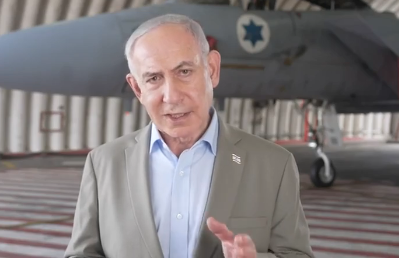
Prime Minister Benjamin Netanyahu said earlier Thursday that Israel was investigating possible Iranian involvement and expected to reach conclusions “within days.” He said preliminary findings indicate that the Omani co-pilot had undergone a process of severe Islamist radicalization. The United Arab Emirates has also publicly acknowledged that its investigation is examining whether the incident involved terrorist activity, prior planning or direction.
Prime Minister Netanyahu | Screenshot
Saudi investigators, meanwhile, are examining whether the incident began as a personal dispute that escalated or constituted a hostile act potentially connected to Iran or its Houthi proxies in Yemen. Trump again praised the passengers and crew members who prevented the incident from becoming a mass-casualty disaster after the aircraft plunged nearly 14,000 feet in less than half a minute.
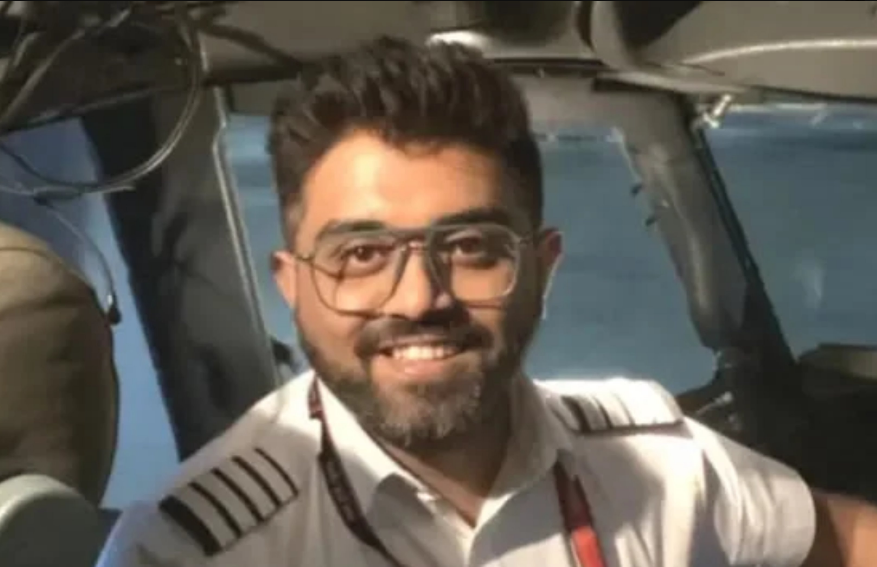
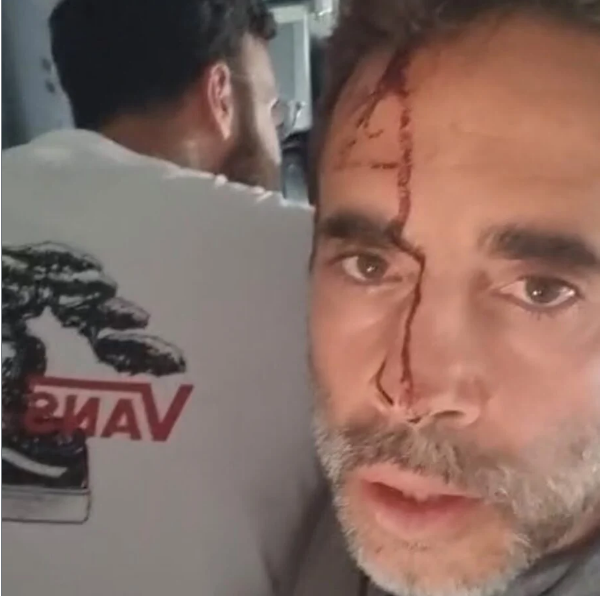
He singled out Indian captain Smit Machchhar, who managed to open the cockpit door despite being stabbed and seriously wounded, as well as Israeli passenger Yaniv Hayun and other passengers who rushed into the cockpit and subdued the alleged attacker.
Indian hero FlyDubai pilot Smit Macchachar | Screenshot
The investigation has taken on increasing international significance as Israeli, Saudi, Emirati and American officials work to determine whether the attack was carried out by a lone radicalized individual or was planned or directed by a wider terrorist network. Trump’s latest remarks now place Iran squarely at the center of that investigation — while attaching an explicit warning of U.S. retaliation should Tehran’s involvement be established. “They’ll be hit very hard,” the president warned.
Israel’s assessment is getting dramatic backing in Riyadh and Washington: a Saudi official briefed on the investigation and a senior U.S. official told NBC News that the stabbing and dive incident aboard the flight to Israel is shaping up as a planned terror attack. A Saudi embassy spokesperson confirmed investigators are examining possible links to Iran or the Houthis. New details on the terrifying moments in the sky: the Boeing plunged more than 14,000 feet in less than half a minute before passengers broke into the cockpit and subdued the Omani attacker.
Chaos on FlyDubai flight
A dramatic and significant turn in the investigation into the stabbing and attempted crash aboard Fly Dubai: suspicions that this was a deliberate terror attack targeting Israelis received its first official confirmation from outside Israel Thursday evening. A Saudi official briefed on the investigation’s findings and a senior U.S. official told NBC News that based on preliminary findings on the ground, the incident aboard Flight FZ1073 is clearly shaping up as a terror attack. Despite the progress, the identity of those who sent the attacker and the precise motive remain under intensive investigation.
FlyDubai plane at Ben Gurion airport | Photo by Yossi Aloni/Flash90
According to the NBC News report, the evidence collected so far in Saudi Arabia significantly strengthens the line Israel’s security establishment has been pushing since the emergency landing at Tabuk airport. Saudi embassy spokesperson in the U.S. Hessa Al-Yahya confirmed to the network that the kingdom’s investigators are examining two main possibilities: whether this was a personal conflict that escalated between crew members in the cabin, or whether it was a hostile operation linked to Iran or its Houthi proxies in Yemen. She said further clarifications are expected within about 24 hours.
Meanwhile, a senior U.S. official involved in details of the Israeli investigation said that while the findings clearly point to an attempted attack carried out by the co-pilot—an Omani citizen—there is currently no direct evidence that Iran ordered or commanded the operation. Investigators are examining the possibility that the attacker acted as a “lone wolf” inspired by extremist ideology.
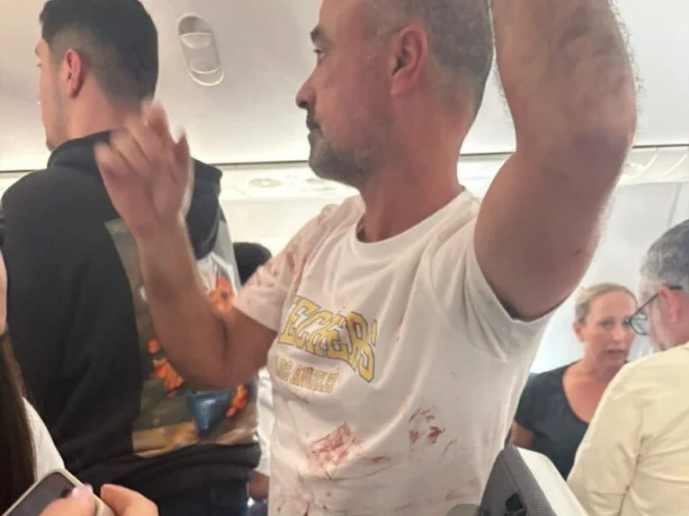
Image from FlyDubai attempted hijacking
At the same time, the dimensions of the terror passengers experienced during the peak moments of the drama are becoming clear: data from the tracking site Flightradar24 shows that following the stabbing struggle in the cockpit, the Boeing 737 plunged a staggering 14,125 feet in just 29 seconds. Passengers reported screams, massive panic, and blood spattering in the cabin. A major disaster was averted thanks to the resourcefulness of the wounded Indian captain, Sumit Machehar, who managed to open the cockpit door, and four passengers—including Israeli Yaniv Hayon—who stormed inside, subdued the Omani suspect, and regained control of the aircraft until landing in Tabuk.
Fly Dubai, which has temporarily suspended its flights on the route to and from Israel, said it is awaiting official investigation findings before releasing final conclusions. The Omani suspect remains in custody in Saudi Arabia and continues to be interrogated by local security forces.
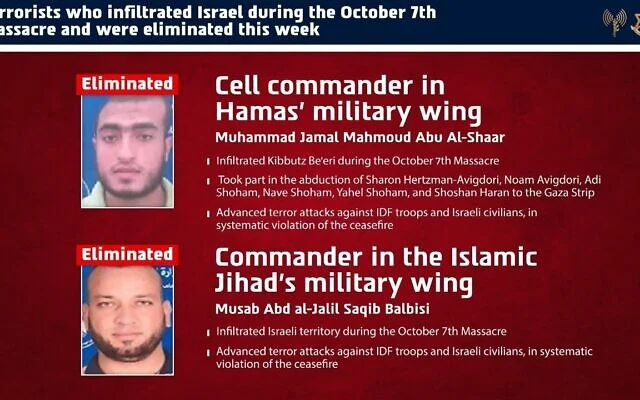
The IDF announced Thursday it killed two terrorists who participated in the October 7 massacre. The senior operative, Muhammad Jamal Mahmoud Abu al-Sha’ar, a cell chief in Hamas’s military wing, was killed Tuesday in Gaza City. According to the IDF, Abu al-Sha’ar was among the terrorists who raided Kibbutz Be’eri and participated in kidnapping Sharon Hertzman-Avigdori and her daughter Noam, Adi Shoham and her two children Naveh and Yahel, and Shoshan Haran. All six family members were held captive for 50 days and released together in the second phase of the hostage deal in November 2023.
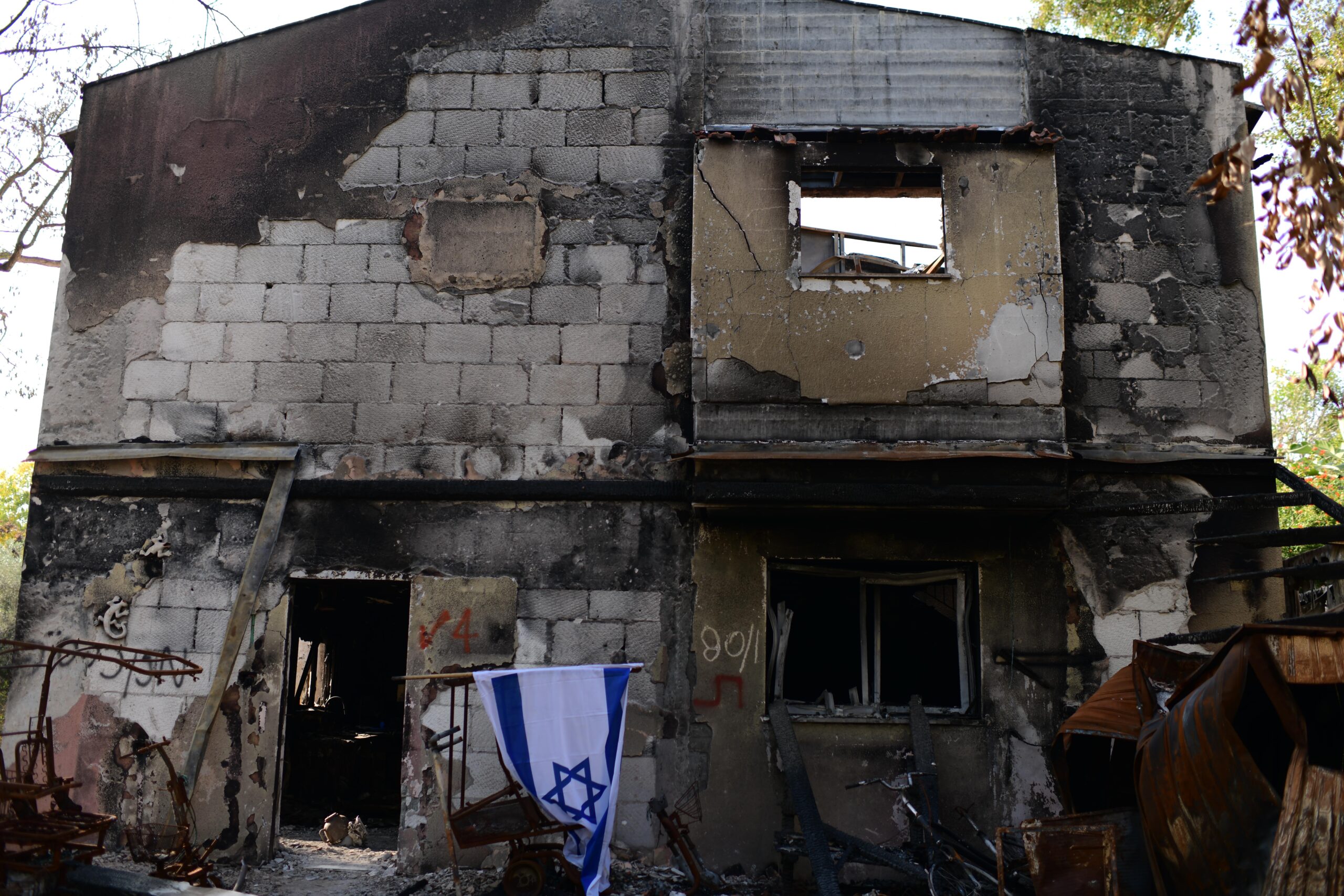
Kibbutz Be’eri home after Oct 7 | Photo: Flash 90
Nearly three years after the massacre, the IDF announced that one of the terrorists who participated in kidnapping six women and children from Be’eri has been eliminated. On Tuesday, the Air Force struck Muhammad Jamal Mahmoud Abu al-Sha’ar in Gaza City, whom the IDF defines as a cell commander in Hamas’s military wing.
According to the military’s statement, Abu al-Sha’ar didn’t stop with his October 7 activities. Recently he continued advancing terror operations against IDF forces and Israeli civilians, systematically violating the ceasefire. Because of the threat attributed to him, he was struck from the air. That same day the IDF carried out another elimination, this time in Jabaliya. The strike killed Mus’ab Abd al-Jalil Sakeb Balbisi, whom the military defined as a commander in the military wing of Palestinian Islamic Jihad.
Adi and Yahel Shoham are being returned from Hamas captivity in Gaza | Photo: IDF Spokesperson
Balbisi was also among the terrorists who raided Israeli territory in the October 7 massacre. Balbisi too, according to the military’s statement, recently continued advancing terror operations against IDF forces and Israeli civilians. The IDF noted that both terrorists were eliminated from the air to remove the threat they posed. Before the strikes were carried out, according to the IDF, steps were taken to minimize the possibility of harming civilians, including use of precision munitions and aerial surveillance.
On October 7, 2023, three generations of the Haran family were staying at the family home in Be’eri. Adi Shoham had come to Be’eri with her husband Tal and their children Naveh, then eight, and Yahel, then three. Sharon Avigdori and her daughter Noam, who had come from Hod HaSharon for a family visit, were also staying in the kibbutz. During the attack, the family members hid in the safe room. From testimonies published since, the terrorists set the house on fire and forced the family members outside. Shoshan Haran later recounted that when she was taken out of the safe room, she saw the terrorists controlling the kibbutz grounds.
Neve and Yahel Shoham | Courtesy of the family
Abu al-Sha’ar, who according to the IDF participated in the Be’eri raid, took part in kidnapping six family members: Shoshan Haran, her daughter Adi Shoham, her grandchildren Naveh and Yahel, Sharon Hertzman-Avigdori and her daughter Noam. Tal Shoham, Adi’s husband and father of Naveh and Yahel, was also kidnapped in that incident. The price the family paid that morning was even heavier. Avshalom Haran, Shoshan’s husband, was murdered in the attack. Shoshan’s sister, Lilach Kipnis, and her husband Avitar Kipnis were also murdered.
October 7 terror, archive | Photo: Flash90
The six family members were held in Gaza for 50 days. On November 25, 2023, they were released together in the second phase of the hostage deal: Shoshan Haran, then 67, Adi Shoham, 38, eight-year-old Naveh, three-year-old Yahel, Sharon Avigdori, 52, and 12-year-old Noam. Tal Shoham remained in captivity at that time. Upon their return to Israel, the six reunited with their family members at Sheba Medical Center. Despite the release, the family members emphasized then that as far as they were concerned, the struggle wasn’t over as long as Tal and the other hostages remained in Gaza.
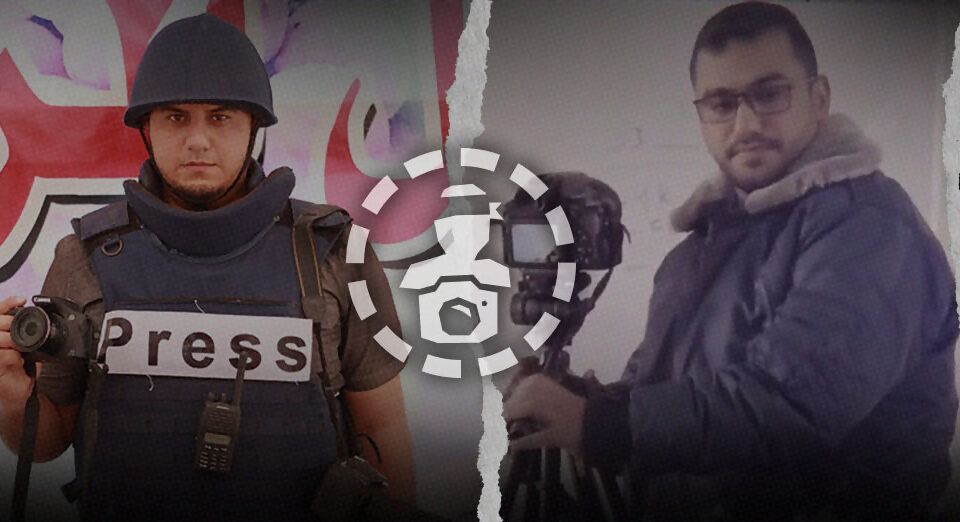
After months of investigation, the IDF revealed Thursday evening that 170 Gazans killed during the war and presented to the world as journalists and media workers actually served as terrorists in Gaza Strip terror organizations, primarily Hamas and Islamic Jihad.
Photo: IDF spokesperson
118 of the journalists on the list were active in Hamas terrorists, 49 operated in Islamic Jihad, one terrorist belonged to the Lords of Destruction organization, and two others to the Resistance Committees. 17 of them even infiltrated Israeli territory during the October 7 attack.
In recent months, a recurring pattern emerged in which Hamas and Islamic Jihad themselves published information indicating retroactively that some of those killed who were presented to the world as journalists and media workers were actually terrorists in the military wings of terror organizations. The information was released after the narrative that the IDF deliberately targets journalists had already taken hold in the international arena.
Photo: IDF spokesperson, translated using AI
As part of the disclosure, the IDF is publishing verified evidence, including visual materials and documents produced by the terror organizations, some of which were found in the field during forces’ operations. The documents attest to the terrorists’ organizational affiliation and the roles they filled in the ranks of terror organizations.
Some of the journalists on the list even worked for left-wing international media outlets, including Reuters, CNN, ABC Australia, BBC, AFP, AP, and Le Monde.
Photo: Flash 90
Throughout the war, the narrative that Israel deliberately targets journalists became one of the most cited arguments against Israel worldwide. It appeared in reports by international media outlets, human rights organizations, international institutions, and politicians, without distinguishing between journalists who performed their duties and those who simultaneously operated as terrorists in terror organizations.
The killing of more than 40 of the journalists on the list, who served as terrorists in terror organizations, drew condemnations from the UN against Israel.
In a statement following the disclosure, IDF Spokesman Lt. Col. Efi Defrin said: “Today we exposed that 170 Gaza residents who were presented as supposedly innocent journalists were actually terrorists in terror organizations in the Strip.”
Photo: Flash 90
Defrin also attacked what he described as an attempt to create a picture that the IDF operates indiscriminately in the Strip. “Hamas and its supporters are trying to create a false impression of indiscriminate harm,” he said, adding: “We will continue to expose these lies and present the facts.”
For the disclosure, the IDF established a dedicated website compiling the names and photos of the 170 terrorists, their organizational affiliation, the roles they filled, and the evidence that can be disclosed about them.
Photo: Flash 90
The disclosure comes alongside an extensive IDF response to the film “NAZA,” which deals with the processes of planning and striking targets during the war. Defrin sharply attacked the film and claimed it “presents a distorted, misleading, and unrealistic picture of the target planning and striking process in the IDF.”
According to him, the filmmakers did not convey their claims to the IDF before the screening, did not allow the military to view the film, and did not request a response or fact-checking in advance. Only after the IDF viewed the film and analyzed the claims raised in it was a full response formulated.
Photo: Abed Rahim Khatib, Flash90
“The film includes manipulative editing, which distorts reality and falsely and unsubstantiatedly attributes malicious intentions to the IDF,” Defrin said. According to him, the military’s response refutes the main claims presented in the film and addresses them according to the facts and reality on the ground.
The IDF spokesman also addressed the claim that the military allegedly approved a strike in which a huge number of civilians were expected to be killed. “I say here clearly: The IDF never planned, approved, or carried out any strike in which 500 civilians were expected to be killed, or even a number approaching that,” he clarified.
Photo: Flash 90
Defrin emphasized that the IDF’s strike processes distinguish between terrorists and uninvolved civilians, and that target identification and approval are done by authorized intelligence officers and according to the chain of command.
He also addressed claims about the use of artificial intelligence for operational decision-making and said: “We never used artificial intelligence to activate or approve targets.”
Photo: Shutterstock
According to him, criticism of the IDF ignores how Hamas operates in the Strip. “Those who point an accusing finger at the IDF ignore the fact that Hamas is a cruel terror organization that uses its civilians as human shields.”
Defrin concluded his remarks with a message for the coming days: “Those who ignore the cruel and inhuman nature of October 7 give tailwinds to terror.” According to him, “We will continue to believe in the righteousness of our path, remember the fallen, defend Israel’s residents, act decisively against our enemies, and fight for the truth.”
The IDF released an unusually detailed 17-page response Thursday to the documentary NAZA, which claims the military loosened restrictions on civilian casualties during the fighting in Gaza. The military flatly rejects the film’s allegations, arguing it’s based on “fundamental factual errors,” anonymous testimonies, and a distorted presentation of IDF decision-making processes.
Photo: Reuters, Canva
The document opens by stating the film presents a “distorted, misleading and unrealistic” picture of how the IDF plans and approves strikes. The filmmakers, the military argues, chose to show only early, limited stages of the strike process while omitting the planning, oversight, and operational approval phases—creating a picture that doesn’t reflect reality. The IDF adds that the film ignores the operational context of the Gaza fighting and uses what it calls “manipulative” editing.
The military emphasizes that the term “NAZA”—collateral damage—is a professional term used by militaries worldwide and refers to assessing potential civilian harm as required by international law. The film, according to the IDF, presents the very existence of such assessments as evidence of indifference to human life, when in fact it’s a tool designed to allow commanders to change plans, add precautions, and even cancel strikes to minimize civilian casualties as much as possible.
The document also criticizes how the film was made. The IDF says the filmmakers never contacted the military for comment before release, didn’t provide a copy despite requests, and didn’t share details that would allow examination of the incidents mentioned. Because of this, the military notes, the response was written based on documentation from a public screening, public reports, and the filmmakers’ own statements.
The IDF goes on to explain that the anonymous testimonies in the film refer, it claims, only to limited parts of the strike process. Intelligence analysts don’t decide whether to carry out strikes, the military says—they’re just one link in a broad chain that includes commanders, operational personnel, legal advisors and other officials. Presenting the testimonies as if they reflect overall strike policy is wrong and misleading, according to the military.
The IDF also addresses claims in the film that strikes were approved where an unusually large number of civilians were expected to be killed. “The IDF never planned, approved or carried out any strike in Gaza where 500 civilians were expected to be killed,” the document states, adding that claims about approval thresholds of 200 casualties are also incorrect. According to the explanation, the numbers referenced in the film aren’t a “quota” of permitted casualties, but at most authority thresholds determining who can approve a strike, with each case requiring individual examination under international law.
The Gaza documentary “NAZA” earned a massive 24.5-minute #VeniceFilmFestival ovation as the crowd cheered and waved Palestinian flags.
This marks the longest-ever standing ovation at Venice, beating the 22-minute ovation for “The Voice of Hind Rajab” last year, and perhaps the… pic.twitter.com/WuE0Lr7ZFi
Regarding the “Lavender” system and the use of artificial intelligence, the IDF rejects claims that algorithms autonomously selected targets for strikes. The document explains that AI tools are used only to cross-reference intelligence information, and that every target is identified and examined by human intelligence analysts and officials before going through an operational approval process that includes commanders and legal advisors.
Another issue the document addresses is firing near humanitarian aid distribution centers in Gaza. The IDF emphasizes that rules of engagement prohibited firing at civilians, and that every report of irregular conduct is examined. The military also notes that following incidents in which civilians were killed, lessons were learned, procedures were updated, and steps were taken to improve the operational environment in distribution areas.
The document also addresses claims that “there are no uninvolved people in Gaza” and the question of defining genocide. The IDF rejects both claims entirely. The distinction between terrorists and uninvolved civilians is a fundamental principle in the military’s procedures and orders, it argues, and the claim of genocide is described in the document as baseless. The document adds that interviewees’ personal opinions in the film cannot testify to the military’s policy or intentions.
In its conclusion, the IDF writes that the film presents a “false picture of an army interested in causing harm to civilians,” and ignores processes designed to minimize harm to the civilian population—including canceling strikes, changing operational plans, requiring additional intelligence, and legal review of strikes. “The tragic consequences of wars do not justify distortion of the facts,” the document states, with the military concluding that the film creates a false impression by omitting factual context and presenting a partial picture of reality.