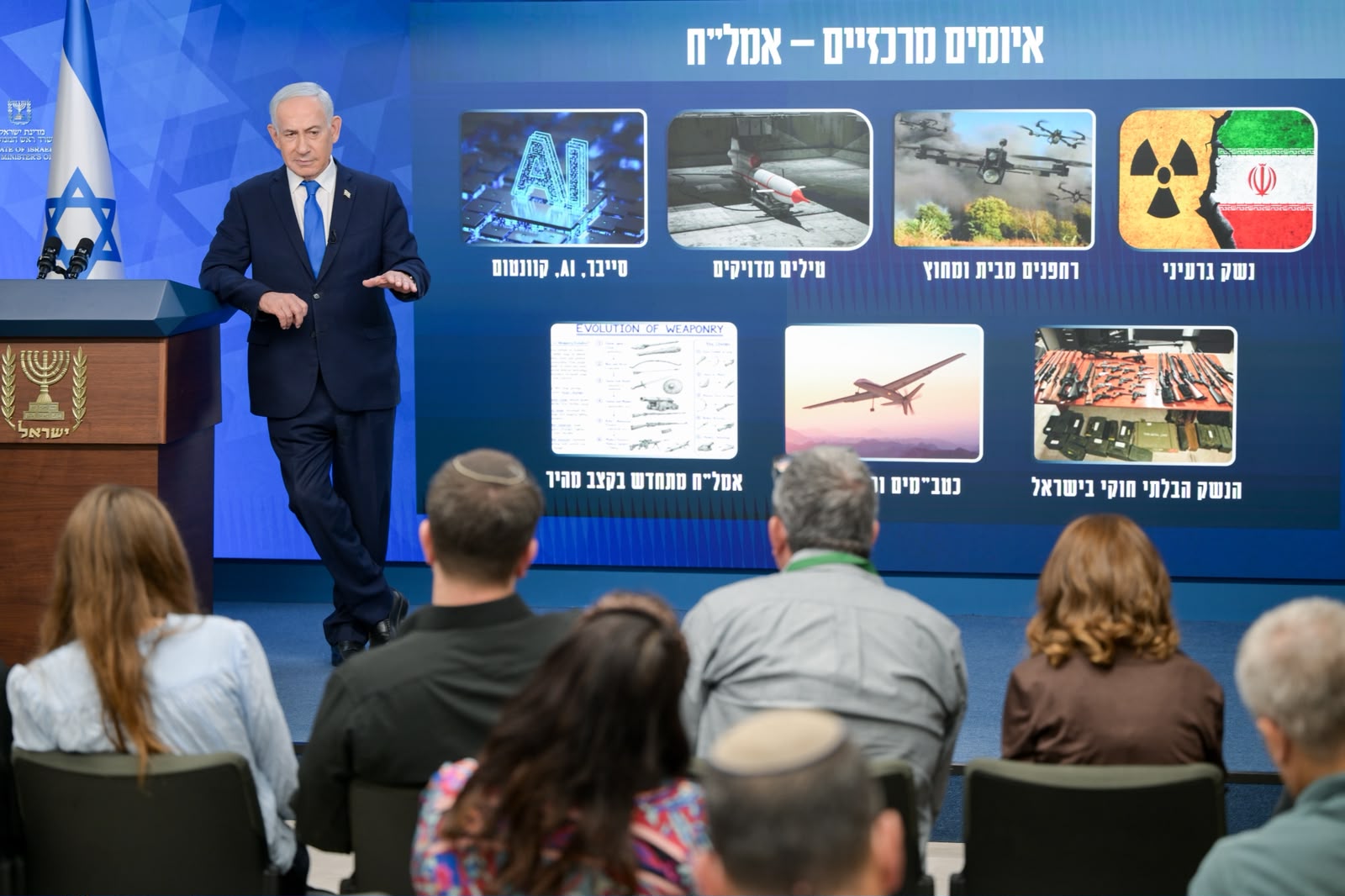
Prime Minister Benjamin Netanyahu on Sunday evening unveiled a comprehensive ten-point national security doctrine designed to recalibrate Israel’s operational posture in the wake of the October 7 massacre and the multi-front War of Resurgence. At the core of the document lies a formal departure from decades of containment and passive defense, prioritizing offensive initiative, readiness for surprise preemptive strikes, and maximum domestic defense self-reliance.
Meanwhile, Netanyahu disclosed significant diplomatic momentum across the region. In response to a query from Channel 14 diplomatic correspondent Sraya Harush regarding the expansion of the Abraham Accords and potential normalization with Saudi Arabia, the Prime Minister revealed that regional states are actively courting Israel behind closed doors, despite Jerusalem’s explicit opposition to the creation of a ‘Palestinian’ state.
“There are quite a few countries in the Middle East, to say the least, that are approaching us. I do not intend to elaborate,” Netanyahu stated to Channel 14. Addressing how Israel’s refusal to concede ‘Palestinian’ statehood impacts these prospective pacts, the Prime Minister noted: “Our potential partners understand this as well. They speak differently in public and in private.”

The diplomatic overtures reflect the broader premise of Netanyahu’s security blueprint: that overwhelming military power and decisive victories create the foundation for regional deterrence and strategic partnerships. In the preamble to the document, Netanyahu stressed that relentless combat across fronts stretching from Gaza to Yemen, and from Lebanon to Iran, eliminated an immediate existential nuclear threat and removed the Iranian axis’s encirclement ring, directly enabling new regional alignments.
A Preemptive Military Doctrine
The ten principles codify a structural shift throughout the Israel Defense Forces (IDF) and all security branches. The traditional security triad—deterrence, early warning, and decisive victory—has been overhauled to establish offensive prevention and readiness for surprise preemptive strikes as supreme operational priorities.

Significantly, the doctrine instructs intelligence agencies to track adversary military capabilities rather than ambiguous political intent. This operational update directly addresses the intelligence failures preceding the October 7 invasion, directing that hostile capabilities be monitored and neutralized even without explicit attack warnings.
The doctrine also formalizes the proactive, offensive prevention of nuclear weapons development, explicitly stating that Israel reserves the right to initiate preemptive military strikes to stop emerging strategic weapons threats.

Munitions Independence and the Threat Matrix
To protect national decision-making from external diplomatic leverage, the document mandates aggressive expansion of Israel’s sovereign defense manufacturing base. It establishes national targets for technological dominance in artificial intelligence, quantum computing, and space systems, alongside a substantial increase in the annual defense budget. While designed to minimize dependence on foreign suppliers, the policy seeks strategic autonomy during wartime emergencies rather than a decoupling from primary allies.
Within the document’s primary threat matrix, the national security architecture explicitly maps the Iranian-led Shiite Axis, the Muslim Brotherhood, domestic terror subversion, international delegitimization campaigns, and a notable reference to “The Egyptian Trap,” alongside defined geographic perimeter threats across Israel’s northern, eastern, and western borders.

Redefining Total Victory
Under the updated doctrine, the threshold of victory moves beyond tactical battlefield containment. Operational objectives are now formally defined as breaking both the enemy’s physical military force and its core belief in its ability to threaten Israel.

Concluding with the concept of “National Spirit,” the document underscores internal cohesion, Jewish heritage, pioneering settlement across the land, and democratic strength as foundational requirements to sustain long-term military superiority. By pairing an offensive, preemptive military posture with sovereign industrial expansion, the doctrine posits that Israeli strength remains the primary catalyst for compelling both adversaries to retreat and regional Arab powers to seek covert and overt integration.