


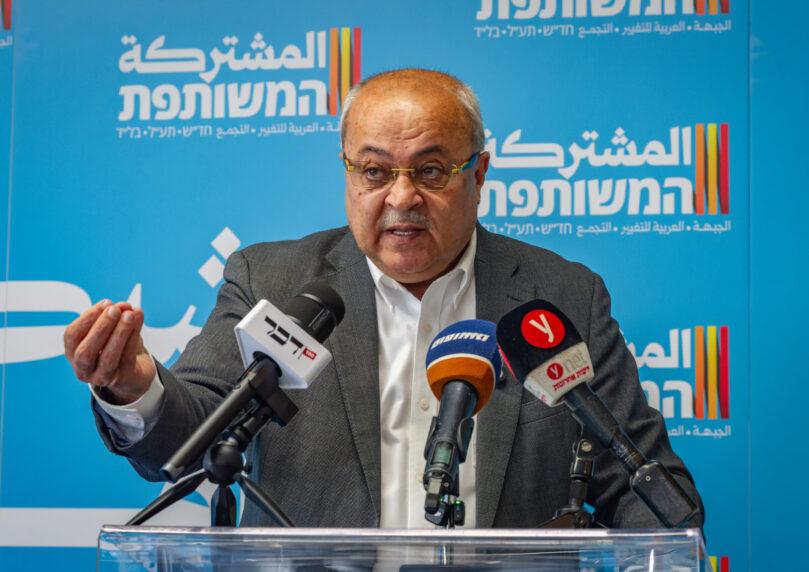

One of the central questions heading into the 26th Knesset elections is whether opposition parties can form a government that relies on support from Arab parties. While Ra’am, led by Mansour Abbas, has declared its desire to rejoin the government, the Joint List is seeking to influence the composition of the next ruling coalition. But deep divisions exist within the opposition parties themselves over this possibility.
The issue is expected to become especially significant if neither bloc achieves a majority of 61 seats. In that scenario, support from Ra’am and the Joint List could carry political weight—but also create difficulties in negotiations among parties seeking to replace Prime Minister Benjamin Netanyahu.
Liberman: No Ra’am, No Joint List
The most categorical position came from Yisrael Beiteinu chairman Avigdor Liberman, who made clear his party will not be part of a government with Ra’am or the Joint List, and will not support a minority government leaning on them.
In a statement published on October 15, Liberman announced his intention to work toward forming a coalition composed only of Zionist parties, without the Arab parties and without Shas and United Torah Judaism. He also clarified that Likud without Netanyahu could be a partner in an alternative government.
This declaration poses a challenge to scenarios in which Gadi Eisenkot’s Yshar, together with Naftali Bennett’s Beyachad, the Democrats, and Yisrael Beiteinu, would form a government with direct or indirect support from the Arab lists. If Liberman stands by his commitment, a different coalition arrangement will need to be found.
Ra’am: The Goal Is to Return to Government
Mansour Abbas, by contrast, isn’t hiding his desire to return to government. During the campaign, the Ra’am chairman presented participation in the coalition as a means to advance efforts against crime in Arab society, secure budgets, and improve services for Arab citizens.
The addition of Yoav Segalovitz to second place on Ra’am’s list was meant to reinforce this message. Segalovitz, who previously served as deputy minister for internal security, presented the Jewish-Arab partnership as a tool for changing government policy.
Voices calling for action to replace Netanyahu have also been heard during the campaign from the Joint List, though there’s a distinction between supporting a change of government and willingness to join a coalition or support it from outside.
What About Eisenkot, Bennett, and Golan?
Opposition parties aren’t presenting a unified front on the issue. Yashar, led by Eisenkot, and Beyachad, led by Bennett, seek to replace Netanyahu but also must contend with the positions of potential partners and the question of how to assemble the next government.
The Democrats, led by Yair Golan, are more open to political cooperation with the Arab parties, while Yisrael Beiteinu explicitly rejects it. This gap could become one of the most significant obstacles on the path to forming an opposition-led government.
In 2021, parties with different positions managed to cooperate within a single government. But the current political reality, especially the disputes following October 7, raises anew the question of the boundaries of partnership.
Ultimately, election results will determine whether the possibility of forming a government with Arab party support will have practical significance. Even in that case, the decision won’t be purely numerical—it will require party leaders to decide which campaign commitments they’re willing to keep and under what conditions they’ll agree to sit together.