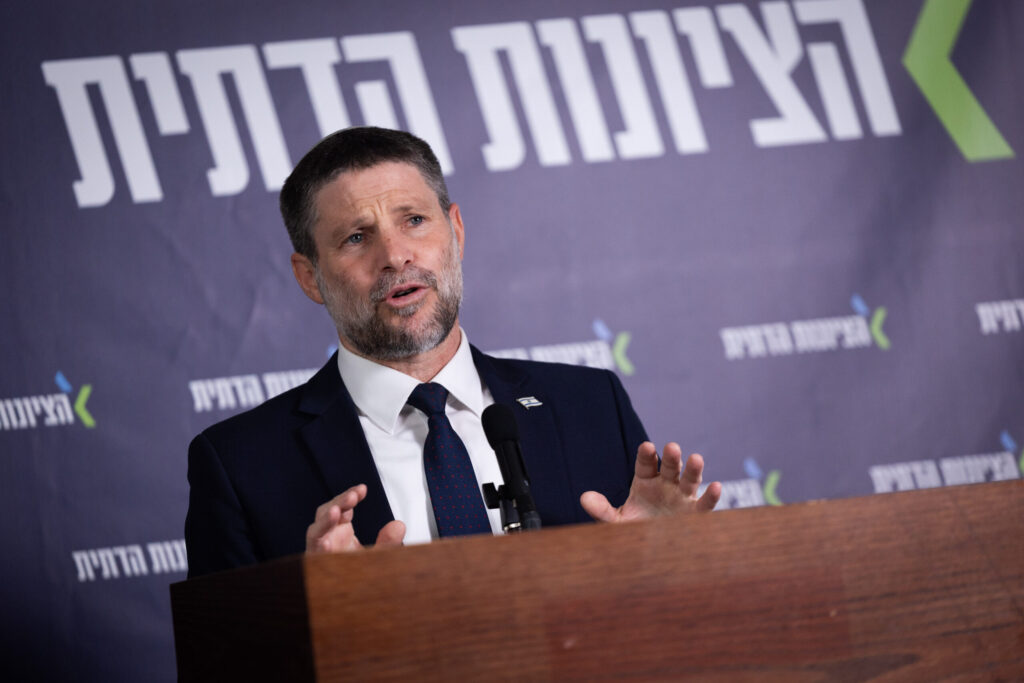
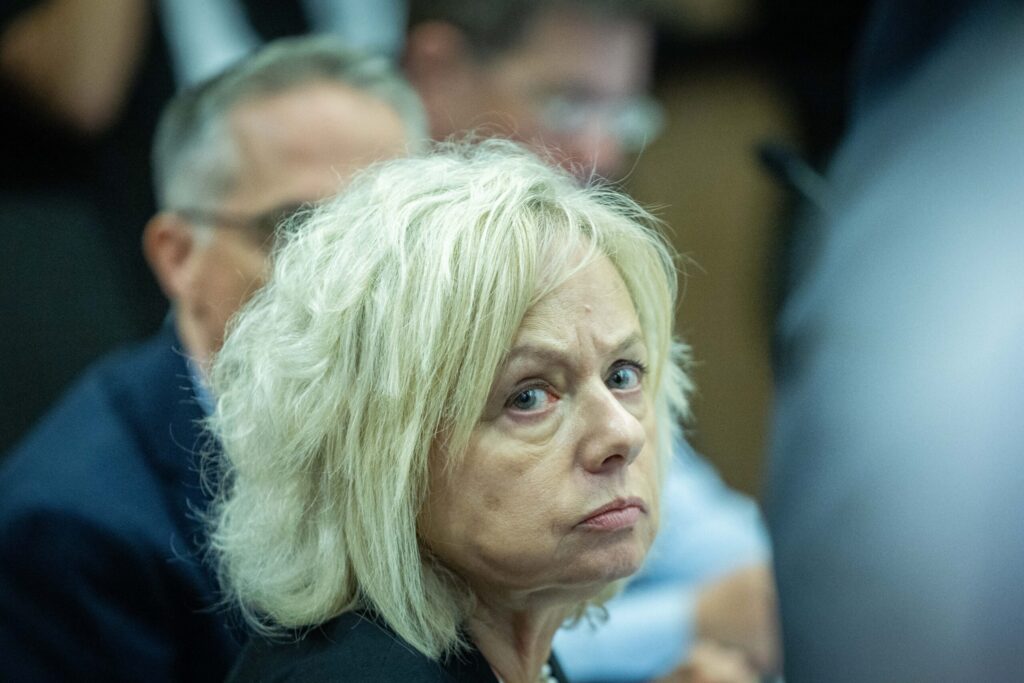
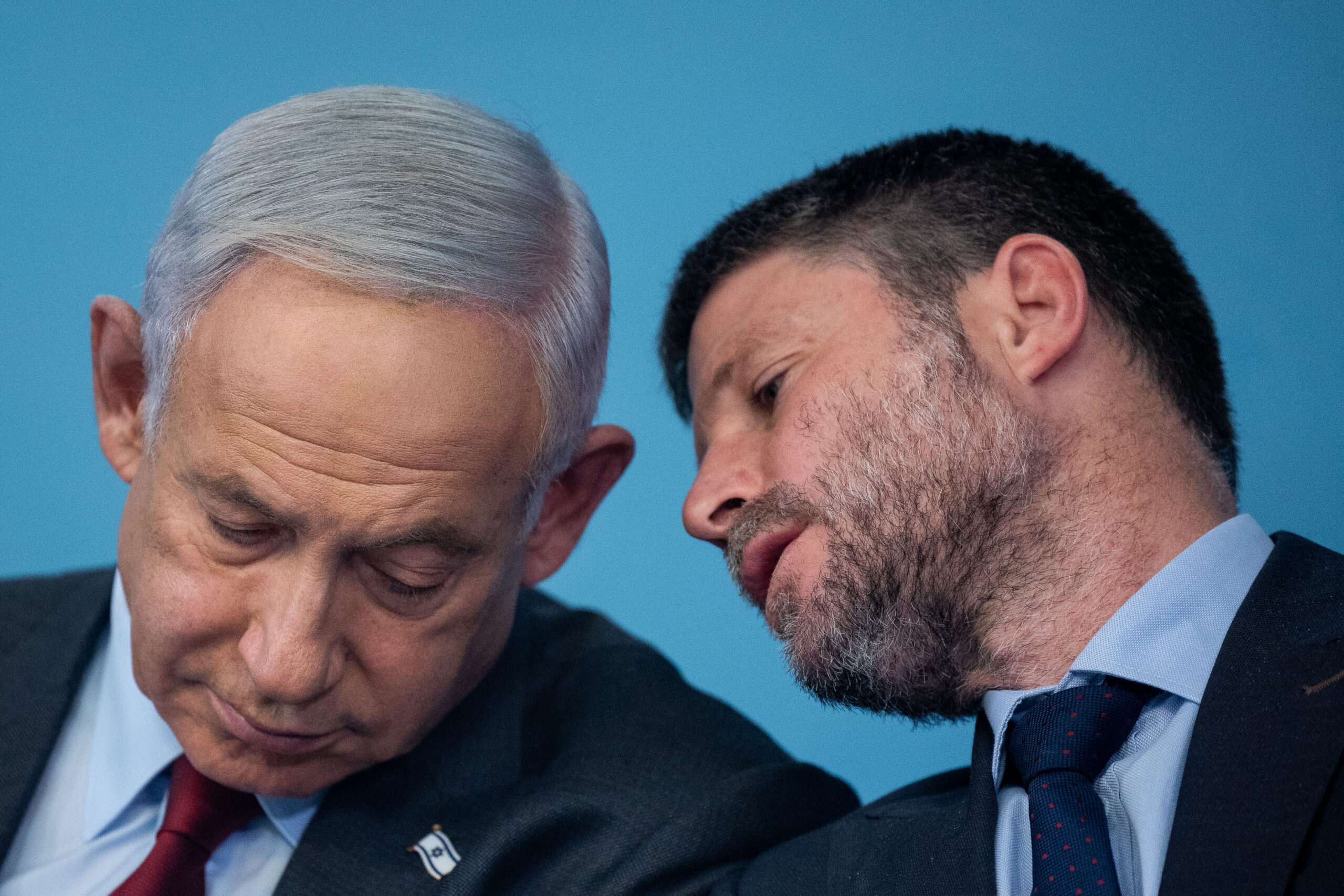
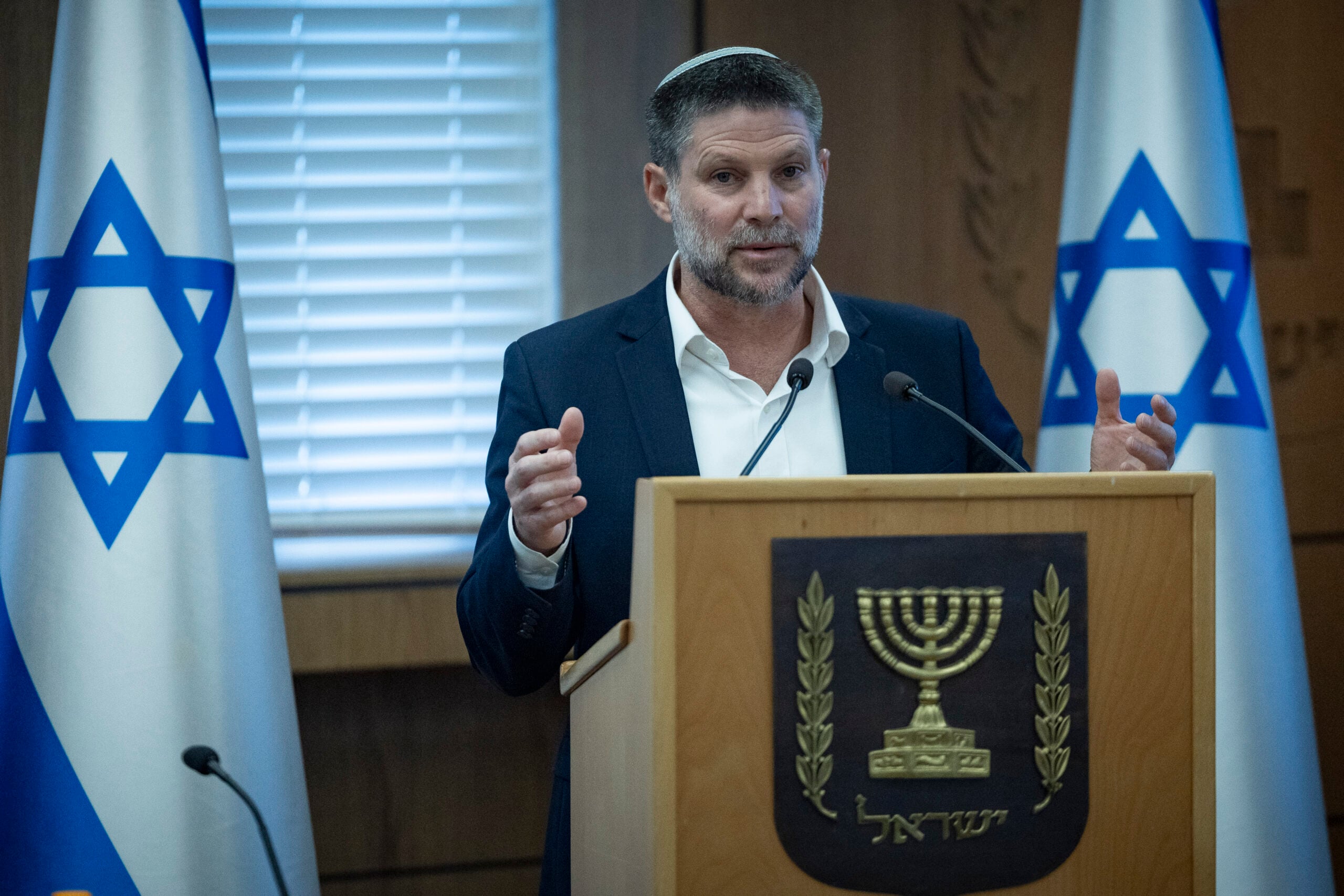
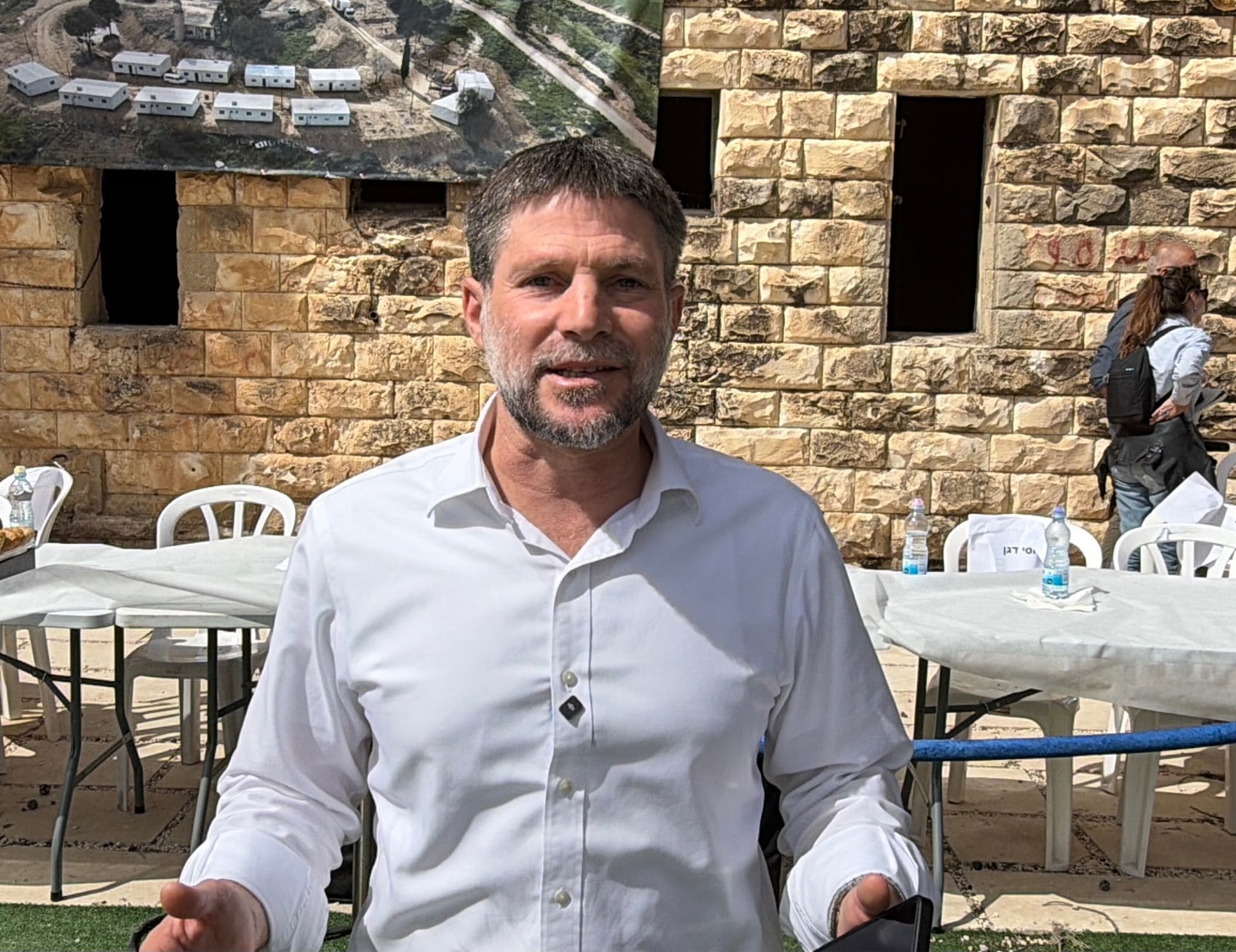
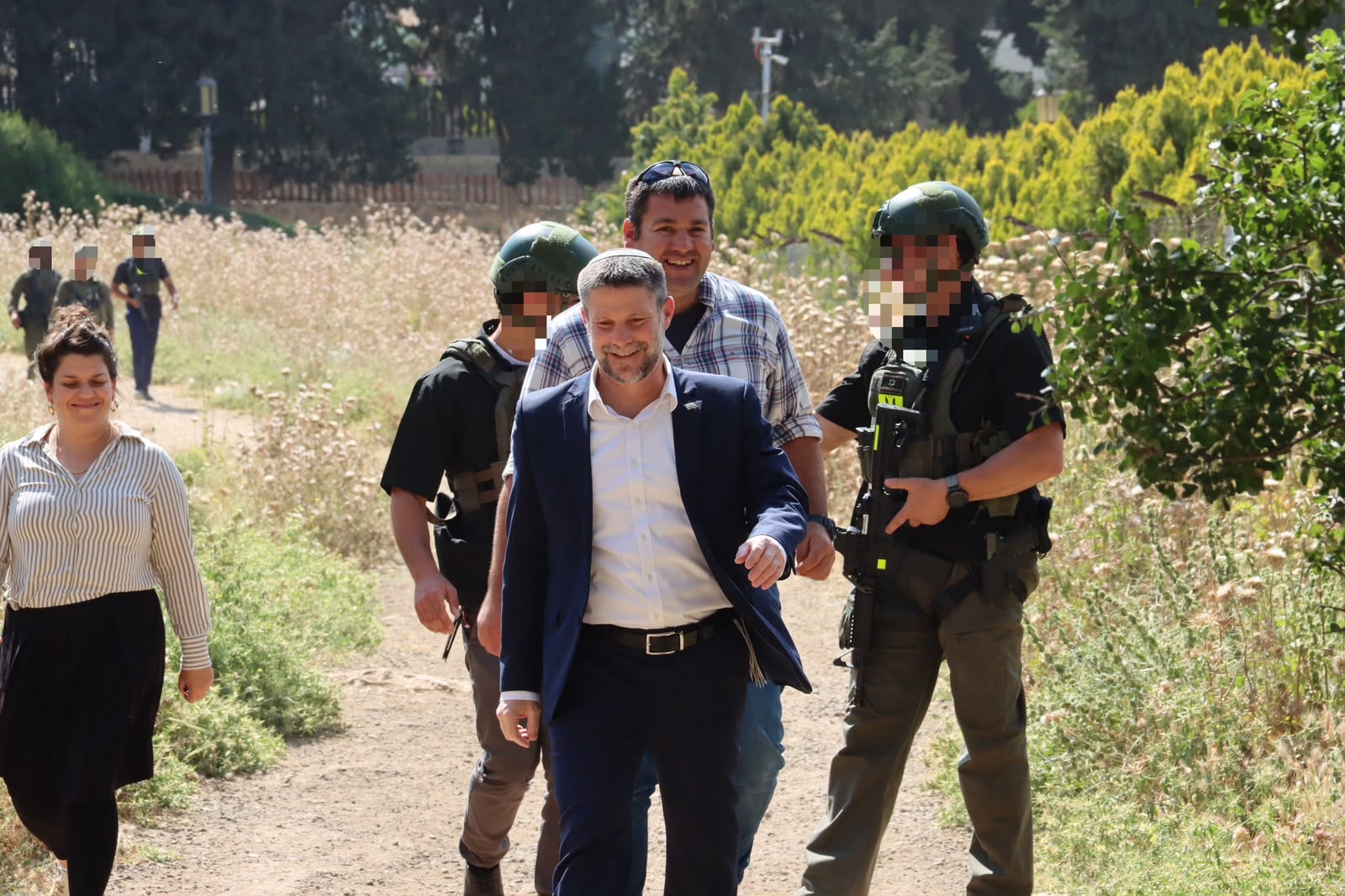
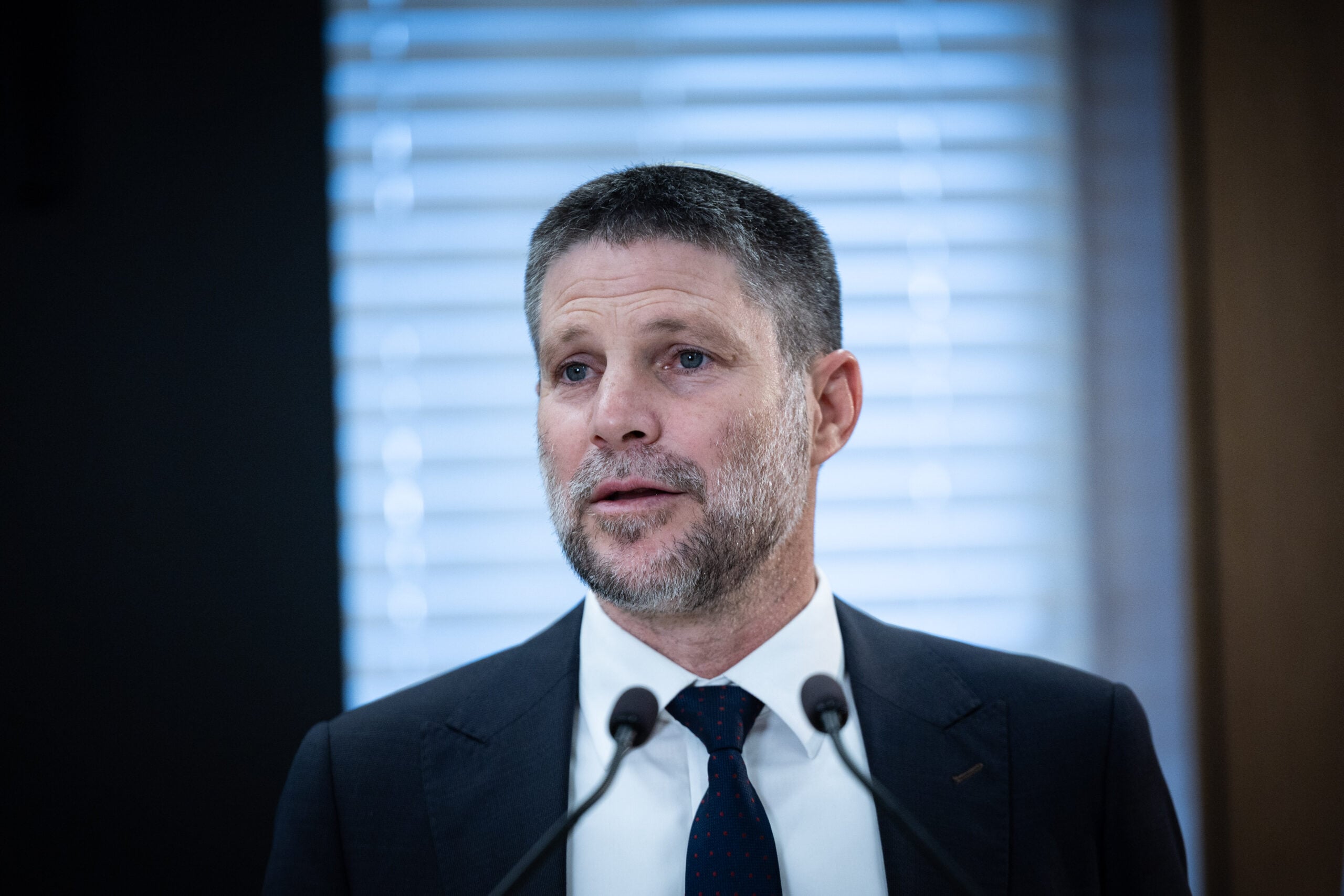
Finance Minister and Religious Zionism party chairman Bezalel Smotrich filed a petition with the High Court of Justice on Tuesday against Attorney General Gali Baharav-Miara, challenging her directive to delay opening bids and selecting winning developers for the strategic E1 construction tender. Smotrich was forced to file and finance the legal petition out of pocket after the State Attorney’s Office rejected the Attorney General’s executive stance. In the petition, the minister argues that the AG’s intervention constitutes an improper, unlawful disruption of a vital national priority.
Photo: Yonatan Sindel, Flash 90
At the center of the dispute is a land marketing tender to construct 1,234 residential housing units across seven sectors in Mevaseret Adumim, within the Ma’ale Adumim municipal boundary. Government policy clearance to advance the project was formally granted in October 2025—well before the current election campaign was declared. The petition emphasizes that each phase of the public tender was managed strictly by civil service professionals along predetermined timelines, completely insulated from political interference by elected officials.
Conversely, the Attorney General’s intervention halted the tender process’s generalization. The E1 corridor is widely considered a premier geopolitical flashpoint, as it physically links Jerusalem to Ma’ale Adumim to the east. The strategic corridor determines whether contiguous Israeli-Jewish communities are secured around the capital, or whether a wedge remains open to facilitate a contiguous ‘Palestinian’ state.
Photo: Yonatan Sindel, Flash 90
Smotrich directed blistering criticism toward the Attorney General, accusing her of political partisanship: “The Attorney General has officially, improperly, and unlawfully aligned herself with Gadi Eisenkot’s campaign, who should scrap construction in E1… Through this obstruction, Gali Baharav-Miara is operating as an instrument of the Israeli left to advance a ‘Palestinian’ state that directly jeopardizes the lives of Israeli citizens. There is no other explanation.”
The minister further contended that Baharav-Miara is abusing the authority of her office, pointing to the structural paradox in which an elected cabinet minister is denied the ability to articulate state policy through official government counsel—because the very official blocking the policy is also empowered to monopolize or deny legal representation. In this context, Smotrich reiterated that the impasse provides definitive proof of the urgent need to split the Attorney General’s powers and regulate the General’s jurisdiction, and that the nationalist camp will decisively complete judicial reform legislation to restore institutional checks and balances in the upcoming legislative term.
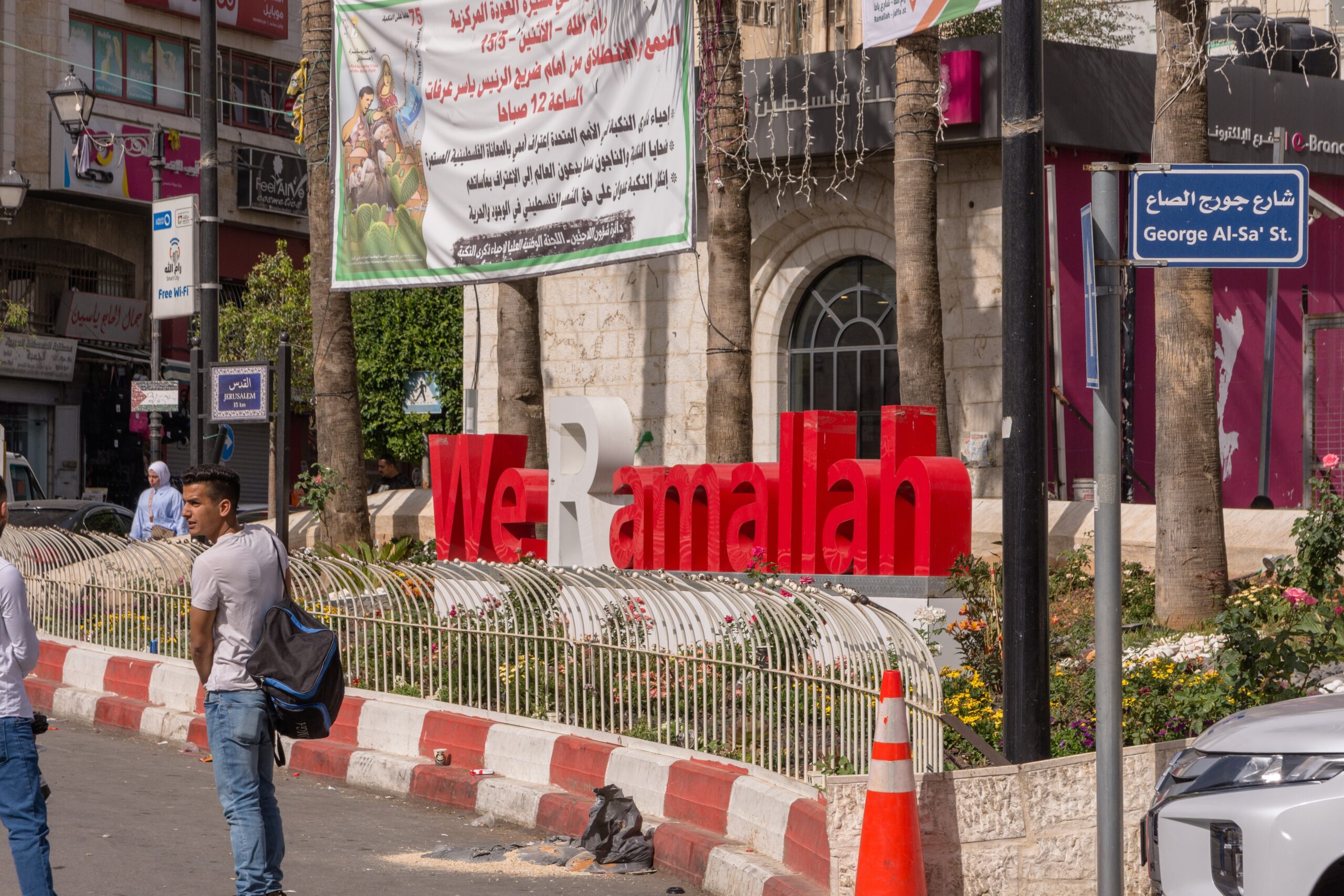
Two Israeli citizens recently entered the ‘Palestinian’ Authority administrative center of Ramallah with the declared goal of promoting the concept of a regional federation, fostering peace, and engaging with their ‘Palestinian’ counterparts. However, for their message to be received without incident, one minor detail was best kept out of the conversation: the fact that they were Israeli.
The two toured the city with a local fixer because, as it turns out, the road to cross-cultural harmony apparently requires someone on hand to advise where one may walk and where it is perilous to do so. In the course of their visit, the pair arrived at the mausoleum of Yasser Arafat—because what could be more natural when building bridgeheads of peace than paying respects at the grave of the former ‘PLO’ chairman who orchestrated terror campaigns that claimed the lives of hundreds of Israelis?
At one stage during their excursion, the local guide explicitly warned them to downplay and conceal their Israeli identity. After all, there is seemingly no better way to demonstrate genuine coexistence than by ensuring nobody around you discovers who you actually are—considering that had locals known they were Israelis, the encounter would have almost certainly concluded in an entirely different manner.
This surreal encounter unfolds even before addressing the legal reality of how they reached the city in the first place. Ramallah is classified as Area A, where the entry of Israeli citizens is strictly prohibited under standing IDF military injunctions, barring exceptionally rare, officially sanctioned exemptions. Had the situation turned hostile, it takes little imagination to determine who would have been required to breach the perimeter to rescue them: IDF soldiers, who would have been forced to put their lives on the line to extract the pair from mortal danger.
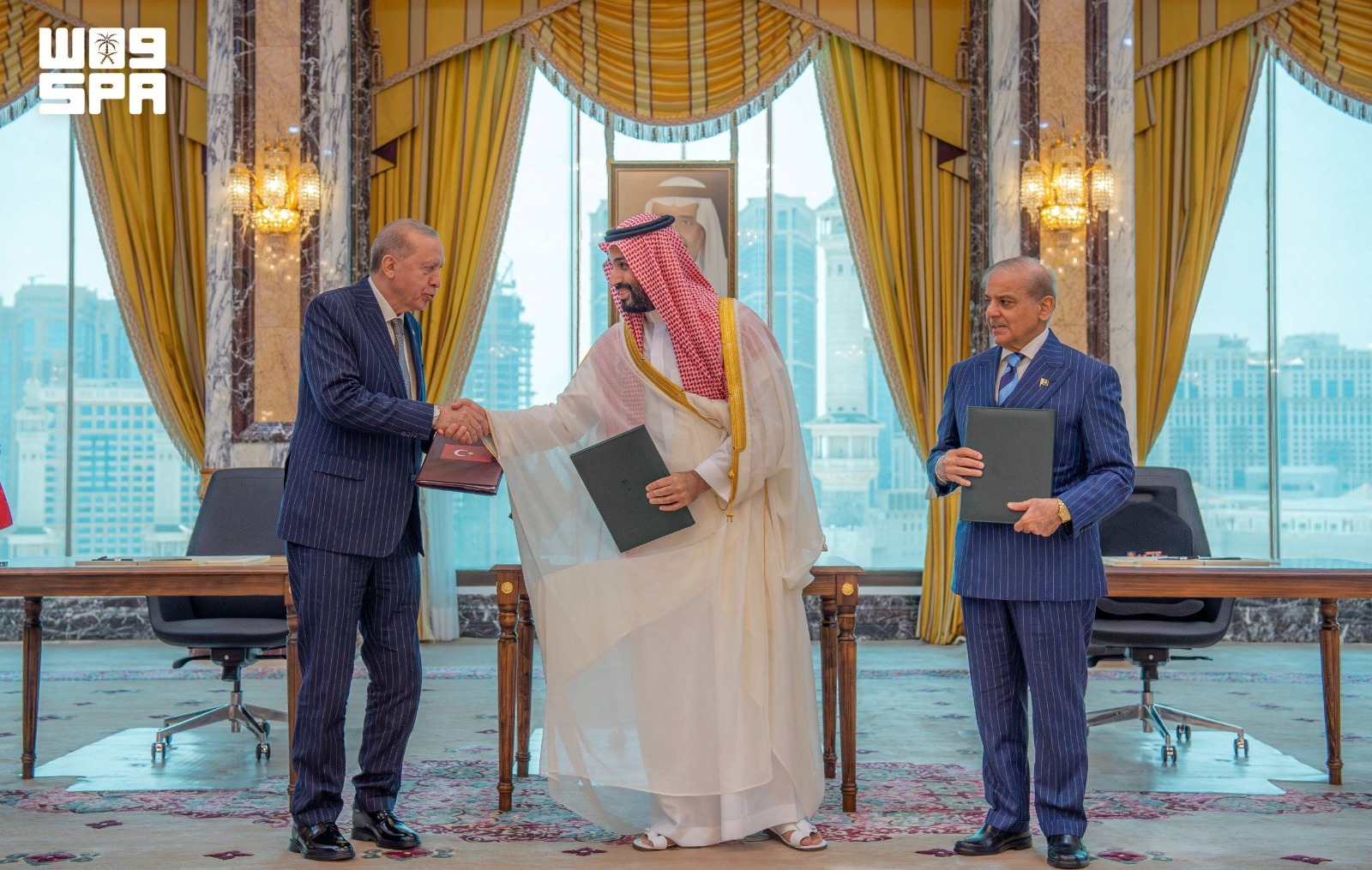
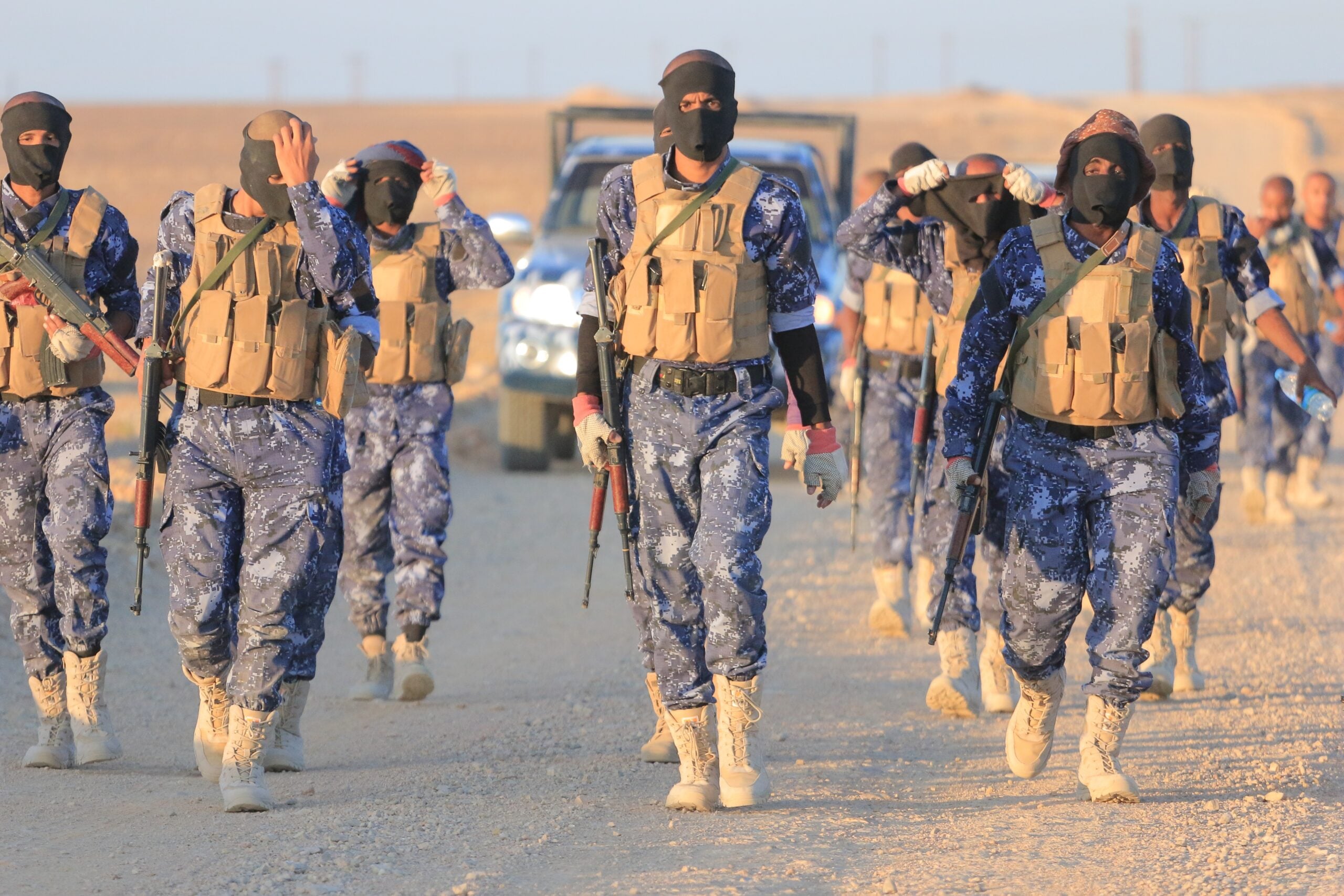
The announcement by the “Mecca Alliance”—the newly forged trilateral pact uniting Ankara, Islamabad, and Riyadh—regarding the deployment of Turkish and Pakistani military forces onto Saudi soil to support the campaign against the Houthis is a geopolitical shift that demands Israel’s focused attention.
The Houthis in Yemen | Photo: Shutterstock
On the surface, this deployment represents immediate military assistance for Saudi Arabia’s confrontation with the Yemeni Houthis. In this theater, Israel aligns closely with Saudi interests and reportedly provides intelligence support. However, the operational precedent being established is fraught with strategic complications.
Potential military friction between Israel and Turkey has increasingly entered policy and defense assessments in Jerusalem, no longer dismissed as an entirely theoretical contingency. Consequently, as the Mecca Alliance transitions from a symbolic declaration of intent into an operational diplomatic-military axis, Israeli strategists cannot entirely rule out future Pakistani military backing for Turkey should tensions erupt.
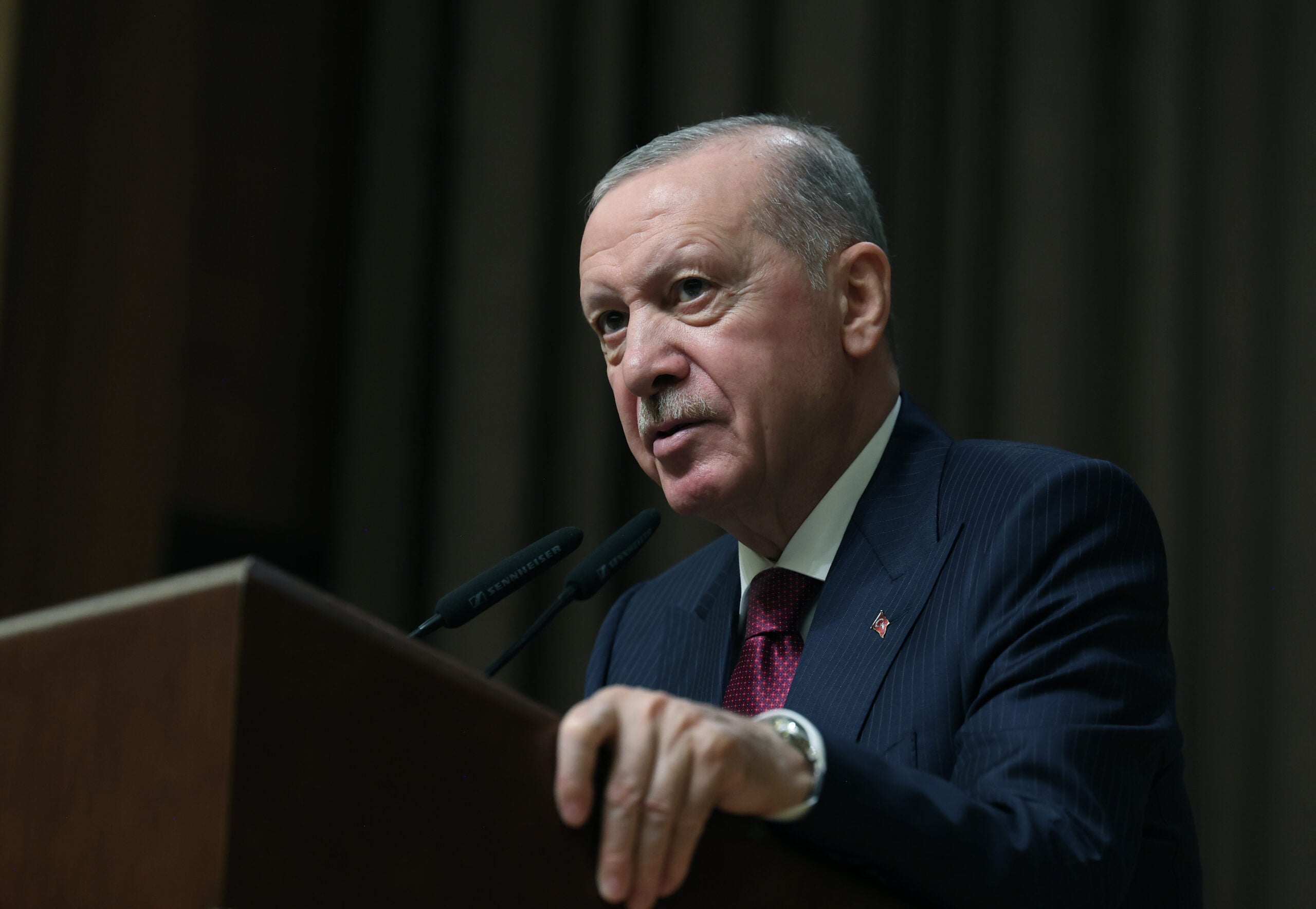
Turkish President Erdoğan | Photo: Reuters
Pakistan represents a formidable military power and remains the only Muslim nation in the world equipped with an operational nuclear arsenal. Furthermore, during its most recent armed clashes with India in May of last year, Pakistani forces demonstrated substantial combat capabilities across multiple engagements against a formidable peer adversary.
While there is no cause for alarmism—direct military conflict between the IDF and the Turkish military remains an unlikely contingency, and an engagement with Pakistan is far more remote—Israel must maintain a vigilant eye on this emergent trilateral alignment while actively cultivating its own regional counter-alliances.
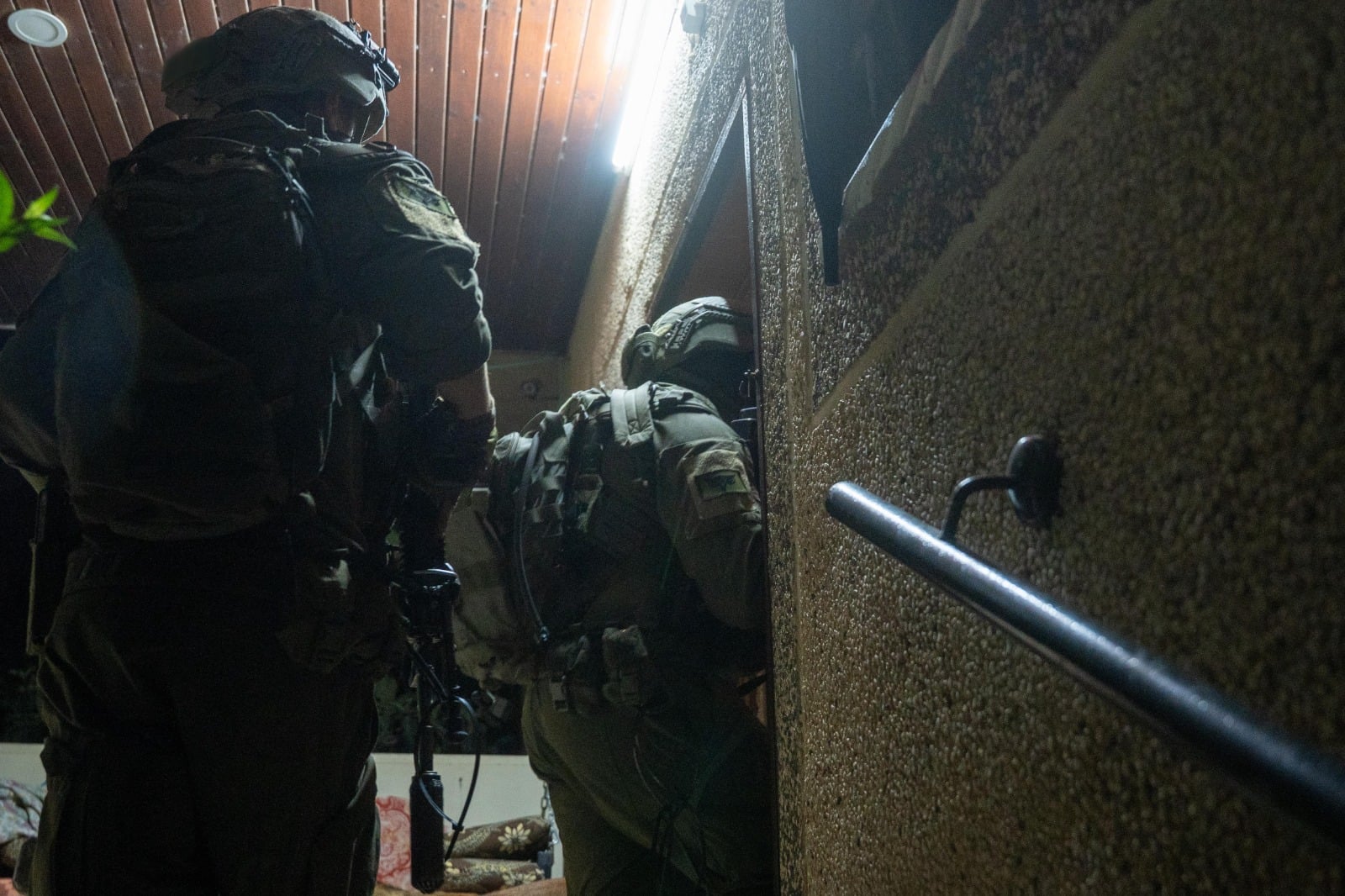
Israel’s security establishment is on high alert ahead of the third anniversary of the October 7 massacre according to the Gregorian calendar. The IDF is preparing for potential escalation in Gaza, Judea, and Samaria, with the baseline scenario including attempts by terror groups to replicate the October 7 attack—launching assaults against settlements and IDF forces in Judea and Samaria and against Israeli troops inside the Yellow Line in Gaza.
Photo: Police spokesperson
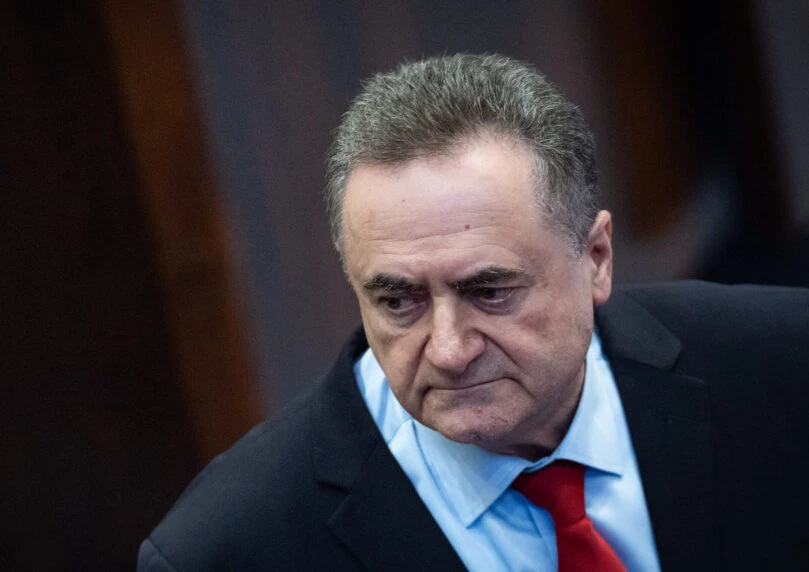
In a cabinet meeting today, Defense Minister Israel Katz laid out the main scenarios the security establishment is preparing for. Beyond concerns about jihadist attacks against Israeli civilians and soldiers, security officials are also preparing for an even more extreme and severe scenario—a complete reversal by ‘Palestinian’ Authority mechanisms and the Tanzim militias associated with it. According to Katz, such a case wouldn’t be just another passing wave of terror or a prolonged intifada, but an all-out war against the ‘Palestinian’ Authority.
A comprehensive operational plan to deal with these scenarios has already been formulated and approved by Prime Minister Benjamin Netanyahu and the defense minister, after being presented to cabinet ministers. According to the plan, the planned campaign would be short and intense, including air and ground firepower, targeting senior figures, destroying weapons caches and terror infrastructure, alongside large-scale evacuation of Arabs from combat zones.
Photo: IDF spokesperson
Parallel to the heightened alert and as the third anniversary of the war approaches, the IDF is releasing new data about the prolonged fighting and the underground campaign. One of the main infrastructures recently uncovered is an underground route about a kilometer and a half long, dubbed “Schwartz.” The route was located in an area added to IDF control as part of expanding the Yellow Line—a move carried out for operational reasons to provide better protection for forces and nearby settlements.
This tunnel was destroyed by forces in sections, causing significant damage to the route and the surrounding area. Security officials note this isn’t an isolated case; since the ceasefire took effect, the IDF has destroyed numerous tunnels in the Yellow Line area. Some of these infrastructures were known to intelligence but were only physically exposed and accessible following the expansion of operational control in the field, allowing forces to reach them and neutralize them completely.
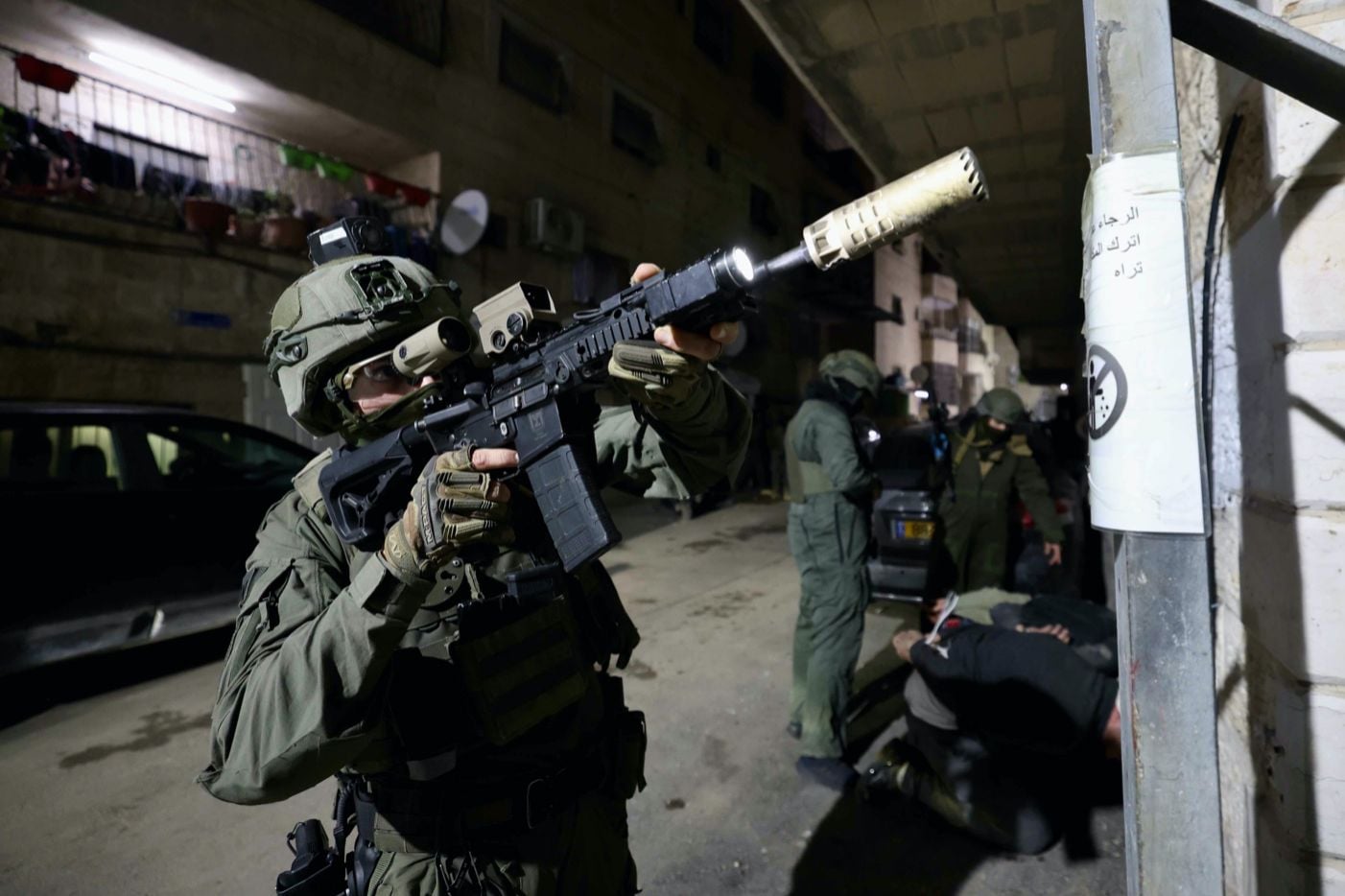
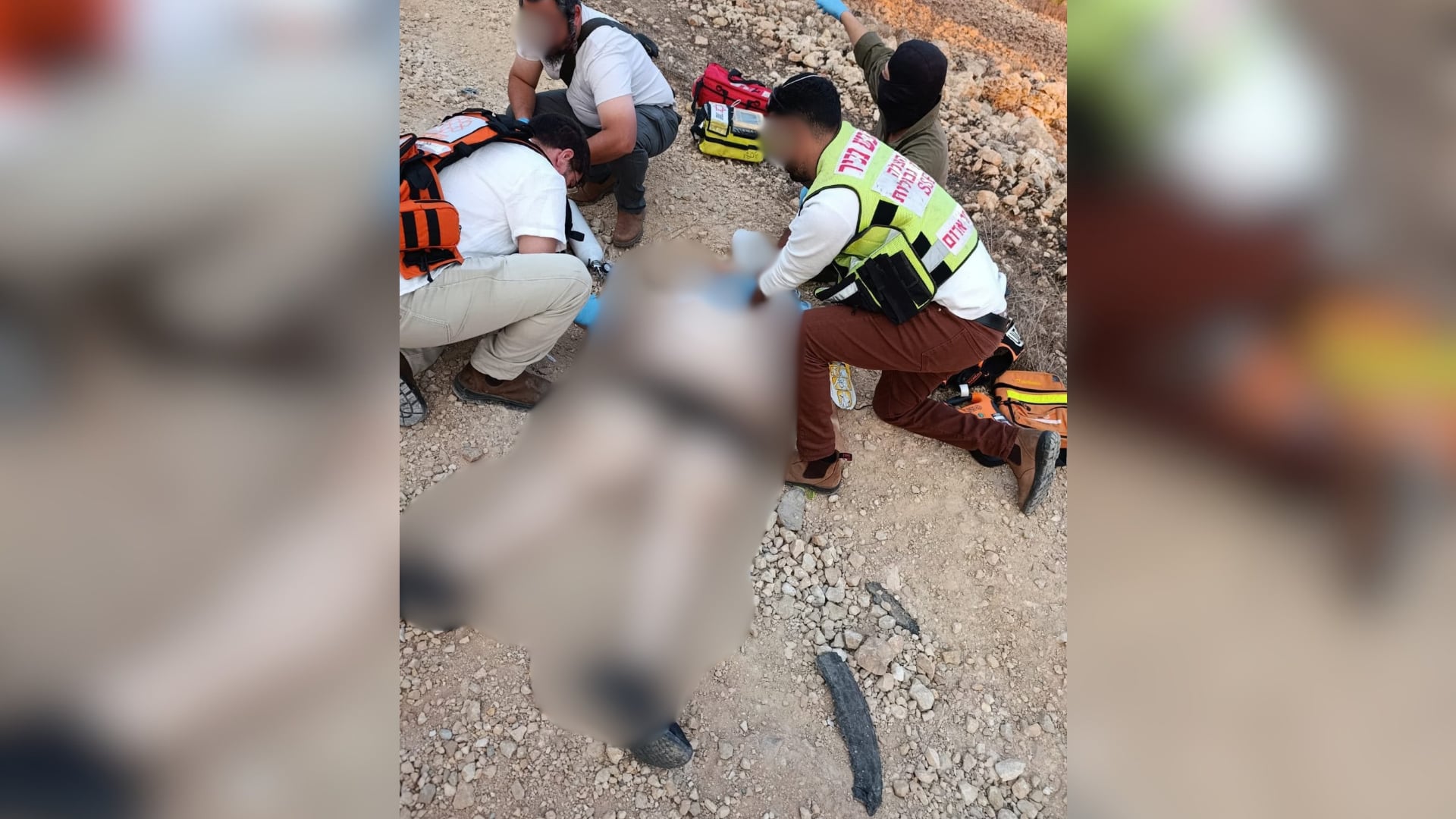
A serious arson attack was thwarted Friday afternoon in western Binyamin. Two terrorists arrived at Eretz Hatzvi ranch armed with firebombs, intending to set the ranch ablaze and harm residents.
The neutralized terrorist | Credit: None
The ranch owner, who spotted what was happening, acted quickly and calmly. He initiated suspect arrest procedures that included warning calls, and ultimately shot at one of the terrorists and neutralized him. The terrorist was wounded, arrested on site, and transferred for further treatment and interrogation by security forces.
This incident joins a series of attempted attacks and acts of aggression by terrorist elements against communities and ranches in the area, which continue to stand as a fortified wall guarding the Land of Israel. By the grace of God, thanks to the ranch owner’s alertness and resourcefulness, the incident ended with no casualties to our forces, and the danger was removed.
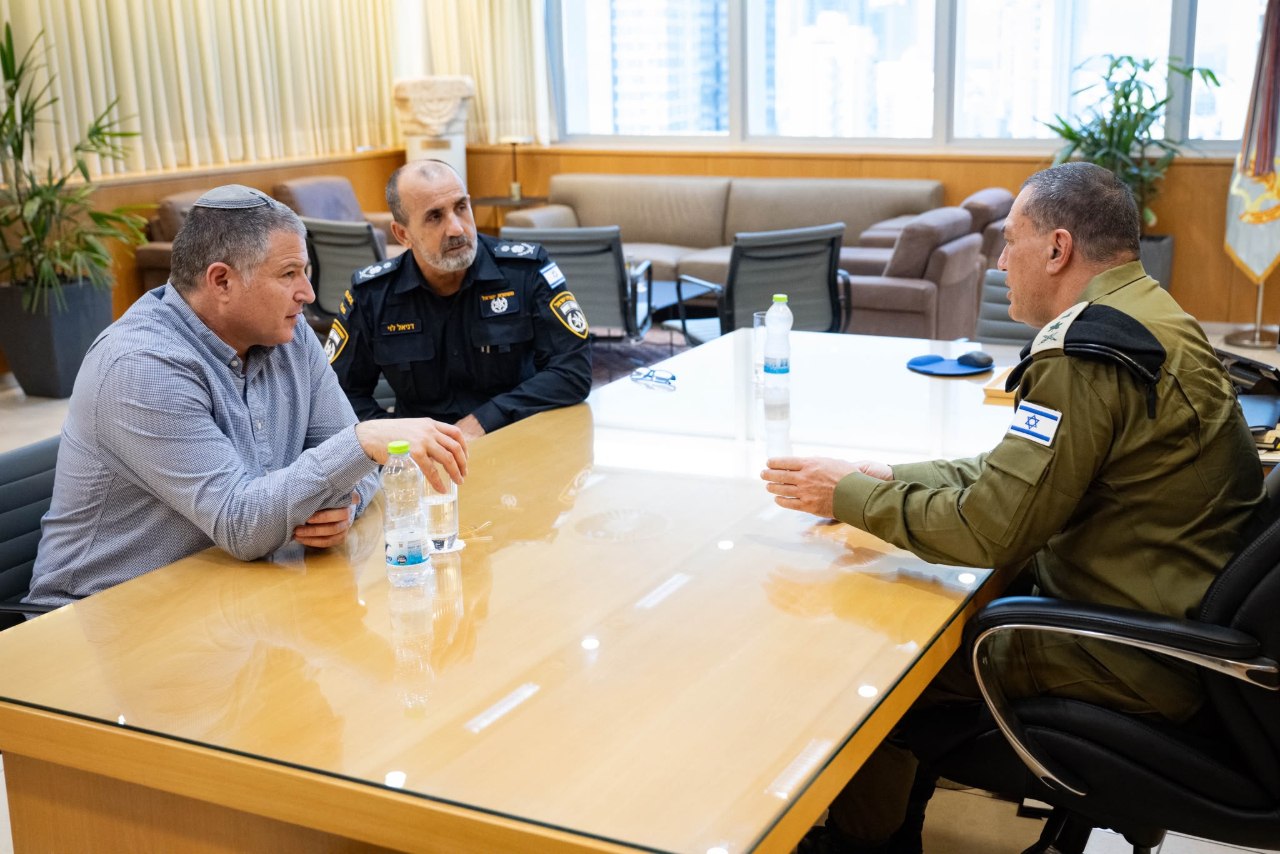
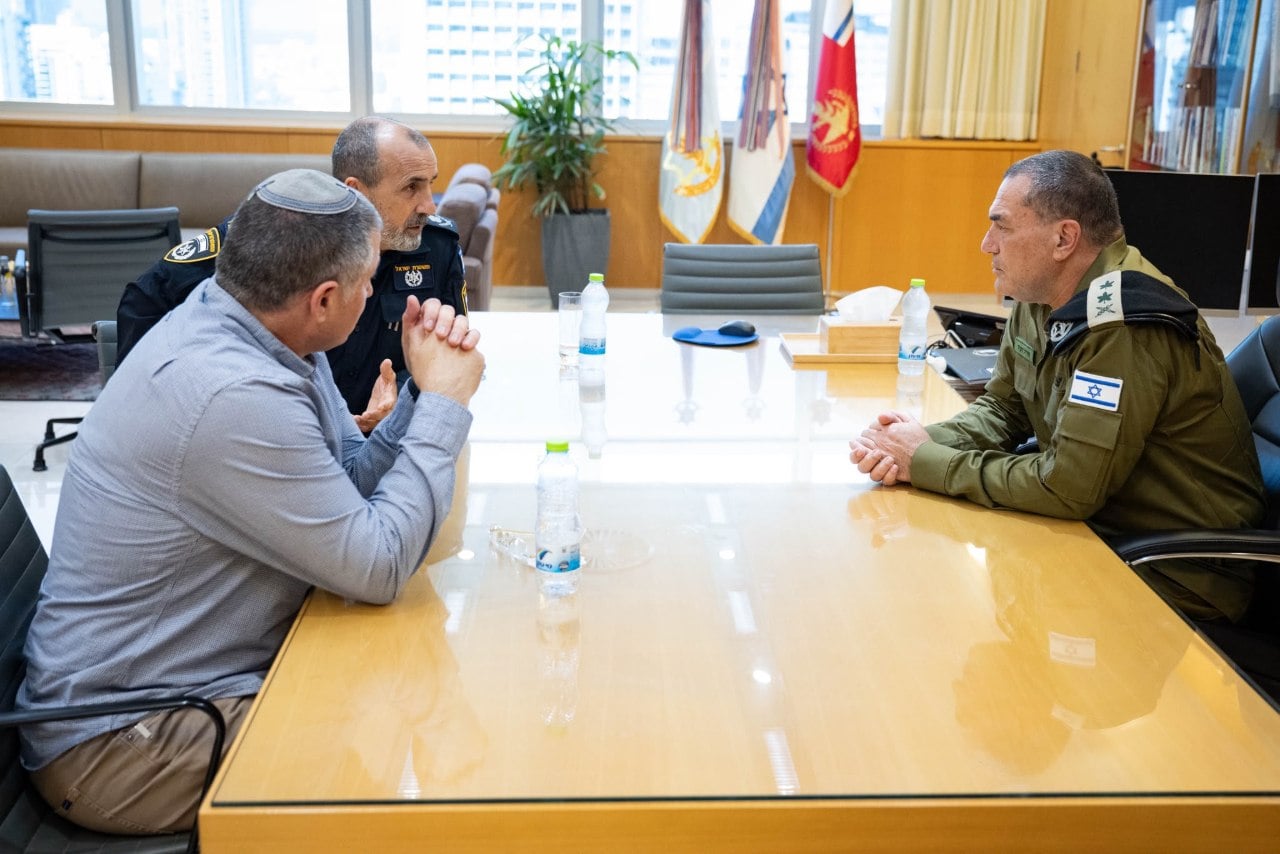
IDF Chief of Staff Eyal Zamir, Police Commissioner Danny Levy, and Shin Bet Director David Zinni held a joint multi-arena security assessment Tuesday as part of preparations for what officials described as a “sensitive period” in the coming weeks and ahead of the elections.
Photo: Police spokesperson
During the meeting, the security chiefs were briefed on the current intelligence picture at the borders and inside Israel. Officials also detailed efforts to strengthen multi-arena defense, continue the fight against terror organizations, and combat nationalist crime.
At the end of the assessment, the heads of the IDF, police, and Shin Bet agreed on a series of joint measures designed to leverage each organization’s relative advantages and strengthen cooperation between them.
The measures are aimed in part at ensuring the safe and orderly conduct of the upcoming elections, while continuing to address security threats across different arenas.
Prominent American Zionist influencer and advocate Lizzy Savetsky spent an immersive day traveling across Samaria, using the opportunity to spotlight the Jewish people’s unbreakable historical roots in the region, its indispensable military topography, and the growing disconnect between American media narratives and the reality on the ground.
EXCLUSIVE: “I realized after October 7th that there was never going to be a two-state solution.” American Zionist activist @LizzySavetsky goes over the ‘Green Line’ with C14’s @SophiaTupolev, straight to the booming ranches in Judea and Samaria – where 100K Israelis spent this Sukkot holiday.
“What is ‘Palestine?’ – They don’t even know what they mean when they say ‘Free Palestine’” – Savetsky slams useful idiots, Jewish institutions, and Mamdani, and talks about the personal toll of activism. Link to full interview below.
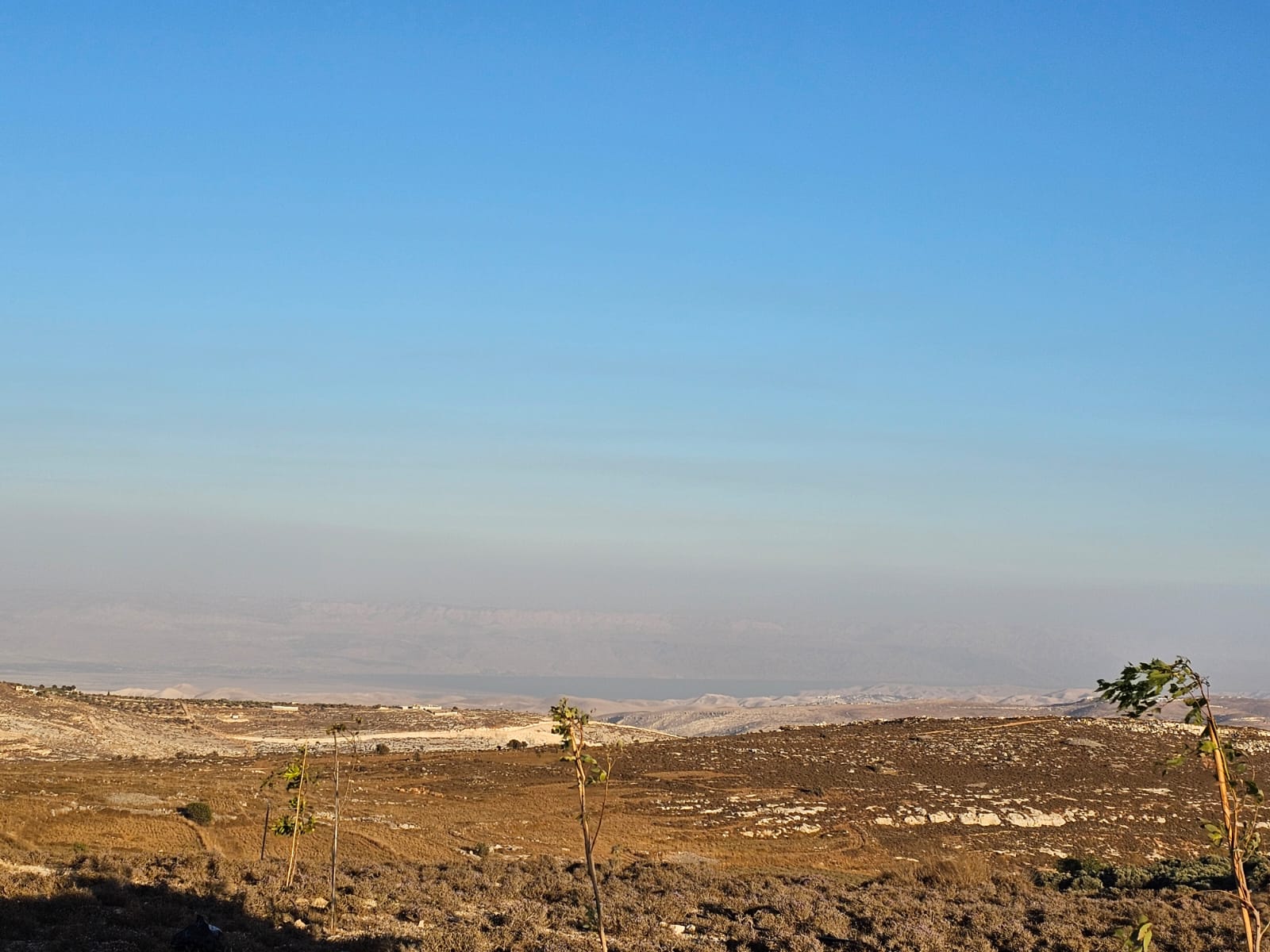
Beginning the day on the heights of Peduel, known as Israel’s Lookout, Savetsky looked out over Israel’s narrow central waistline, which directly commands views of the coastal plain, hotels, and Ben Gurion International Airport.
“I felt so incredibly blessed to be a Jewish person in this lifetime, looking out at this beautiful land that God promised to Abraham,” Savetsky remarked. “Standing where our Patriarch stood brings an unbelievable feeling of pride. But looking down from here, you immediately understand the immense danger if Israel did not maintain control over this terrain. You can literally see everything.”
Shattering Media Caricatures
Savetsky, who grew up in Fort Worth, Texas, expressed unexpected delight at seeing cattle grazing alongside centuries-old olive orchards, but reserved her strongest observations for the ideological and physical reality of the communities across Judea and Samaria.
“If I was just to watch CNN and only get my information from MSNBC, I would think that every Israeli out
here, every Jewish person out here, was a violent, you know, ill-motivated person.”
Savetsky noted that the trauma of the October 7 massacre permanently shifted internal Israeli perceptions regarding the region. “Prior to October 7, some people still harbored the illusion of a two-state compromise. That concept has been completely squashed. Even among more secular and liberal Israelis, visiting across the Green Line has ceased to be taboo. People increasingly recognize the strategic imperative of our presence here.”
Confronting Radicalism and Complacency in the US
Turning her focus toward developments in the United States, Savetsky voiced profound concern regarding the normalization of anti-Israel extremism across domestic politics, particularly in New York City. She cited the visible mainstreaming of figures like New York’s Zohran Mamdani as an alarming indicator of political complacency.
Holding Jewish Legacy Organizations Accountable
Savetsky was equally candid regarding the performance of established American Jewish institutions, arguing that despite substantial financial endowments and vast community apparatuses, major organizations have failed to wage an effective battle against skyrocketing antisemitism.
“This has been the single greatest disappointment,” Savetsky said. She noted that the Jewish community has unmatched financial resources, yet legacy organizations have achieved very little of measurable impact in safeguarding our communities or preventing radical candidates from rising in the most Jewish cities in America. There is an obsession with maintaining an artificial appearance of bipartisanship and bureaucracy, while true leadership is absent.
She specifically addressed controversial funding allocations: “For a long time stayed silent about it because I didn’t want to come out against my own, but I just can’t do that anymore. It’s just these are precious dollars, and the fact that UJA could give a million dollars to Gaza when our own safety is at risk in New York City, it’s disgusting, it’s infuriating, and you know they continue to. Platform politicians who have endorsed Zohran Mamdani at their rallies and events, and what are we doing? What are you doing?”
“We Are Fighting the Same War”
Acknowledging the personal toll of high-stakes public advocacy—a journey she describes as leaving an indelible mark on her heart—Savetsky affirmed her resolve to keep advocating for the Jewish state from abroad, expressing pride that her children aspire to future IDF service.
Addressing Israeli viewers directly, Savetsky delivered an emotional message of solidarity:
“But we’re fighting the same fight. You know, it’s it’s a global fight for the Jewish nation. I just want to say thank you to every Israeli. For weathering a very, very, very difficult storm, nobody can understand what it was like the past few years to be here, and how challenging it was. And every time that you ran to the bomb shelter, every time that you stayed put when you had an opportunity to leave to escape, you said to the world, “We are resilient. This is our home, and we are not going anywhere.” And on behalf of the Jewish people, I just have to say thank you. We have such a beautiful partnership, and I know that we have a lot of conflict within ourselves, but at the end of the day, we know that we are one family, and there’s nothing that we wouldn’t do for each other. And I just, I feel so grateful. Like I’ve never felt more connected to the Israeli people, even though I I need to work on my Hebrew. So pardon my English and Thank you for always making me feel so at home here, cause it is my home.”
The CIA has given Israel a short list of five to ten senior Iranian officials who should not be assassinated, according to a report in the Wall Street Journal.
Is the U.S. preparing for regime change in Iran? Photo: Shutterstock
According to the report, these are figures within the Iranian system who American intelligence believes could play a central role in the country’s future. The interpretation given is that Washington assesses some of these officials could be integrated into a future Iranian government structure.
The report further claims that the very act of passing the list to Israel may indicate that the U.S. intelligence community is already identifying certain figures within Iran’s power structure as potential leaders in the event of a regime change.
CIA Director John Ratcliffe | Photo: Shutterstock
According to that interpretation, the goal is to preserve figures the U.S. sees as potentially taking part in a different Iran—one that would act in a more moderate and normalized way toward the West.
Likud’s election campaign under the slogan “Right or ‘Palestine’” seeks to focus the race on the question of establishing a ‘Palestinian’ state. But while the issue has become one of the central campaign slogans, recent years have seen a series of major moves in Judea and Samaria—many of them led by Religious Zionism chairman and Finance Minister Bezalel Smotrich.
Minister Smotrich | Photo: Yonatan Sindel, Flash 90
Since the government was formed, 104 communities in Judea and Samaria have been advanced and legalized, along with more than 160 farms. Throughout his term, Smotrich has presented expansion as one of the main tools for creating Israeli territorial continuity and preventing the possibility of establishing a ‘Palestinian’ state in the future.
E1: The Plan That Waited Decades
One of the most significant moves advanced during his tenure is approval of the E1 plan, between Jerusalem and Ma’ale Adumim. The plan includes about 3,400 housing units and was frozen for many years due to opposition and international pressure.
In August 2025, the plan received final approval from the planning committee. Smotrich explicitly presented the move as part of a policy designed to thwart the establishment of a ‘Palestinian’ state. Opponents of the plan also argue that it severely damages the possibility of creating territorial continuity for a future ‘Palestinian’ state. “The idea of a ‘Palestinian’ state is taken off the table not through slogans, but through actions,” Smotrich said after advancing the plan.
Tens of Thousands of Housing Units and a System Change
The change wasn’t limited to establishing new communities. Since Smotrich took office, close to 60,000 housing units have been advanced in Judea and Samaria. For comparison, in the decade between 2013 and his entry into office, 56,185 housing units were approved. In other words, in just about three years, the volume of approvals reached a number higher than what was recorded throughout the preceding decade.
Alongside the construction volume, the working method also changed. In June 2023, the government changed the mechanism for approving construction plans in communities and eliminated the need for political-level approval at each stage of advancing a plan.
Minister Smotrich in Sa-Nur, archive | Credit: None
Subsequently, the Supreme Planning Council began meeting far more frequently than before—sometimes every two weeks and even weekly—instead of a limited number of concentrated meetings per year. This made the process of advancing construction in Judea and Samaria more continuous and less dependent on specific political approvals.
Billions for Roads in Judea and Samaria
Another significant change was recorded in infrastructure. Smotrich advanced a plan totaling about 7 billion shekels ($2.3B) over five years for roads in Judea and Samaria. Part of the road budgets were incorporated into the baseline budget for the first time, a step that enables long-term planning of transportation infrastructure in the area. In addition, a budget framework of more than a billion shekels was approved for paving roads to the new communities established during the term.
Photo: Spokesperson
Alongside the roads, 61 million shekels were invested in improving cellular reception in Judea and Samaria. In the first stage, 22 antenna sites were established under state leadership, and in the second stage 28 additional sites, with another stage in staff work.
State Lands, Enforcement, and Farms
The land sector also saw significant acceleration. From Oslo until Smotrich took office, about 60,000 dunams were recognized as state land. During his roughly three years in office, more than 30,000 additional dunams were recognized. Added to this is the establishment of more than 160 farms, holding a cumulative area of about a million dunams.
Minister Smotrich | Photo: Yonatan Sindel, Flash 90
At the same time, enforcement against illegal ‘Palestinian’ construction in Area C was increased. The scope of enforcement grew significantly compared to previous years, and 2025 was recorded as a record year for demolitions of illegal construction in the area.
And What About Money to the ‘Palestinian’ Authority?
Another significant front is relations with the PA. For many months, Smotrich, within his authority as finance minister, withheld transferring funds to the PA. The decision was renewed monthly, and cumulatively involves billions of shekels.
Throughout the years, Smotrich has presented economic policy toward the PA as part of the fight against the move to establish a ‘Palestinian’ state and as a response to its activity against Israel in the international arena.
Minister Smotrich | Photo: Yonatan Sindel, Flash 90
Alongside activity in Judea and Samaria, Religious Zionism is also advancing a plan for Jewish communities in the Negev and Galilee. Under the plan, community nuclei have begun to take shape that are supposed to be established on the ground.
In the civilian sphere as well, steps were advanced during the term to narrow the gap between Judea and Samaria residents and residents within the Green Line, including application of tracks parallel to Tama 38 and evacuation-reconstruction.
Between the Slogan and Actions on the Ground
The “Right or ‘Palestine’” campaign is expected to become one of Likud’s central messages in the election. But the battle over the future of Judea and Samaria and the possibility of establishing a ‘Palestinian’ state has also been waged in recent years far from billboards and campaign videos.
The campaign poster | Translated using AI
Establishing and legalizing communities, tens of thousands of housing units, E1, declaring tens of thousands of dunams as state land, changing planning mechanisms, and investing billions in infrastructure—all of these actually changed the reality in Judea and Samaria during the term.
A significant portion of these moves was led by Smotrich, who received significant powers related to Judea and Samaria and the Civil Administration when the government was formed. From his perspective, at least, the message that Likud is now presenting in its election campaign has already been translated during the term into policy and steps on the ground.
The emergency airbridge established to bring Israeli citizens back from Dubai is ongoing and is scheduled to reach its conclusion in the coming days. Since the weekend, Israeli commercial air carriers have operated continuous flights between Dubai and Israel to repatriate citizens who remain in the United Arab Emirates and wish to return home.
Arkia | Credit: PR
Meanwhile, the total number of repatriated citizens continues to climb. According to official data from the Ministry of Transport, 7,415 passengers have already landed safely in Israel. That figure includes Israelis brought home on Etihad Airways flights originating in Abu Dhabi, as well as special flights chartered from Dubai and operated by Israeli airlines.
The initial rescue flights from Dubai touched down in Israel on Friday, and intensive efforts have continued around the clock to bring the remaining passengers back quickly and safely. The Ministry of Transport confirmed that the emergency airlift is projected to conclude on Thursday, marking the completion of all scheduled rescue operations connecting Dubai to Israel.
El Al planes, archive | Photo: Shutterstock
The Ministry of Transport continues to coordinate closely with Israeli airlines and relevant operational authorities to maintain flight continuity and adjust passenger capacity to real-time travel demand. Officials reiterated that they will closely track passenger manifests and maintain operations until every citizen in Dubai seeking repatriation has secured a seat, prioritizing passenger safety and inter-agency coordination.
Minister of Transport and Road Safety, Brig. Gen. (res.) Miri Regev, stated: “From the very first moment, the Ministry of Transport acted in concert with all relevant bodies to enable Israelis to return home. We are maintaining an intensive, concentrated effort to conclude this repatriation operation, ensuring that additional Israelis can return home safely, swiftly, and in an orderly fashion. Our overarching objective is to complete the mission as expeditiously as possible, providing an answer for every Israeli seeking to return home.”