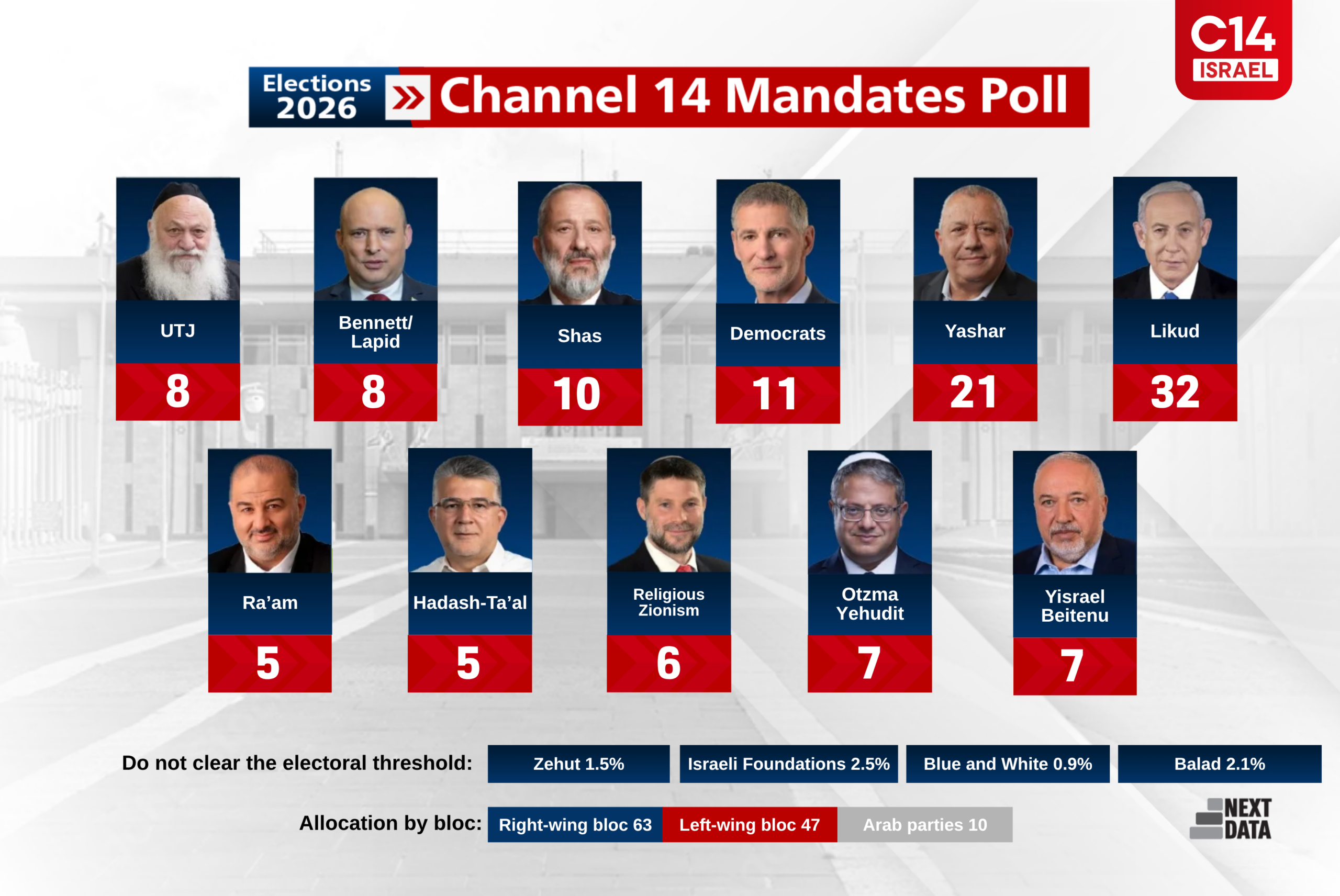
Channel 14’s weekly poll, broadcast Thursday evening, shows that if elections were held today, the right-wing bloc would maintain stability with 63 mandates and continue to hold a majority in the Knesset. Additionally, Benjamin Netanyahu is strengthening in the question of suitability for prime minister, but the Likud party is weakening by one mandate in favor of Religious Zionism.
Photo: Flash 90
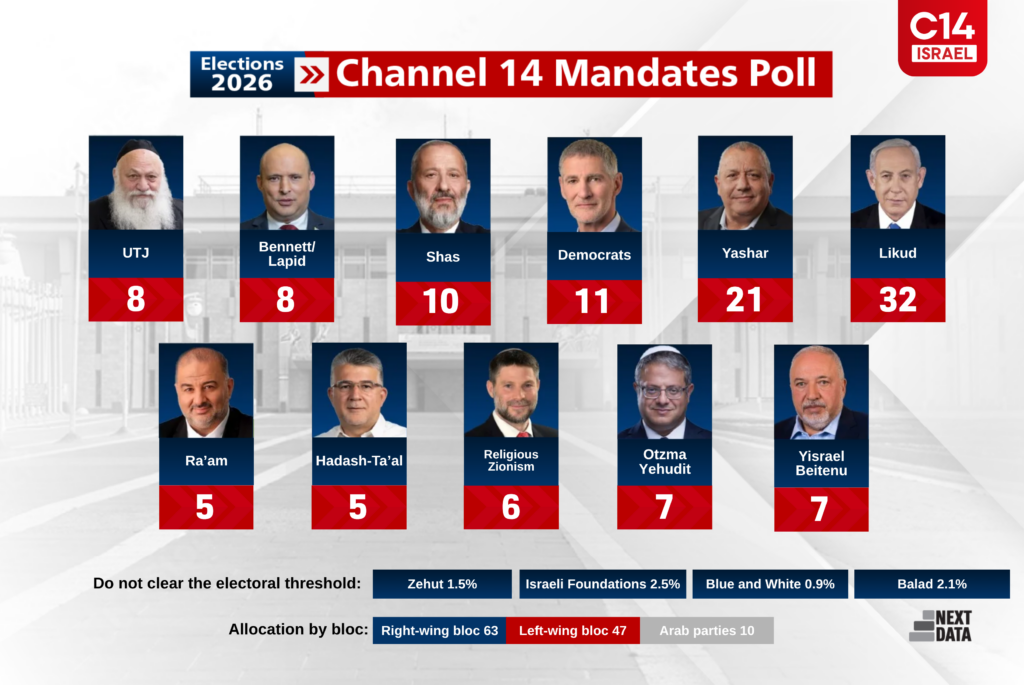
Likud remains Israel’s largest party with 32 mandates. Behind it stands the “Yashar” party led by Gadi Eisenkot with 21 mandates. In third place is the “Democrats” party with 11 mandates, followed by Shas with 10 mandates. Further down the list are United Torah Judaism and the joint Bennett- Lapid party with 8 mandates each. Yisrael Beiteinu and Otzma Yehudit each receive 7 mandates, Religious Zionism rises to 6 mandates, Hadash-Ta’al receives 5 mandates, and Ra’am also stands at 5 mandates.
Below the electoral threshold are the Israeli Foundations party led by Yoaz Hendel and Hili Tropper with 2.5%, Balad with 2.1%, the Zehut party led by Moshe Feiglin with 1.5%, and Blue and White with 0.9%.
Photo: Flash 90
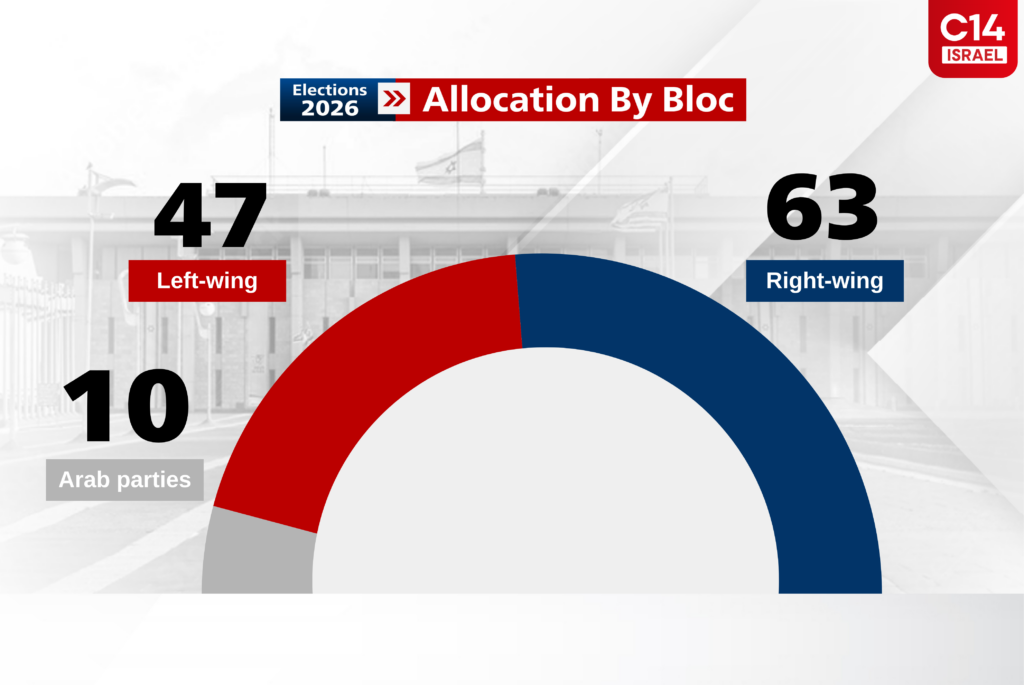
In the bloc breakdown, the right-wing bloc stands at 63 mandates, the left-wing bloc at 47 mandates, and the Arab parties hold 10 mandates.
Photo: Flash 90
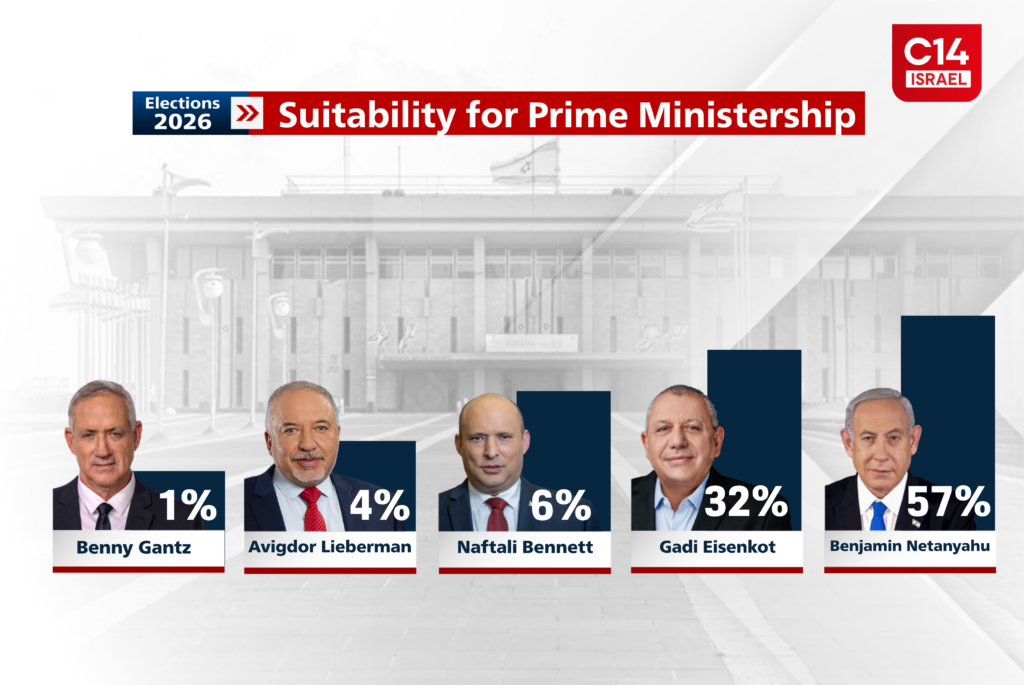
On the question of suitability for prime minister, Prime Minister Benjamin Netanyahu continues to lead by a significant margin. Netanyahu receives 57% support, compared to 32% for Gadi Eisenkot. Naftali Bennett receives 6%, Avigdor Lieberman 4%, and Benny Gantz receives only 1%.
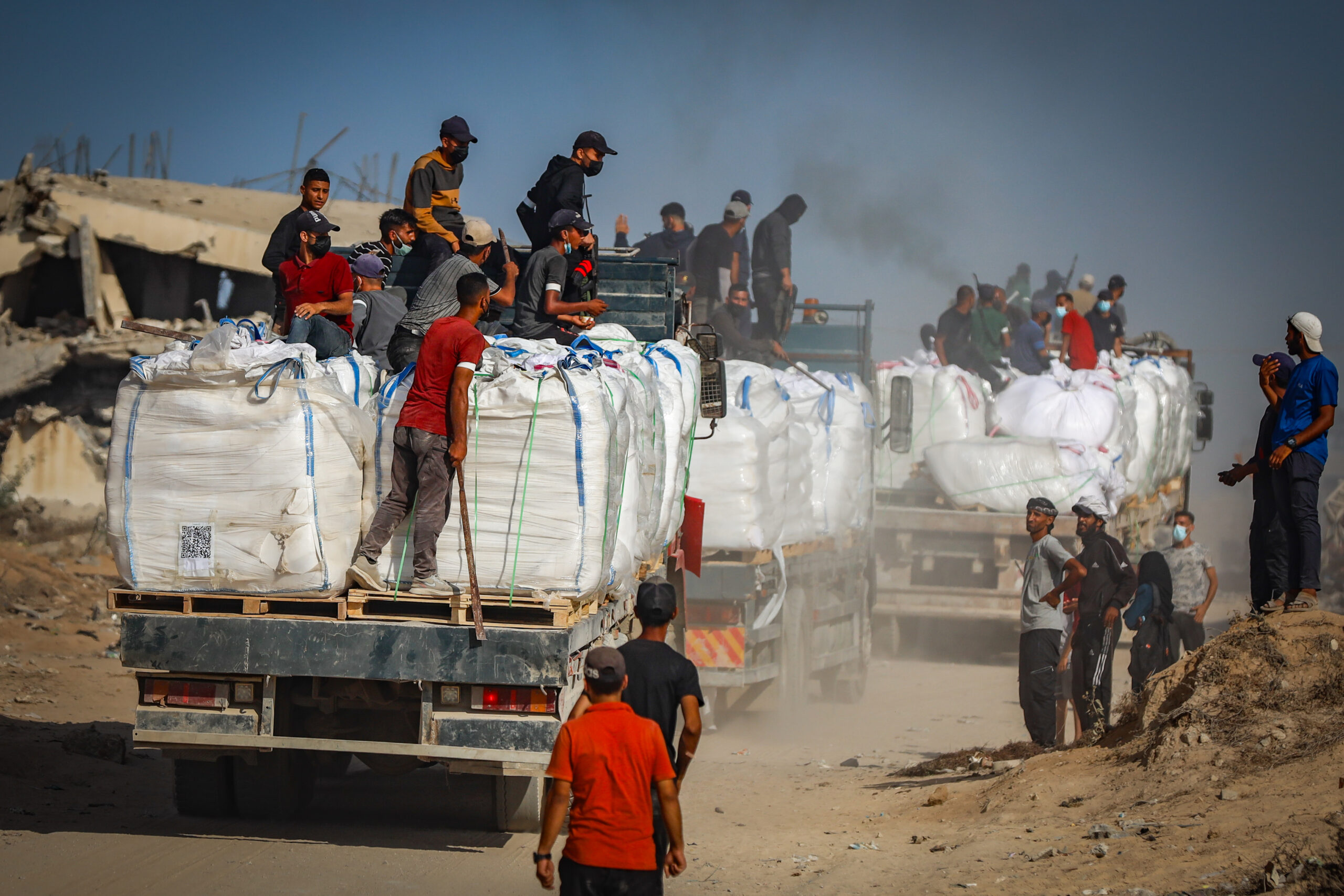
Jared Kushner, advisor to President Donald Trump, is calling for a change in how the world delivers aid money to the Gaza Strip. In a closed-door conversation with foreign ministers from Europe and Arab states held in Brussels for the launch of an aid package worth roughly €900 million, Kushner presented what he calls a “new approach” to rebuilding the Strip, according to Euronews.
Photo: Screenshot
During the video conference, Kushner criticized the current aid system, arguing it’s been shaped step by step by non-governmental organizations and terrorist actors. According to him, a steady flow of money reached Hamas, which used it to buy weapons, build tunnels, and develop rockets.
Kushner made clear that the world needs to move from “giving painkillers” to the problem toward real change of direction, emphasizing that the goal should be creating a situation where future donor conferences won’t be necessary.
Photo: Flash90
“One Government with One Gun”
One of the central themes in Kushner’s remarks was disarming Hamas. He made clear that reconstruction efforts in Gaza can’t succeed as long as armed organizations hold military capabilities. He presented the principle of “one government with one gun” as a basic condition for any progress. Though he didn’t name UNRWA specifically, his words were interpreted as a call to bypass the organization—a position likely to create friction with the European Union, the agency’s largest donor.
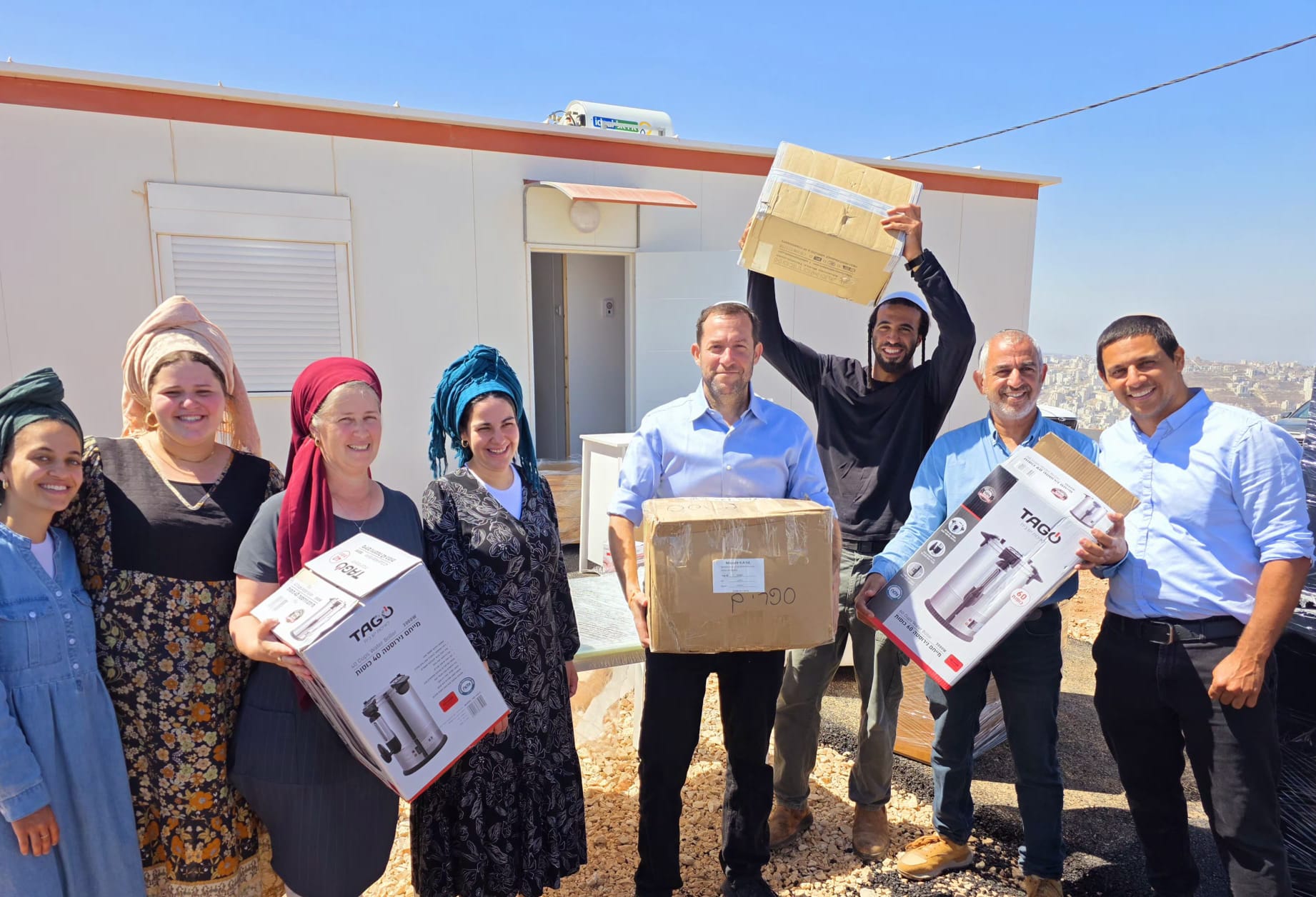
The first families moved into the new community of Ebal in northern Samaria Thursday morning, bringing equipment into trailer homes set up at the site. An official ceremony is scheduled for later Thursday with members of Knesset and public figures in attendance.
Travelers at the altar and Mount Ebal | Credit: Tzilumiri
The move comes about a year after a cabinet decision led by Ministers Israel Katz and Bezalel Smotrich, as part of the “Reconnection Plan” spearheaded by the Samaria Regional Council. The plan calls for establishing 19 new communities across northern Samaria to strengthen security in the area and address what supporters call the injustice of past evacuations.
The community is being built on Mount Ebal, a site of historical and national significance that contains archaeological remains of what’s believed to be the altar of Joshua bin Nun. Yossi Dagan, Governor of the Samaria Regional Council who accompanied the founding families, said: “This is a great moment for every Zionist who loves this land, to see a new community born in the State of Israel.”
Joshua’s Altar on Mount Ebal | Photo: Yosef Avichai Hershkowitz
Dagan added: “Establishing Ebal is a fitting Zionist response—an answer of building, development and action in Samaria. We’re privileged to write a new and glorious chapter today in the history of re-settling Israel. This land has waited empty for thousands of years—600 families will live here.”
Dagan continued: “My heart is full seeing the equipment trucks climbing the mountain, to see the first children running on Ebal’s new paths and life beginning here from zero. We didn’t come here as passersby—we came to put down roots, build a home and stay forever. We’re establishing a flourishing community that will light up the entire region, and this is a giant step toward expanding our hold across all of northern Samaria.”
Photo: Samaria Regional Council
Noam and Na’ama Ozeri, among the founding families and first residents of Ebal, said: “We’re privileged to take part in a movement with all the people of Israel, establishing a new community in Israel. This news shapes how the entire redemption of the land moves forward. The Land of Israel is waiting for us and receiving us with love.”
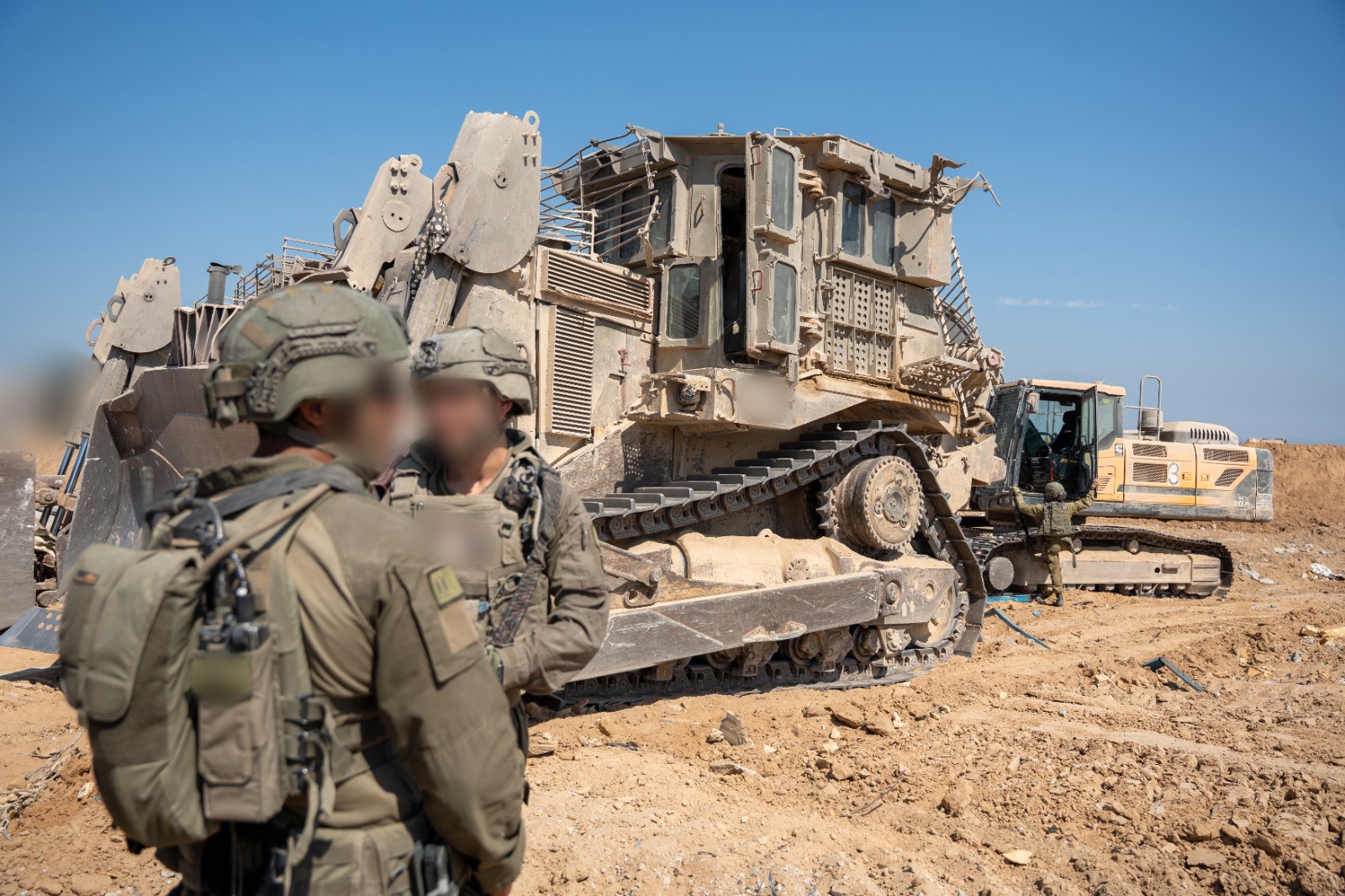
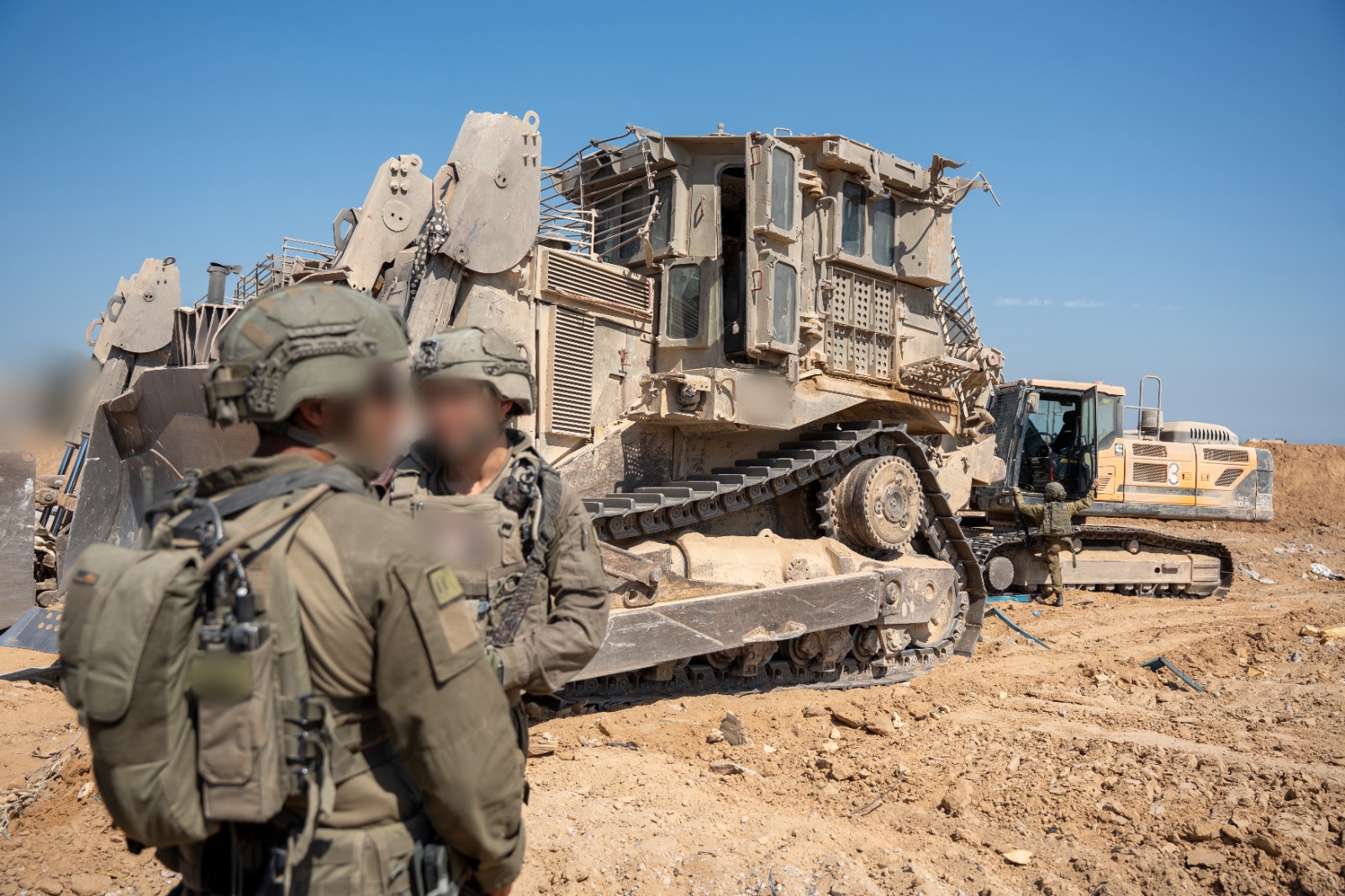
Israeli forces struck in central Gaza yesterday (Wednesday) and killed Omar Ahmad Abu Qasem, a battalion-level sniper commander in the military wing of the Hamas terror organization, the IDF announced.
According to the IDF, Abu Qasem took part throughout the war in executing terror attacks against Israeli forces in the Strip. In recent weeks, he attempted to rebuild Hamas’s military wing and orchestrated additional terror attacks against Israeli troops.
The IDF noted that the operation was carried out in violation of the ceasefire agreement. IDF forces under Southern Command are deployed in the area in accordance with the agreement, and will continue to operate to remove any immediate threat.
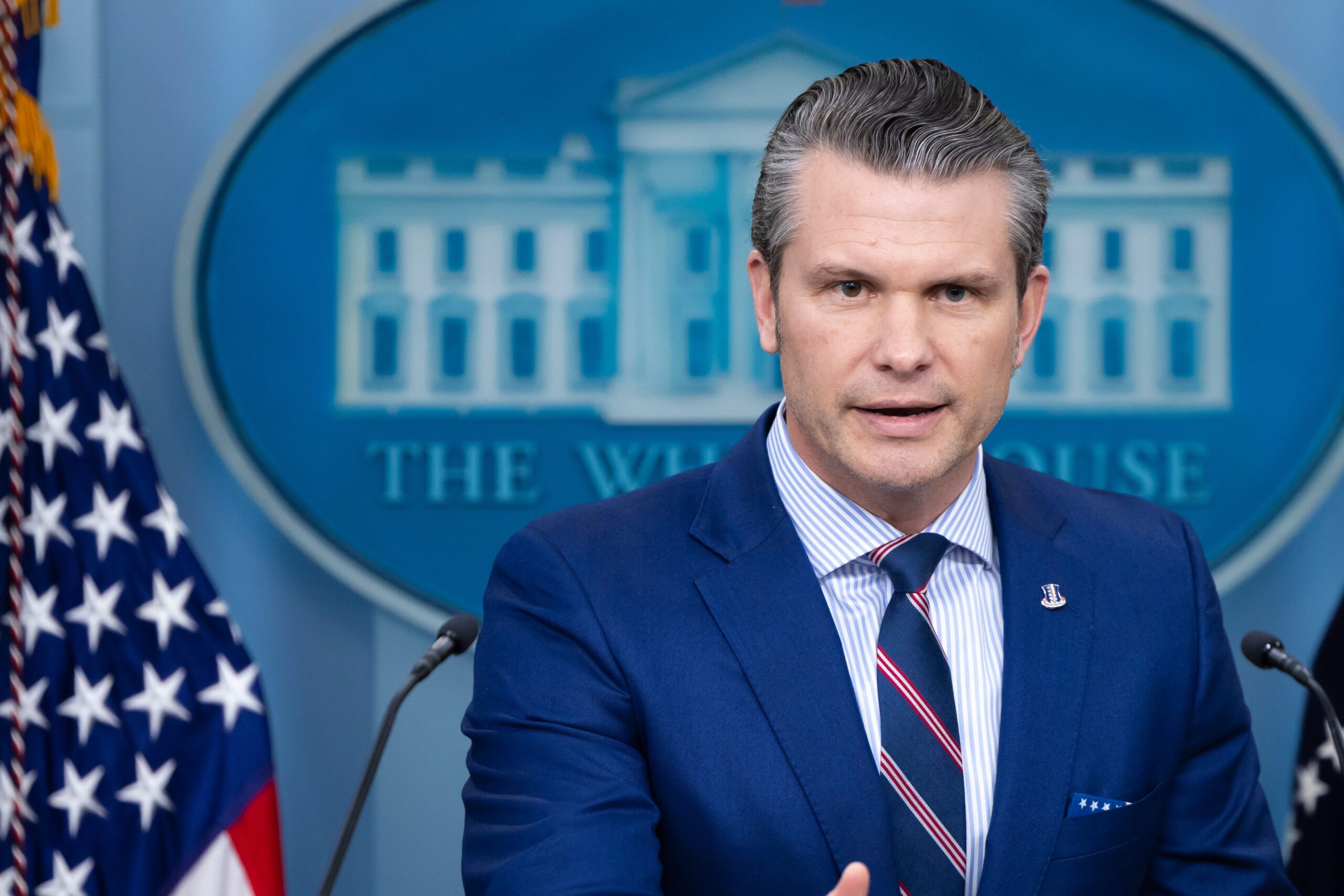
Defense Minister Israel Katz spoke overnight Wednesday into Thursday with U.S. War Secretary Pete Hegseth amidst American military activity in Iran and security developments across the Middle East.
Defense Minister Israel Katz | Photo: Haim Goldberg, Flash 90
Hegseth updated Katz on U.S. military operations in Iran, according to the defense minister’s office. The two agreed to continue coordination between the countries in response to any potential developments.
During the call, Katz briefed Hegseth on Israeli operations against jihadist terror groups in Syria, Gaza and Lebanon. The defense minister stressed Israel’s determination to maintain its presence in security zones across all three fronts to protect the borders and nearby communities—a key lesson from the October 7 attacks, he said.
Gazans near a tank on the Gaza border on October 7 | Photo: Flash 90
Katz emphasized Israel’s sovereignty: “We have never asked the United States to act in our place along our borders. We are committed to defending Israel’s citizens against every threat, and that is what we intend to do.”
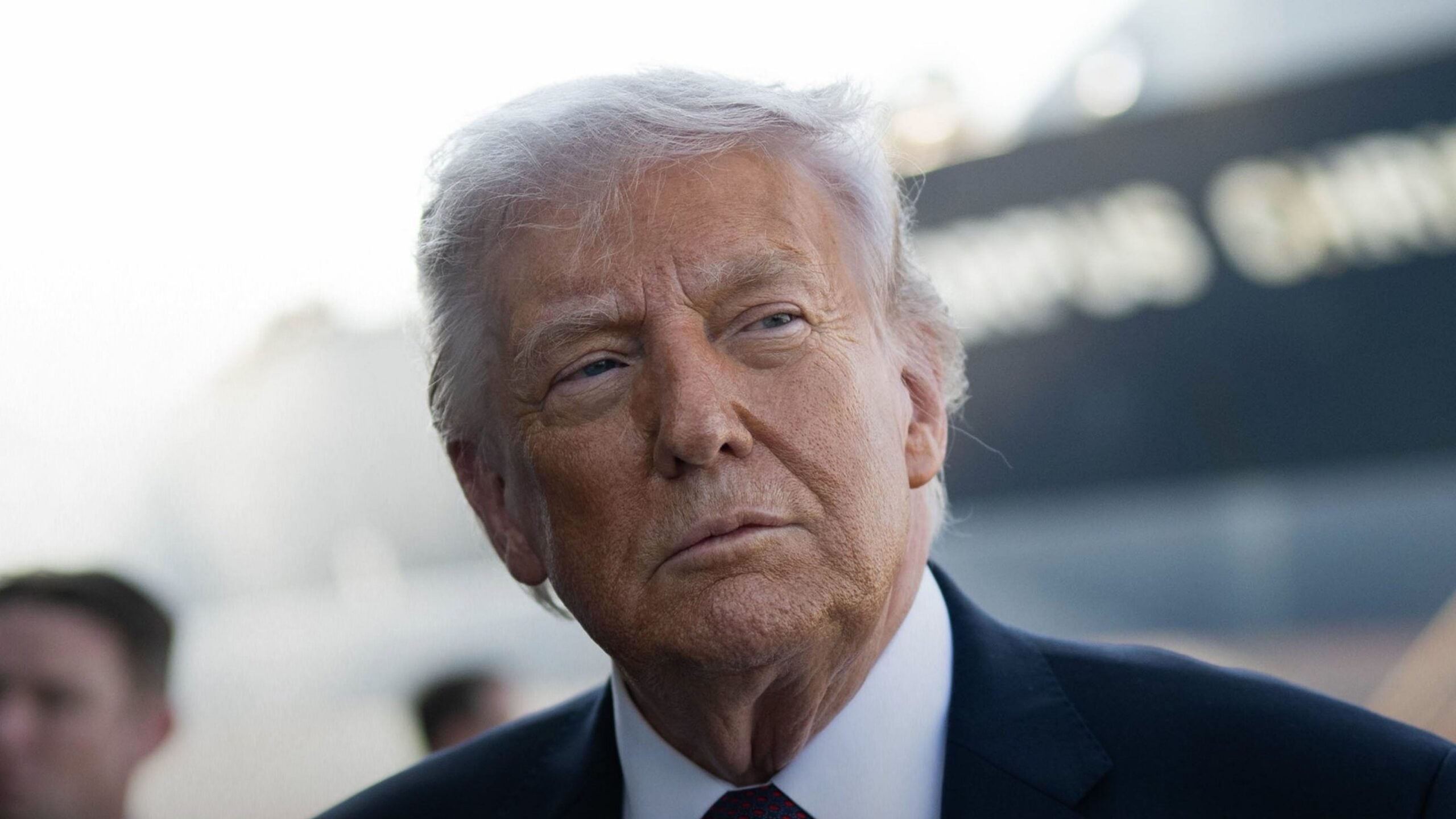
Against the backdrop of escalating U.S.-Iran tensions and a sustained campaign of nightly strikes on Iranian targets, President Donald Trump called on Israel Wednesday to end its ground operation in Lebanon, redeploy its forces, and focus instead on what he described as “the bigger issue—Iran.”
US President Donald Trump | Photo: White House
“It would be good if Israel redeployed its forces in Lebanon to focus on the bigger issue—Iran,” Trump said in an interview with Fox News. Trump said Syria’s president, Ahmed Hussein al-Sharaa—better known as Abu Mohammed al-Julani—could deal with the Hezbollah terror organization. “He’ll deal with Hezbollah differently, without destroying buildings, and he’ll be more precise than the Israelis in confronting the organization. I know he wants to do it,” Trump said. The comments came about a week after Trump removed Syria from the U.S. list of state sponsors of terrorism for the first time since 1979.
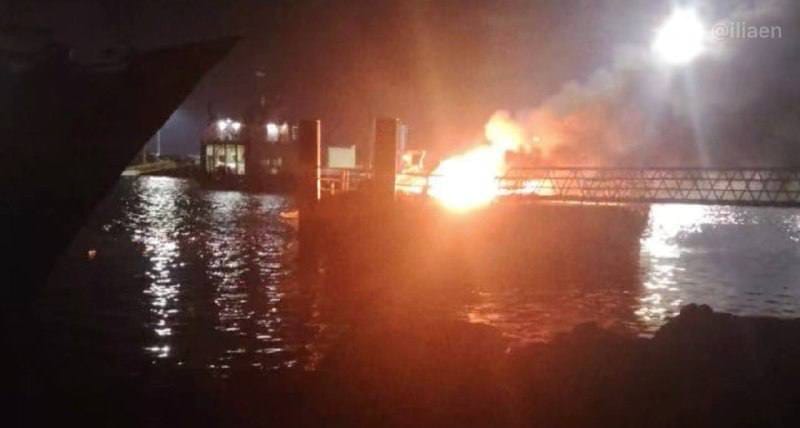
Meanwhile, the United States launched another wave of strikes against Iranian targets earlier today (Wednesday). The operation aimed to degrade military capabilities Iranian forces used to attack commercial vessels in the Strait of Hormuz. This follows Trump’s announcement several days ago renewing the naval blockade on Iranian ports, warning that if Tehran refuses to return to the negotiating table, Washington will expand its campaign to include civilian infrastructure in the country.
Attacks in Iran, Archive | Arab Networks
The latest strikes followed a roughly seven-hour operation overnight, during which American fighter jets and naval vessels hit dozens of military targets near the Strait of Hormuz and along Iran’s coastline, including missile and drone sites, naval assets, and coastal defense systems. According to U.S. Central Command, the moves were designed to reduce Iran’s ability to threaten commercial shipping and civilian crews in the region.
Whether Syria’s new leadership is both willing and capable of confronting Hezbollah remains an open question. For Israel, the answer could have far-reaching consequences.
The wave of incitement against Israel in the international media continues, fueled by Supreme Court rulings and the leaked “abuse video” released by former Military Advocate General Yifat Tomer-Yerushalmi. In a major report published overnight, The Wall Street Journal noted that it had approached Tomer-Yerushalmi following reports of the investigation against her, but her legal team “declined to comment.” Throughout the article, the newspaper repeatedly echoed the narrative that Israel has allegedly subjected ‘Palestinian’ detainees to psychological, sexual, and physical abuse since October 7.
The Journal built its narrative on interviews with members of Physicians for Human Rights, Supreme Court rulings regarding Red Cross access to detainees, and a speech delivered last year by President Isaac Herzog, in which he said that “on the margins of society there are elements that have normalized violence, celebrate it, and even take pride in it.”
As part of the report, The Wall Street Journal interviewed Mohammed Mardawi, 47, who had been imprisoned since 1999. Mardawi repeated allegations of sexual abuse in Israeli detention facilities that closely mirrored claims featured in the “abuse video” leaked by Tomer-Yerushalmi to Channel 12 News. He described how he “hoped he would die” when guards entered his cell, tied him and two other prisoners, and ordered them to kneel. “Then they inserted the stick into me,” he claimed—without presenting any evidence or a shred of proof to substantiate the allegation.
Power 100 | Photo: Jonathan Sindel/Flash90
The allegations against Israel by The Journal also relied on several recent Supreme Court rulings to support its account. For example, the paper cited a Supreme Court decision that last year the state had failed to provide for the basic needs of Palestinian detainees, after human rights organizations petitioned the court, accusing Israel of starvation.
Another ruling quoted in this vein concerned Red Cross visits, in which the Supreme Court determined that the ban on visits violates international and Israeli law. To explain the deterioration in detention conditions, the Journal also cited a 2025 survey by the Israel Democracy Institute, according to which approximately 61% of Jewish Israelis opposed investigating soldiers suspected of abusing detainees from Gaza.
Photo: Olivier Pitoussi, Flash 90
As a reminder, the Sde Teiman affair began in August 2024 with the release of security camera footage from the detention facility, which allegedly showed reserve soldiers abusing a detained terrorist. The publication sparked unprecedented public and international uproar and served as fuel for an international propaganda campaign against Israel.
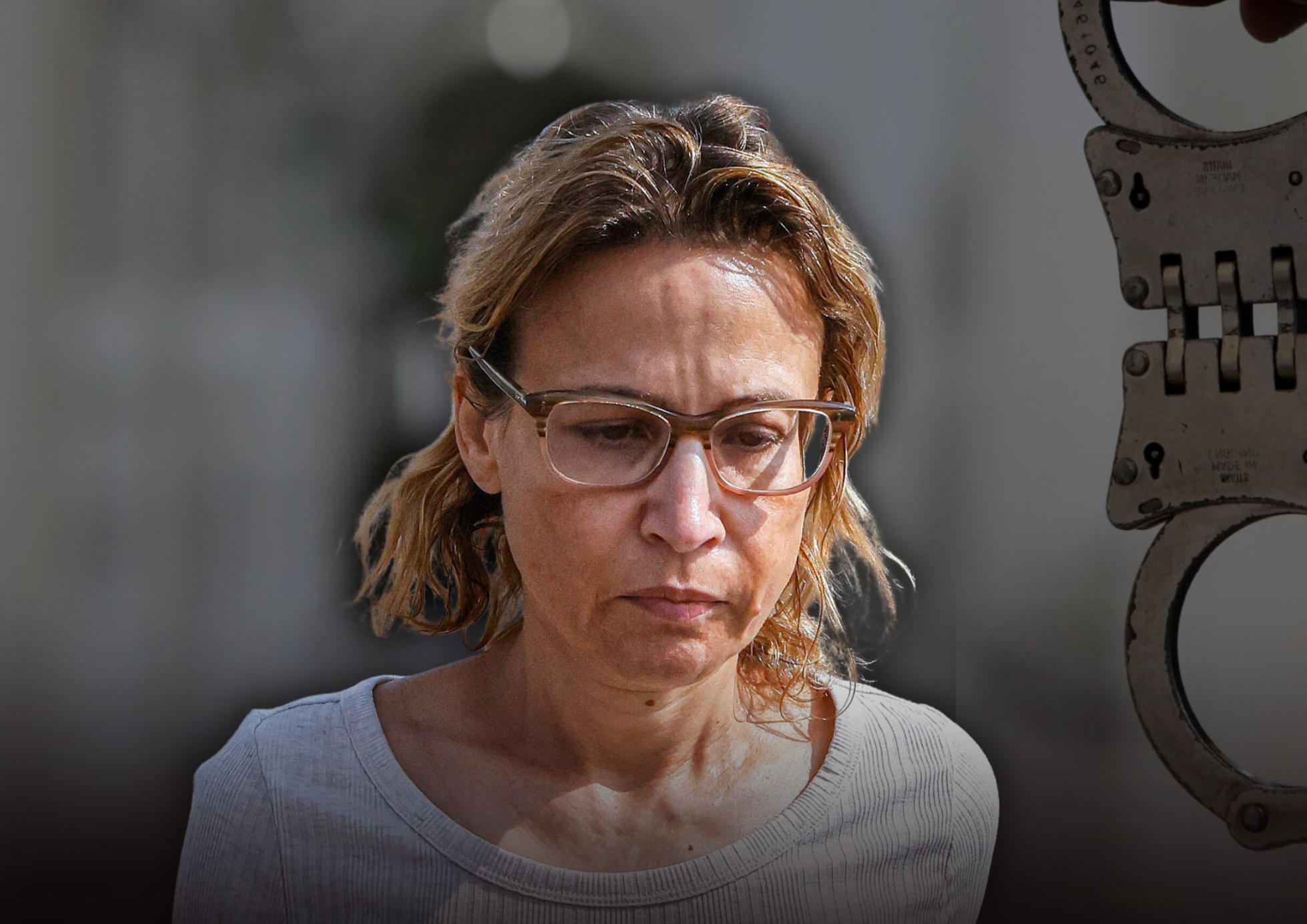
In October 2025, following public pressure and heavy suspicions of distorting the legal process, Israel Police and the State Attorney’s Office opened a criminal investigation into the source of the leak. The investigation led to a dramatic upheaval in the IDF: the then-Chief Military Prosecutor, Major General Yifat Tomer-Yerushalmi, was placed on leave and two days later, on October 31, 2025, resigned from her position while admitting that she personally approved handing over the materials to the media, to “counter false propaganda.”
The affair escalated in early November 2025, when Tomer-Yerushalmi was arrested on suspicion of fraud and breach of trust, abuse of authority, disclosure of confidential information by a public servant, and obstruction of justice. Investigators also suspected her of concealing her mobile phone and submitting a false affidavit to the Supreme Court. Former Chief Military Prosecutor Col. Matan Sulmash was arrested alongside her.
The arrest was accompanied by severe personal drama from the former prosecutor, including prolonged absence, leaving a suicide note, and subsequent medical hospitalization. In May 2026, Chief of Staff Eyal Zamir decided to officially dismiss Tomer-Yerushalmi from military service, while the criminal proceedings and investigation into her and other involved parties in the Military Advocate General’s Corps continue.
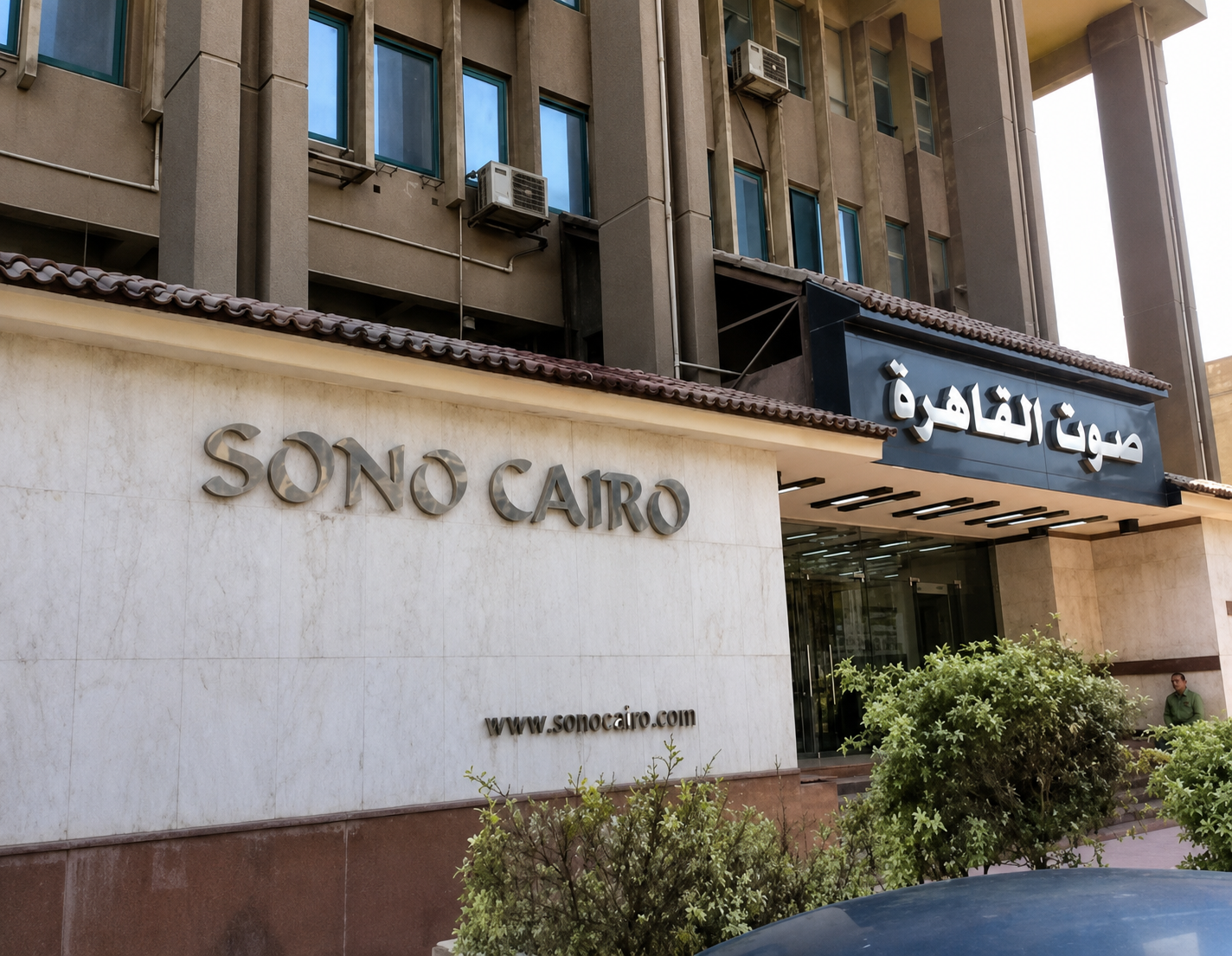
These days, in the heart of Cairo, inside the headquarters of Egypt’s national radio and television authority, the words “Voice of Cairo” still echo daily—in Hebrew. This was never just another radio station, but a strategic weapon and an unconventional instrument of soft power, created by Egypt to reach Israeli society in its own language. Its mission was never entertainment, but psychological warfare: to bypass Israeli military censorship and wage a battle for Israeli hearts and minds.
Voice of Cairo radio station | Photo: Arab Networks, Shofar AI
The staff consists of Egyptian broadcasters, translators, and political analysts—graduates of Hebrew-language departments at Egyptian universities. They possess an exceptional command of Hebrew and a deep understanding of Israeli society, while adhering strictly to Egypt’s national security guidelines and maintaining precise knowledge of what can—and cannot—be said on air.
The Founding
On May 3, 1953, the Egyptian radio station Voice of Cairo began broadcasting Hebrew-language programs aimed specifically at the residents of Israel. It was the third foreign broadcaster to transmit in Hebrew following Israel’s establishment, after the BBC’s Hebrew service (1949) and Syria’s Voice of Damascus (1952).
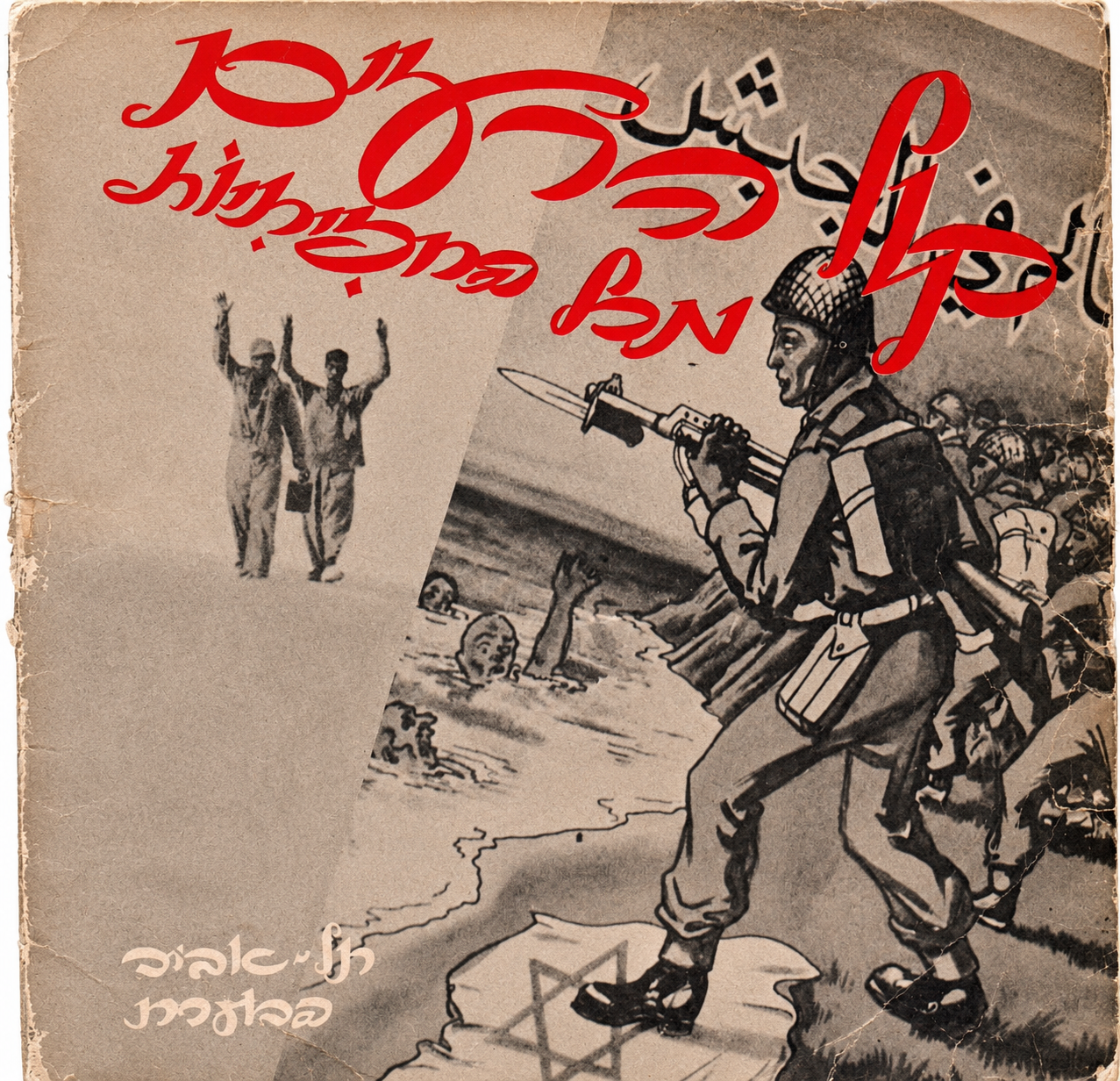
The station was established by the Egyptian government under President Gamal Abdel Nasser as an integral part of Cairo’s pan-Arab propaganda campaign and psychological warfare against Israel. Its broadcasts were characterized by an aggressive tone, military music, and dramatic reports. Its primary objectives were clear:
1. To wage psychological warfare against Israel, its residents and leaders.
2. To lower the morale of the civilian population and the Israeli military.
3. To bypass military censorship.
4. To spread false and misleading information, especially during wartime, to create a sense of Arab victory and distort the situation in Israel.
5. To promote the Egyptian-Arab narrative in the conflict, using sharp slogans, direct threats and repeated accusations against Israel and Zionism.
Changes and Historical Development
In 1958, following the establishment of the United Arab Republic—the union between Egypt and Syria—the station was renamed Voice of Thunder from Cairo. The name remained even after the union dissolved in 1961, as Egypt continued using the title “United Arab Republic” until 1971.
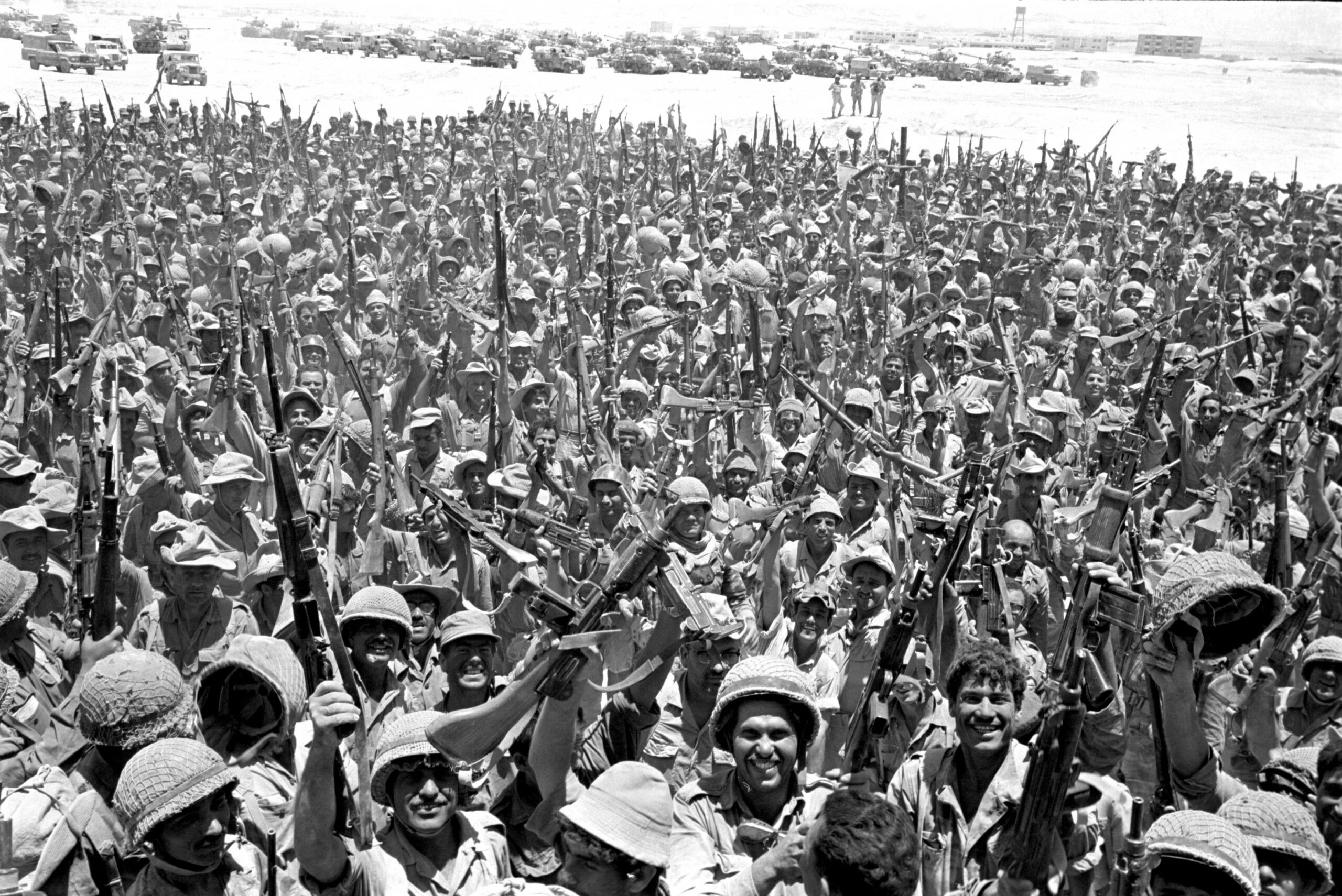
The station reached one of its most active periods during the Six-Day War in June 1967. It broadcast false reports claiming that Arab forces had captured Ashdod, were fighting in Tel Aviv, and were advancing “on all fronts,” while in reality the IDF was securing a decisive victory. Following Egypt’s crushing defeat, the broadcasts became a source of ridicule in Israel because of the stark contrast between the station’s claims and the battlefield reality.
Voice of Cairo radio station | Photo: Arab Networks, Shofar AI
Peak Influence During the Yom Kippur War
During both the War of Attrition and the Yom Kippur War, the station continued broadcasting, including interviews with captured Israeli soldiers.
Its greatest impact came during the Yom Kippur War in October 1973. At a time when Israeli media initially withheld information about battlefield losses, the station’s Hebrew-language broadcasts aired interviews with Israeli prisoners of war, most notably Col. Assaf Yaguri. Those broadcasts prompted thousands of Israeli families to tune in to Voice of Cairo in hopes of learning the fate of their loved ones, contributing to a deep crisis of confidence between the Israeli public and its government.
In the Peace Era
After President Anwar Sadat’s visit to Jerusalem (November 1977), the station’s name changed to “Voice of Peace from Cairo,” and the content became more moderate with calls for peace and normalization. In later years it returned to the name “Voice of Cairo.”
Voice of Cairo, under its various names, remained one of Egypt’s principal tools in its long-running information war against Israel. In 2019, reports indicated that the station’s Hebrew-language broadcasts returned in an experimental format, featuring content that differed significantly from its earlier programming—less overt propaganda and greater emphasis on Israel and the Palestinian issue from an Egyptian perspective.
Israeli soldiers, Six-Day War. Photo: Reuters
Although its direct influence on Israeli public opinion has long been limited, the station reflected Egypt’s strategy of confronting Israel not only on the battlefield, but also in the arenas of information, public consciousness, and psychological warfare. To this day, it remains a defining symbol of classic Arab radio propaganda from the 1950s and 1960s and an important chapter in the history of the Arab-Israeli conflict.
Today, with virtually no audience in Israel—had this article not been written, few Israelis would likely even know it still exists—the station continues broadcasting in Hebrew. Its programming praises Egypt’s role in the Palestinian issue, attacks Israel and its leaders, and continues to wage psychological warfare against the Israeli public.
One message can be sent back to Cairo: “You’re wasting your time.”
The Hebrew University of Jerusalem will not take action against one of its faculty members, Prof. Norman Matanes, after he published an inflammatory post describing Israel as “the land of occupation” and claiming that “crime is work.” In response to a C14 inquiry, the university said: “The statements do not reflect the university’s position, but only the writer’s opinion, and were published outside the framework of his work at the university.”
The Hebrew University of Jerusalem, archive | Photo: Flash90
The post opens with a story about a man who appears to be an ordinary citizen—smiling, beloved by those around him, and helpful to others. But it soon becomes clear that this “man” is actually, according to the writer, a senior security service official. “On regular days, a man lives among people as one of them… but very few know… that hidden within the man is a leader in a senior security service in some country,” he wrote.
The professor then attributes a series of grave actions to this security official. According to him, in the past the official used to detain ambulances merely on suspicion, but now, he claims, he doesn’t check them at all but orders their destruction. “Now he sees emergency ambulances only as targets. He gives direct orders: ‘No need to check, destroy them.’ The killing has become part of the plan, not an incidental phenomenon,” he wrote.
The Hebrew University of Jerusalem, archive | Photo: Flash90
This is an extraordinary accusation—that security personnel are allegedly operating under a deliberate policy of harming medical teams and the wounded, not describing an isolated incident or criticism of a specific operational decision.
Later in the post, the writer claims that this man participates in protests against the government, mocks the prime minister and calls him a “criminal against democracy,” but at the same time “on his hands is the blood of civilians—not to mention children.” In doing so, he attributes to this figure responsibility for the deaths of civilians, while portraying him as someone who doesn’t see himself as complicit in “the great crime.”
The Hebrew University of Jerusalem, archive | Photo: Flash90
Toward the end, the professor clarifies that this isn’t about just one figure. “Although at first glance it seems the story is about one man, the truth is it’s about thousands of men,” he wrote. With this, he expands the accusations from the fictional character to thousands of security personnel.
He closes the post with an unambiguous sentence: “So what’s the surprise? In the land of occupation, crime is work… and the smiles are a mask.” In this sentence he describes Israel as “the land of occupation” and presents crime, according to him, as an inseparable part of reality in the state.
Following the publication, C14 contacted the Hebrew University and asked whether it intends to take any action against the professor in light of the content he published. As noted, the university merely responded that these are the faculty member’s personal views, and did not indicate that any proceedings would be opened against him.