


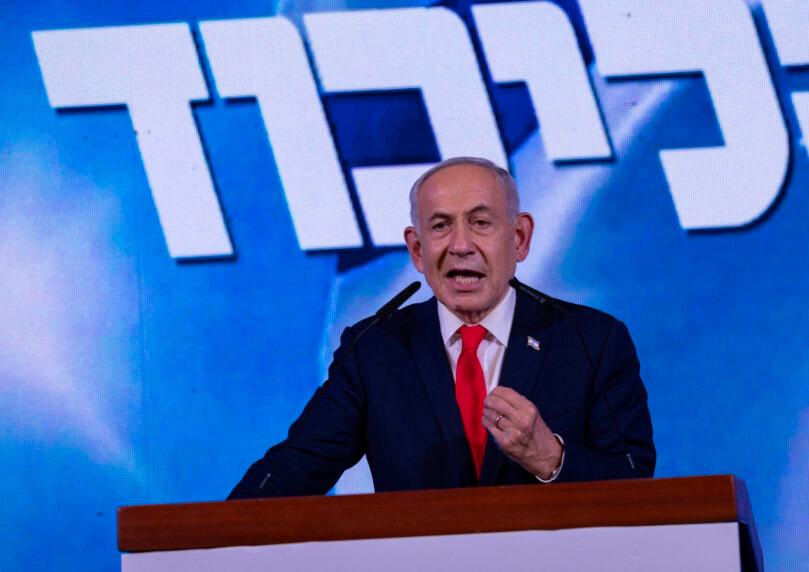

Prime Minister Benjamin Netanyahu spoke today (Monday) at a meeting of the Likud faction, calling for the formation of a broad national unity government. He also launched a sharp attack on his political rivals and on the prospect of a government that would rely on the support of Arab parties. Addressing the debate surrounding the severity of the Iranian threat, Netanyahu argued that those who downplay security risks are doing so for political reasons. Furthermore, he stated that the ultra-Orthodox (Haredi) factions must be part of a unity government, urged flexibility regarding military conscription, and warned against a scenario—as he put it—where Ahmad Tibi, Mansour Abbas, and their associates could influence Israel’s critical security decisions.
At the beginning of his speech, Netanyahu referred to the public’s desire for a unity government, citing the security challenges facing Israel as the primary reason for the need to join political forces. “An overwhelming majority of the country’s citizens—those who view Israel as the nation-state of the Jewish people—yearn for a unity government. This yearning stems from a simple realization: our ability to secure our future in the face of the major threats surrounding us depends on our unity,” he said.
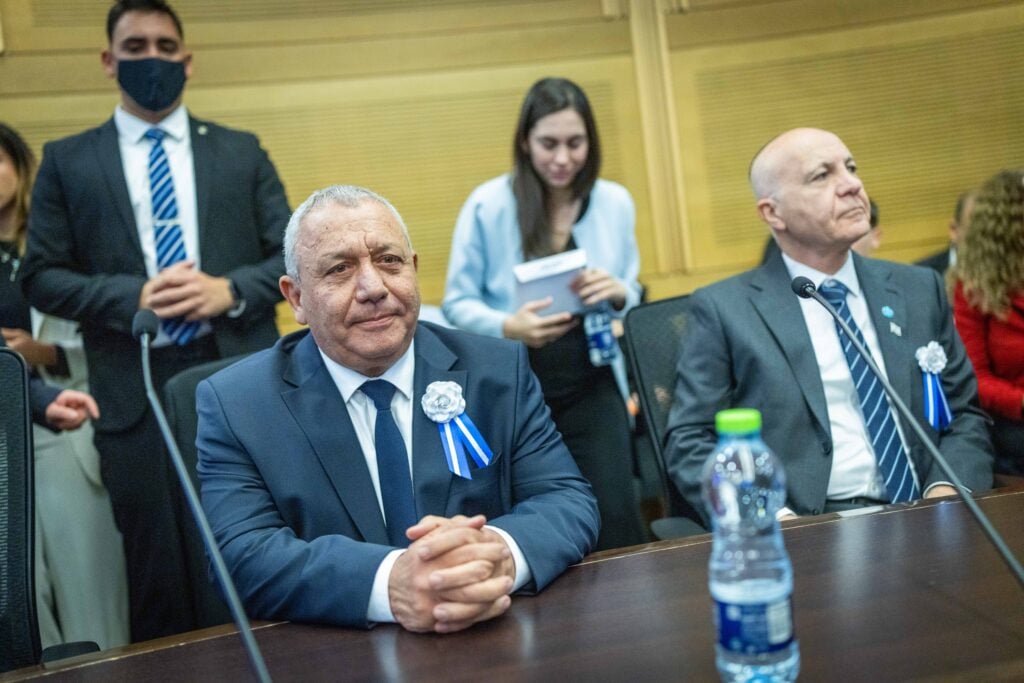
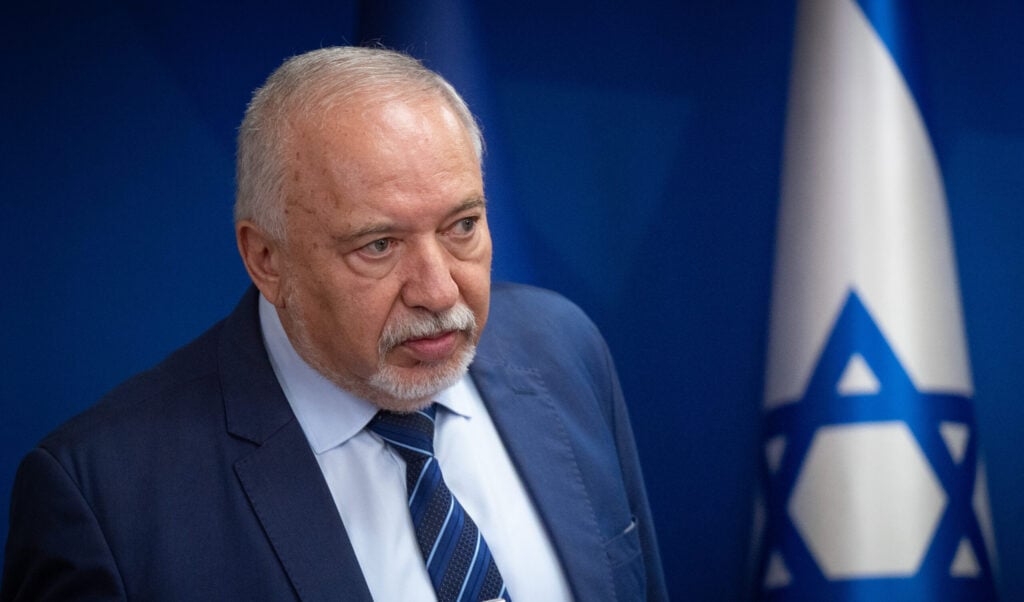
The Prime Minister went on to criticize those who, in his view, minimize the gravity of these dangers: “Those who downplay or dismiss these threats are doing so for political reasons.” These remarks were made against the backdrop of statements by Gadi Eisenkot and Avigdor Liberman, who had earlier expressed the view that there is currently no justification for an independent and immediate Israeli operation against Iran.
Eisenkot stated that while the Iranian threat is the most severe one facing Israel, he does not perceive a direct and immediate danger that necessitates action prior to the formation of the next government. Liberman, for his part, warned against an independent strike conducted without American participation, arguing that such a decision—under the circumstances he described—would be driven by political and personal considerations.
Netanyahu dedicated a significant portion of his speech to efforts aimed at forming a broad-based government. He clarified that, in his view, reaching agreements requires flexibility from all potential partners—including regarding the issue of military conscription for yeshiva students. “This aspiration also stems from a desire to reach agreements that will put an end to the internal divisions among us,” he said. The Prime Minister noted that he had identified the formation of a broad national government as a key objective as early as the election campaign, and reiterated this position following the announcement of the results. “That is why, even during the election campaign, I stated that our mission is to form a broad national government—a point I reiterated immediately after the election results were published,” he remarked.
Subsequently, he addressed a direct message to the ultra-Orthodox (Haredi) factions and other potential partners in the coalition negotiations. “To form a national unity government, each side must show the flexibility required to reach agreements—including on the issue of military conscription, where we must reach a consensus together with our ultra-Orthodox brothers; they must be part of the unity government,” he emphasized.
Netanyahu clarified that flexibility does not mean fully accepting the demands of any single side: “When I say ‘flexibility,’ I do not mean adopting our side’s positions in their entirety, nor adopting the other side’s positions in their entirety.” He added, “Where there is a will, there is a way; when there is a genuine will, there is a path to reaching agreements. And we—I—possess that genuine will.”
Alongside his call for unity, Netanyahu drew a clear “red line” regarding the composition of a future government, ruling out any coalition dependent on elements he defines as “supporters of terrorism.” “Why can we not reach an agreement? We cannot agree to a government in which supporters of terrorism are partners and hold influence,” he declared. He further stated, “A government that relies on supporters of terrorism cannot fight against terrorism.”
The Prime Minister took a sharper tone when referring to those who, he claims, have expressed support for Hamas terrorists: “A government whose members dedicate the election results to the ‘Nukhba’ (Hamas terrorist forces) cannot possibly fight against the Nukhba.” Netanyahu continued: “A government that wishes to fight for the future of the Jewish state cannot be dependent on those who seek to destroy the Jewish state. This is not a matter of religion, race, or gender; it is a matter of ideological outlook.”
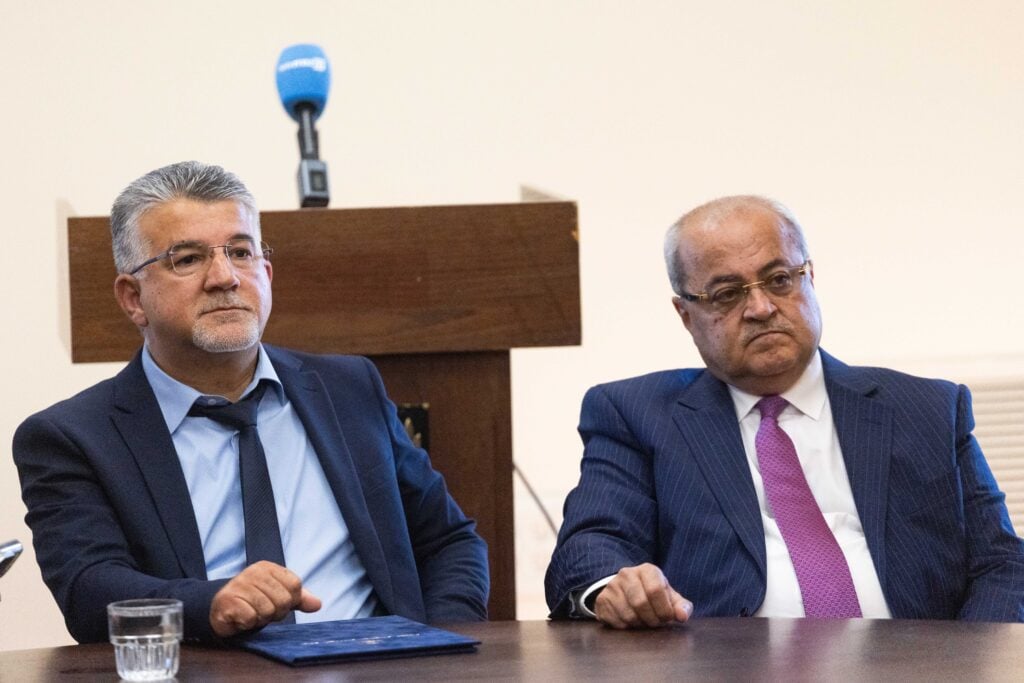
He went on to name Members of Knesset Ahmad Tibi and Ofer Cassif. “A Zionist government cannot be controlled by Ahmad Tibi, nor by Ofer Cassif, nor by their associates,” he stated. Netanyahu rejected claims that his remarks opposing the inclusion of Arab parties in a coalition constitute incitement. “The attempt I see to characterize this clear, understandable statement as incitement is not only a distortion of the facts, but also an attempt to obscure a simple truth that an overwhelming majority of the public understands,” he argued.
In another part of his speech, Netanyahu criticized the conduct within the Knesset toward bereaved families and combat soldiers, accusing those managing the proceedings of treating them with humiliation. “The distressing scenes we are witnessing in the Knesset serve to illustrate exactly what it would mean to have a government controlled by Ahmad Tibi, Mansour Abbas, and their associates,” he said. The Prime Minister added: “I am certain that you, like me, were shocked to see the demeaning treatment of bereaved families in the Knesset.” “They treated them in such a deeply humiliating manner—people who have sacrificed everything.”
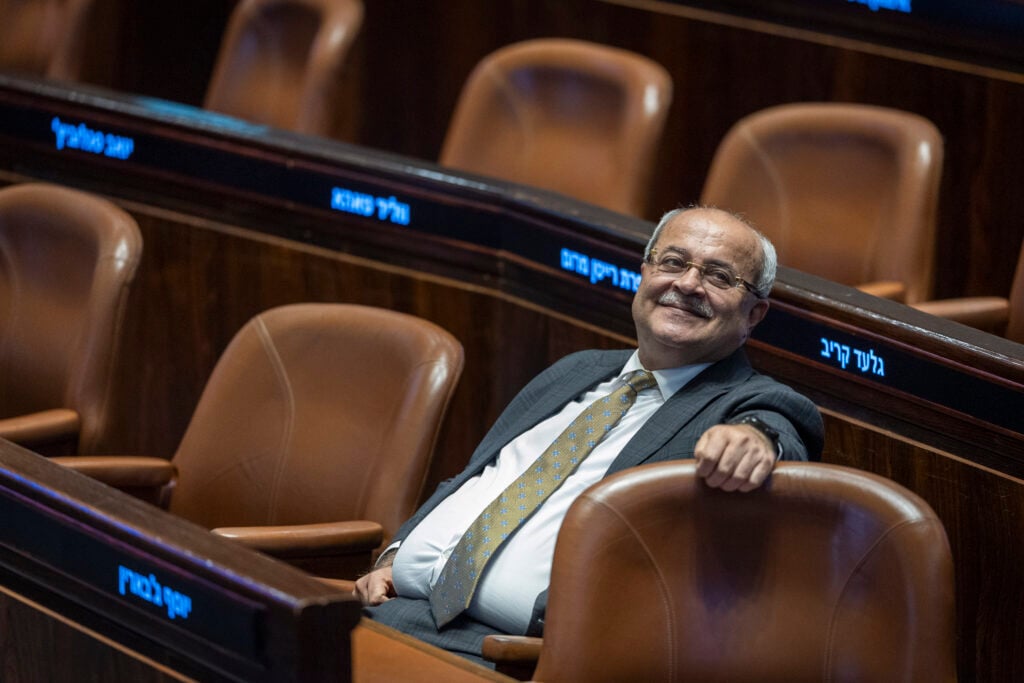
According to him, this conduct is unprecedented: “Such ugly behavior, on such a scale, with such cruelty—we have never seen anything like this here in the Israeli Knesset.” Netanyahu compared the current situation to how the Knesset operated during his previous term, asserting that, back then, bereaved families and the families of hostages were given far greater opportunity to make their voices heard.
“I remind you that during the previous term, we acted differently; we saw it as a duty to allow bereaved families and the families of hostages to speak at length at the opening of Knesset committee meetings. Today, they are barely even allowed to enter—they are simply being silenced,” he said. He further addressed the removal of combat soldiers from Knesset proceedings: “And today, combatants who fought for our home are being thrown out by Ahmad Tibi, who boasts that *he* is the one in charge.”
Netanyahu went on to criticize the distribution of roles within the Knesset and the appointment of committee chairpersons, presenting these moves as an example of the political influence wielded by the Arab parties. “They have already appointed Yousef Jabareen and Mansour Abbas as committee chairs—it’s essentially letting the cat guard the cream,” he said. He further argued that the formation of a national unity government would bring about a change in this conduct: “A national unity government will put an end to this cruel ruthlessness and this irresponsibility.”
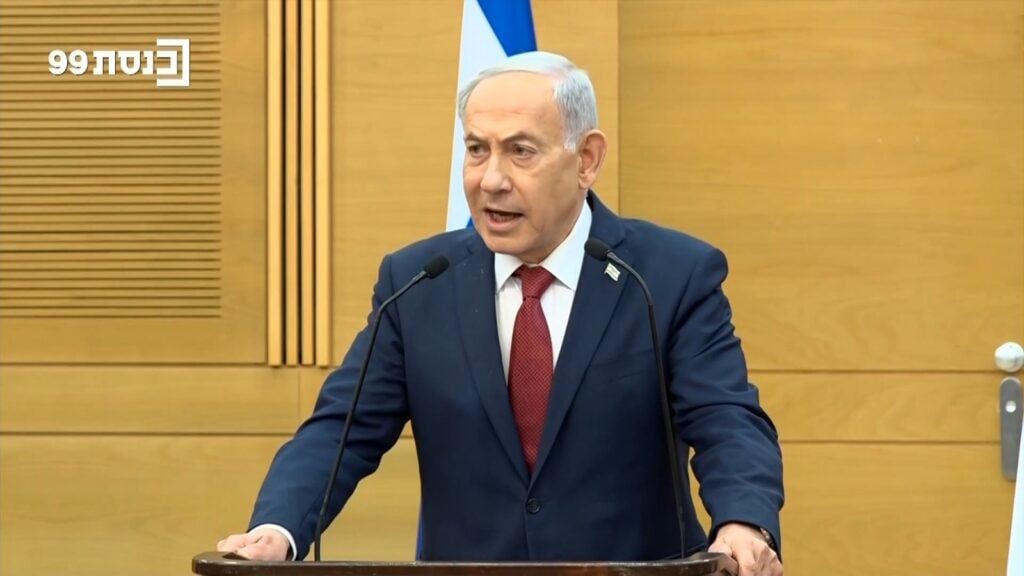
The Prime Minister drew a link between the composition of the future government and Israel’s capacity to make security-related decisions. He warned against a scenario in which critical choices—concerning the most sensitive issues—would depend on elements he opposes including in the coalition. “Instead of a government that fights for our very existence, *they* will decide the fate of the government itself. They will decide whether or not we fight Hamas, whether we remain in or withdraw from the security zone, and whether or not we strike Iran. This is on the horizon, and we must not allow it to happen,” he warned.
Toward the end of his speech, Netanyahu addressed the members of the Likud faction, congratulating both the newly elected and the veteran members, and highlighting the party’s electoral strength. “My friends, immense tasks lie ahead of us. I am pleased to see here Likud’s excellent and unique team—the largest party in Israel. We received over a quarter of a million more votes than the next party,” he stated. Netanyahu concluded his remarks with a message of internal unity, calling on his faction members to work toward the future of the nation. “I congratulate each and every one of you—newcomers and veterans alike. There is no better team to contribute to the unity of Israel—and to the future of Israel.”