




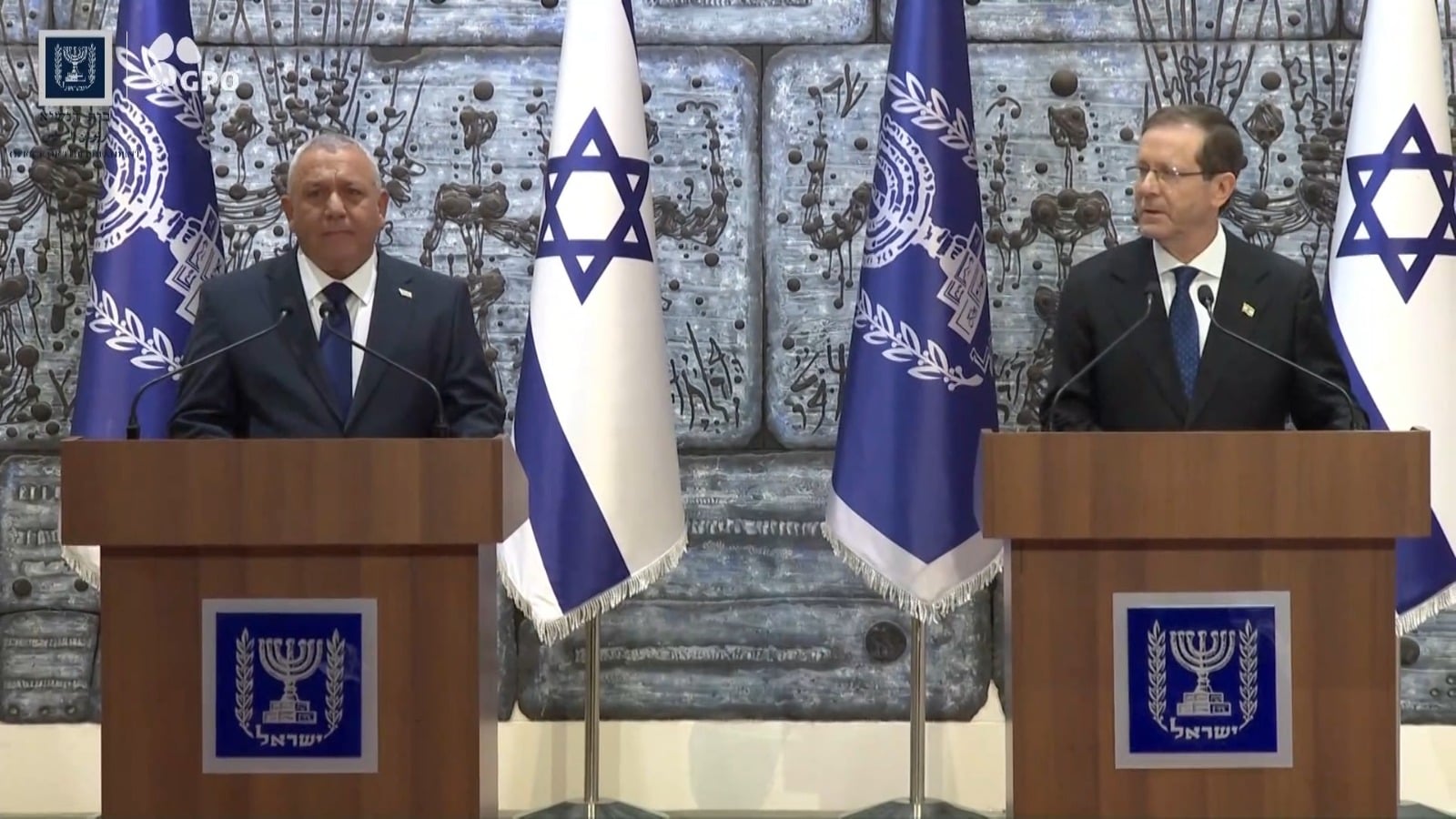
The ceremony transferring the mandate to form Israel’s next government began Sunday at the President’s Residence in Jerusalem. President Isaac Herzog formally handed the mandate letter to Gadi Eisenkot, leader of the Yashar party. With the mandate, Eisenkot’s clock starts ticking: he has 28 days to try to assemble a coalition and swear in a government.
If necessary, the president can grant an additional extension of up to 14 days only. If Eisenkot fails, the president can assign the task to another candidate (for 28 days without extension), or transfer the decision to the Knesset (within a 21-day period). If no one succeeds in securing 61 signatures, Israel will head to new elections.
The Recommendation Map: Eisenkot’s Advantage on Paper
The ceremonial event comes after two tense days of consultations that ended over the weekend, during which representatives of the 12 factions elected to the 26th Knesset made their way to the President’s Residence.
The Likud faction closed out the round by recommending Prime Minister Benjamin Netanyahu, but the final recommendation picture gave Eisenkot a clear numerical advantage: 67 Knesset members from 6 factions recommended Gadi Eisenkot: Yesh!, Yisrael Beiteinu, The Democrats, Ra’am, the Joint List, and Yachad.
46 Knesset members from 5 factions recommended Benjamin Netanyahu: Likud, Shas, Religious Zionism, Otzma Yehudit, and the Zehut party led by Moshe Feiglin. Abstaining: United Torah Judaism was the only faction that did not recommend any candidate, with its representatives choosing to focus their meeting on arranging the status of yeshiva students and the draft law crisis.
A Stormy Round
The meetings at the President’s Residence were accompanied by deep ideological confrontations and explosive issues raised by right-wing Knesset members. No cooperation with terror supporters: Religious Zionism representative Minister Orit Strock expressed fierce opposition to including Arab parties in the coalition, and made clear they should not be included even in routine parliamentary processes.
The Hamas test and election integrity: Otzma Yehudit representative Minister Yitzhak Wasserlauf demanded that President Herzog set a threshold condition and require every faction that comes to recommend to declare explicitly that Hamas is a terrorist organization. Wasserlauf and Moshe Feiglin (Zehut) raised before the president the serious suspicions regarding damage to election integrity and attempts to skew results at polling stations.
Contradictory recommendations: Yisrael Beiteinu representatives did recommend Eisenkot, but immediately clarified they would not sit in a government alongside the Joint List. On the other hand, the Joint List openly admitted their recommendation of Eisenkot does not stem from ideological agreements—but from one goal only: preventing Netanyahu’s return to power.
President Herzog himself summed up the round in a sober tone and warned: “The results of the consultations are seemingly clear, but the ability to form a government is not at all clear given the mutual disqualifications between the blocs and within the blocs themselves. I asked tough questions to try to get the sides to break free from their mental fixation.”
The Scenarios on the Table
Despite the smiles and official ceremony taking place now, our political correspondent Moti Kastel points to a series of landmines that almost prevent Eisenkot from assembling a stable left-wing government, and analyzes the real possibilities:
1. The Arabs’ 19 Trap and Liberman’s “Hypocrisy Show”
Although Eisenkot holds 67 recommenders, 19 of them belong to Arab parties—a figure causing shock behind the scenes and raising deep concern on the right and among senior political establishment figures. On the other hand, Avigdor Liberman declared he will not lend a hand to a minority government leaning on their votes.
To try to solve the conundrum, Liberman is attempting to entice the ultra-Orthodox parties with the 2018 draft law proposal. However, this is an unfeasible move: Shas has already officially announced it will not join, and in Channel 14’s studio the attempt by Liberman to sit under the same roof with ultra-Orthodox alongside Yair Golan, Gilad Kariv and Naama Lazimi was defined as “a boiling stew that won’t hold up.”
2. The Secret Channel: Netanyahu–Eisenkot via Gabi Ashkenazi
Under the radar and far from the combative statements in the studios, it turns out quiet contacts are taking place between Netanyahu and Eisenkot. The main mediator between the two is Foreign Minister and former IDF Chief of Staff Gabi Ashkenazi, with President Herzog also involved in the efforts.
The political establishment recalls the precedent of Benny Gantz in the Corona government (2020), who entered Netanyahu’s government at the last moment despite a fierce campaign against him. Now, as he realizes a government with the Arabs or with the ultra-Orthodox is a dead end, Eisenkot may find himself pushed into Netanyahu’s arms while trying to extract a high political price.
3. Bottom Line: Unity Government or Repeat Elections
According to Moti Kastel’s analysis, after clearing away the background noise and spin of recent days, only two realistic options remain on the field:
A construction of a unity government (or temporary emergency government): A combination of forces that will prevent reliance on hostile elements and allow stability during wartime.
Repeat elections—currently the most realistic option: If the left continues to entrench itself in its contradictory campaign promises, boycotts Netanyahu and rules out any cooperation, and on the other hand fails to establish an alternative government—the State of Israel will find itself heading to the polls again.