




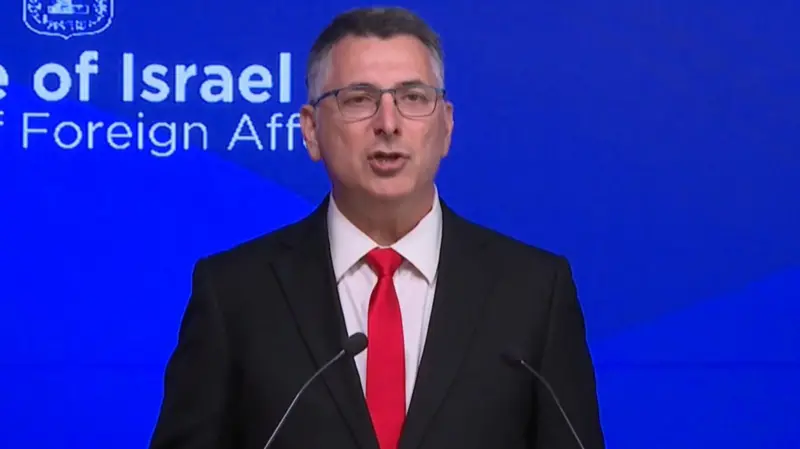
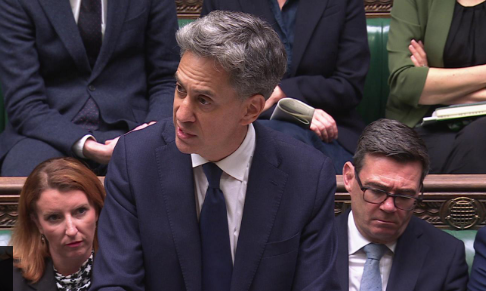
Israeli Foreign Minister Gideon Sa’ar issued a scathing response to the British government on Tuesday following its announcement of sanctions targeting what it calls illegal Israeli communities in Judea and Samaria, accusing London of interfering in Israel’s upcoming election and announcing a series of Israeli countermeasures. Sa’ar said the measures follow a “series of anti-Israel decisions” by Britain’s Labour government, accusing Foreign Secretary Ed Miliband of spreading “outrageous lies.”

 2+
2+Sa’ar described the Labour government as “hostile” toward Israel and accused it of “systematically working against the State of Israel.”
He then announced four Israeli measures in response to the British sanctions:
1: Closure of the British Consulate General in Jerusalem.
2: Removal of British representatives from the International Gaza Support Center in southern Israel.
3: Termination of British activities in Ramallah to train ‘Palestinian Authority’ forces in Judea and Samaria.
4: Denial of entry to Israel for British elected representatives and other British nationals who promote Jew-hatred or anti-Israel activity, as well as those who “deny the very existence of the State of Israel.”
According to the British government, “the British Consulate General in Jerusalem represents the UK government in Jerusalem, Judea and Samaria and Gaza” and works on “political, commercial, security and economic interests between the UK and ‘Palestine’.”
 2+
2+Sa’ar also took aim at the timing of London’s announcement, noting that the British government chose to announce the measures on the eve of the holiest days of the Jewish calendar and ahead of the Labour Party conference. He accused the government of “blatant interference in the affairs of a sovereign state and its electoral process,” saying its actions carry “echoes” of “antisemitic wars.”
Sa’ar argued that Labour’s move is “particularly absurd” given Britain’s own historic role in recognizing the Jewish people’s right to a national home. It was the British government’s Balfour Declaration of 1917, he noted, that formally recognized “the historic right of the Jewish people to re-establish their national home in the land of Israel.”
Sa’ar went on to call the British boycott of Israeli goods “despicable” before addressing plans for E1, east of Jerusalem, which Miliband announced he would seek to stop. The foreign minister said “no new decisions” had been made regarding those developments, contrary to the British government’s announcement.
 2+
2+Sa’ar then directly linked Labour’s actions to Israel’s election campaign, accusing the British government of making a “blatant and completely unacceptable attempt” to exert influence during an Israeli election. He said the Israeli public overwhelmingly opposes the establishment of a “‘Palestinian’ state” “in the heart of our land”—something he accused the Labour government of attempting to “force upon Israel.”
Sa’ar made clear that Israel’s response would not necessarily end with Britain, saying Israel would also take “counter-measures” at its discretion against other countries “that act or will act against Israel.” “The message to every government that harms us is clear: whoever acts against Israel, Israel will act against them and they will lose their influence and relevance in this region,” Sa’ar said.