



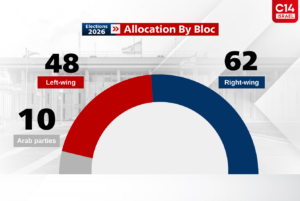
A new C14 poll released Monday evening shows a remarkably stable political landscape, with the right-wing bloc maintaining its solid majority of 62 mandates. Prime Minister Benjamin Netanyahu’s Likud continues to dominate as Israel’s largest party with 33 seats—two more than the last poll—while the left-wing bloc holds 48 mandates and Arab parties secure 10.

 1+
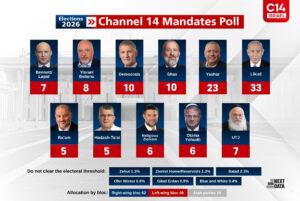
1+In the full mandate breakdown, Gadi Eisenkot’s Yesh party comes in second with 23 seats. Shas and the Democrats each receive 10 mandates. Yisrael Beiteinu gets 8 seats, while Yachad and United Torah Judaism each win 7. Otzma Yehudit and Religious Zionism each receive 6 mandates. Among Arab parties, Hadash-Ta’al and Ra’am each get 5 seats. Falling below the electoral threshold are Balad (2.3%), Zehut (1.3%), Bayit Tziyoni Miluimnikim (1.2%), Gilad Erdan (0.9%), Ofer Winter (0.6%), and Blue and White (0.4%).
 1+
1+On the question of suitability for prime minister, Netanyahu scores a crushing victory with a massive lead at 54% support. His main rival, Eisenkot, receives just 34%, while Naftali Bennett gets 6%, Avigdor Lieberman 5%, and Benny Gantz earns a single percentage point.
In a direct matchup between Netanyahu and Eisenkot, Netanyahu leads with 55% versus 45% for Eisenkot. Among voters of smaller parties and undecided voters, the gap widens significantly—Netanyahu receives 59% support compared to just 29% for Eisenkot, with 12% saying they haven’t yet decided.
The poll was conducted by NEXT DATA with 741 adult participants from the general population on the evening of August 9, 2026. Data analysis by Shlomo Filber.