


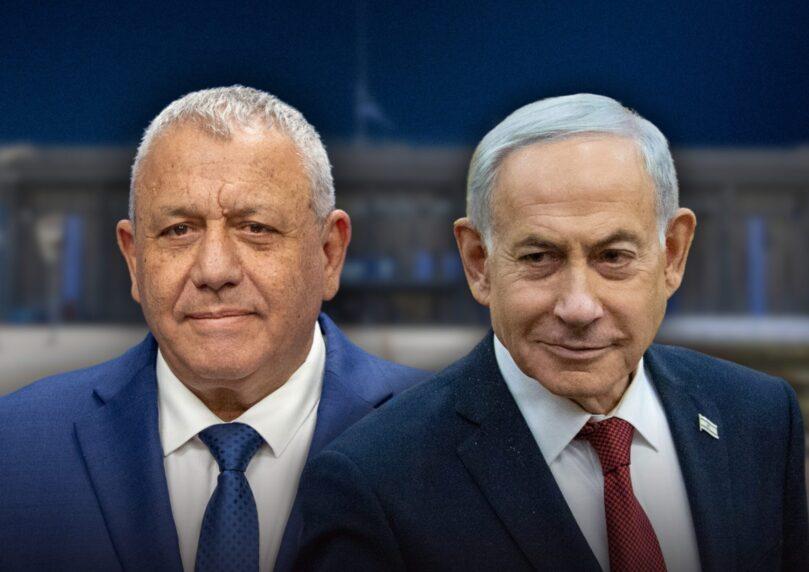

In a game-changing move just before the expiration of the mandate to form a government, Prime Minister Benjamin Netanyahu announced that he is willing to set aside the principle of the largest party and agree that Gadi Eisenkot will serve first in rotation to prevent the formation of a minority government. In response, the chairman of “Yashar” invited Netanyahu and his team to meet tonight to continue negotiations – but emphasized that the basic outlines of his government have already been formulated and that he will examine “the degree of seriousness of the Likud” in the coming days.
The chairman of the “Yashar” party, Gadi Eisenkot, responded this evening (Saturday night) to Prime Minister Benjamin Netanyahu’s dramatic compromise proposal – who had earlier agreed to give up the principle of the largest party and allow Eisenkot to serve first in the rotation – and invited Netanyahu and his team to conduct accelerated negotiations tonight at the Dan Acadia Hotel in Herzliya.
“If the Likud is ready for true unity, I am ready to examine its seriousness in the coming 24 hours and invite Netanyahu and his team, tonight, to the Dan Acadia Hotel in Herzliya, where I am with my negotiating team, to conduct real and accelerated negotiations on basic lines and policy issues – based on the detailed proposal, to which Netanyahu has not yet responded,” Eisenkot said in a statement he published. “I am committed to the citizens of Israel, including those who did not vote for me and my partners – to continue to act in order to establish a good government for all citizens of Israel in the coming days.”
In his statement, the chairman of “Yashar” claimed that secret channel contacts with the prime minister had already taken place, and accused the Likud of dragging its feet: “The unity that Israel needs, for which I am right and for which I am willing to pay political prices – is unity among the citizens of Israel based on values; unity of a new and different way, which will cherish and exalt the Israeli solidarity that I see as a fundamental component of Israel’s national security. Therefore, last Sunday, a detailed proposal was submitted to Netanyahu through a secret channel, established at his request, which included reference to substantive issues. In some of them, as I shared with you before the Sabbath, significant compromise positions were submitted on our part. All of this, before we signed another coalition agreement. Up until this moment, no answer has been returned to us on these issues.
Along with inviting the Likud to tonight’s talks, Eisenkot set a condition and made it clear that he does not intend to withdraw from the agreements he has already formed in the left bloc: “For about three weeks, my team and I have been proposing and trying to conduct real, honest and accelerated negotiations, but have been met with refusal and evasion. In the time that has passed, the basic outlines of the government that I intend to bring to the oath in the coming days have been formulated, and they will form the basis for any future government headed by me.”
The dramatic sequence: from Netanyahu’s concession to the invitation to direct negotiations
Eisenkot’s response comes at the very last moment of his mandate to form a government, and seals a series of dramatic developments at the end of the Sabbath. Earlier this evening, Prime Minister Benjamin Netanyahu issued a special appeal to the citizens of Israel, in which he warned against forming a minority government dependent on the Knesset and the Joint List. In light of the security and national danger that he pointed to, Netanyahu announced that although Likud is the largest party by a quarter of a million votes, he is willing to give up primacy and agree that Eisenkot will serve first as prime minister and that he will serve as an alternate prime minister at the beginning of the term – while asking to continue in his position for several more months until the situation with Iran becomes clearer and President Trump makes a decision.
Netanyahu’s proposal immediately caused a stir in the political system
: the right-wing bloc rushed to stand behind the move, with Religious Zionist Chairman Bezalel Smotrich even offering to serve as a personal guarantor for any agreement reached with Eisenkot and his partners. On the other hand, senior members of the left-wing bloc rejected the proposal out of hand – Yair Lapid called it a “transparent sting exercise”, and Yair Golan called for continuing to form a government without him.
Meanwhile, the chairman of the “Unity” party, Naftali Bennett, welcomed Netanyahu’s willingness to rotate with Eisenkot first, but was quick to set a list of demands for him to join the government – including the establishment of a state investigation committee, limiting the prime minister’s term to eight years, halting legal reform, and excluding the haredi parties. Now, with Eisenkot’s invitation to hold talks tonight at the Dan Acadia Hotel, it remains to be seen whether the Likud teams will respond to the call and whether it will be possible to bridge the gaps within a day.