


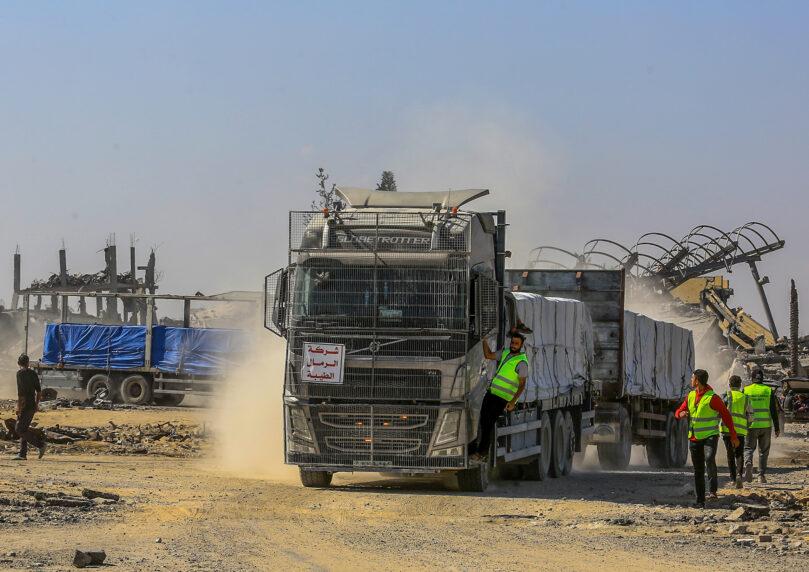

Despite promises from the prime minister and defense minister to residents of Israel’s Gaza border communities, aid trucks began arriving at the Erez crossing this morning for security inspections before continuing to Kerem Shalom, under heavy political pressure from the U.S., Germany, and the UN Security Council. Residents are protesting and warning against rehabilitating Gaza without disarming Hamas, while Britain and Australia impose new sanctions—and Hamas continues to recover and consolidate its control on the ground.


 1+
While Israel is still trying to form a government, international pressure over Gaza is mounting. The pressure intensified following images of last week’s flooding in the Strip. Despite assurances from the prime minister and defense minister to border residents, aid trucks for Gaza arrived at the Erez crossing this morning for security inspection. “They’ll drive after inspection to Kerem Shalom and enter directly there. Meaning, what happens between here and Kerem Shalom along the way—no one’s talking about that anymore,” a border resident told Channel 14. Germany donated the scanning machines installed at the crossing back in August. But plans to operate it met fierce opposition from area residents, who had received promises from the prime minister and defense minister. Initially, dozens of trucks will arrive daily at the Erez crossing. Residents fear this is just the beginning, and what’s presented today as a limited step will later become a broader opening of the crossing.
Ra’ut Ben Haim, founder of the Tzav 9 movement, said: “We’ll see more and more trucks entering; we’ll basically see this thing opening without any control. It’s a slippery slope leading us to rehabilitating the Gaza Strip, when Hamas hasn’t been dismantled or disarmed.” At least until further notice, aid will not enter Gaza directly through the Erez crossing. Here’s how the aid flow works: Trucks arrive at the Erez crossing, undergo security scanning, and then continue with a security escort to the Kerem Shalom crossing. Only after another security check at Kerem Shalom does the aid enter the Strip.
 1+
Yifat Ben Shoshan, a resident of Netiv HaAsara, emphasized: “I want no trucks passing through here tomorrow morning that are supposed to go through Kerem Shalom, and not passing through here at all, until Hamas is disarmed. There will be no rehabilitation without disarming the Strip.”
So why is this happening now?
On Sunday, parallel to the political-security cabinet meeting, a separate discussion took place about the Erez crossing. The decision to operate it for inspection purposes was made at that meeting. The main consideration was heavy political pressure on Israel, primarily from Germany, the United States, and the UN Security Council. Jerusalem understands that the Americans, especially at the Security Council, want to see results on the ground. The call to advance implementation of the plan also comes from a surprising direction—Ron Dermer, who for years was one of the people closest to the prime minister.
But the pressure on Israel isn’t limited to the Erez crossing. In recent days there’s been an escalation in steps other countries are taking against Israel. Yesterday Britain announced sanctions against the Tzav 9 movement, which worked to block aid trucks to Gaza, and against eight construction and real estate companies operating in Judea and Samaria. Today Australia is also joining with additional sanctions against entities connected to settlement in Judea and Samaria. While Israel is required to present more and more easing measures on the ground, Hamas, for its part, refuses to disarm. The reality on the ground is the opposite: the terror organization is recovering and consolidating its control in areas where the IDF is not present.