


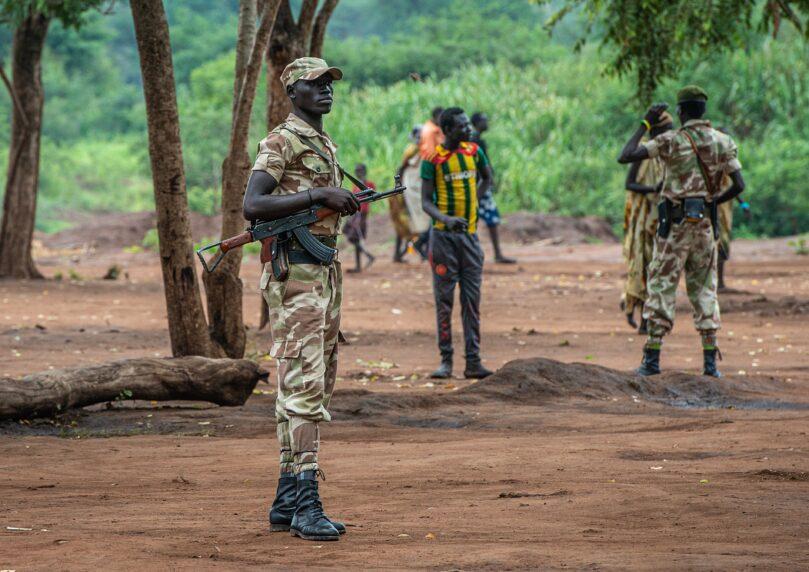

Tensions in Africa: Sudan and Ethiopia are currently escalating their diplomatic and military confrontation along their shared border. Both sides accuse the other of involvement in their respective internal conflicts and of supporting armed rebel forces—a situation that raises genuine concerns about a potential slide into a regional proxy war. Sudan alleges that Ethiopia is allowing the “Rapid Support Forces” (RSF) militia to establish camps on its territory, from which they launch drones and conduct cross-border attacks. Ethiopia, meanwhile, accuses the Sudanese military of assisting rebels in the Tigray region. Both nations deny these mutual allegations.
The conflict spilled into the diplomatic arena this month; in early November, the Sudanese military filed formal complaints against Ethiopia with the UN Security Council and the African Union Peace and Security Council, claiming to have evidence of Addis Ababa’s involvement on the Sudanese militia’s side. In response, Ethiopia expelled six staff members from the Sudanese consulate in Asosa within days and ordered the consulate’s closure. Sudan retaliated the following day by closing the Ethiopian consulate in the city of Al-Qadarif.

The focal point of the military tension is currently the Blue Nile state in Sudan, which borders Ethiopia. In late August, the Yale University Humanitarian Research Lab published an analysis of satellite imagery indicating an unusual accumulation of military vehicles and equipment at an Ethiopian base in Asosa. The researchers concluded that this military buildup is linked to the Rapid Support Forces (RSF). Meanwhile, Ethiopia alleges that Sudan is exploiting their shared border to arm rebels fighting against federal forces in the Tigray region—an area where, last September, fighting resumed following a nearly four-year ceasefire.
Regional experts warn that the link between these two theaters could ignite a broader conflict. Jarwyn Naidoo, a senior political economist at Oxford Economics Africa, told the Associated Press that the situation “increases the risk that instability in Ethiopia could become another front in Sudan’s war, and vice versa.” Alan Boswell, project director for the Horn of Africa at the International Crisis Group, warned that “all the ingredients are present for an escalation into a proxy war that would further destabilize both countries.” The crisis is further complicated by a network of competing regional alliances: while Ethiopia enjoys close ties with the United Arab Emirates, Sudan leans on a regional axis that includes Egypt and Eritrea, and Turkey attempts to maneuver and strike a balance between the parties. A research lab at Yale warns that an escalation between the nations could trigger another wave of mass displacement.
Background: Civil War and Border Disputes
The current tension unfolds against the backdrop of several ongoing crises between the nations, most notably the bloody civil war in Sudan. The country descended into full-scale conflict in April 2023, following a power struggle between the army and the Rapid Support Forces (RSF) militia. According to data from the Armed Conflict Location & Event Data Project (ACLED), at least 59,000 people have been killed and approximately 13 million displaced from their homes to date—though aid organizations estimate that the actual figures are significantly higher.
Beyond internal conflicts, relations between the two nations are also strained over the Grand Ethiopian Renaissance Dam (GERD) on the Blue Nile, which was completed in 2025 at a cost of approximately $5 billion. Sudan and Egypt are demanding a legally binding agreement to regulate the filling and operation of the dam, in order to safeguard their water supplies. At the same time, the fertile strip of land known as Al-Fashqa—where Ethiopian farmers cultivate areas subject to a sovereignty dispute—continues to be a constant source of friction between the armies.