


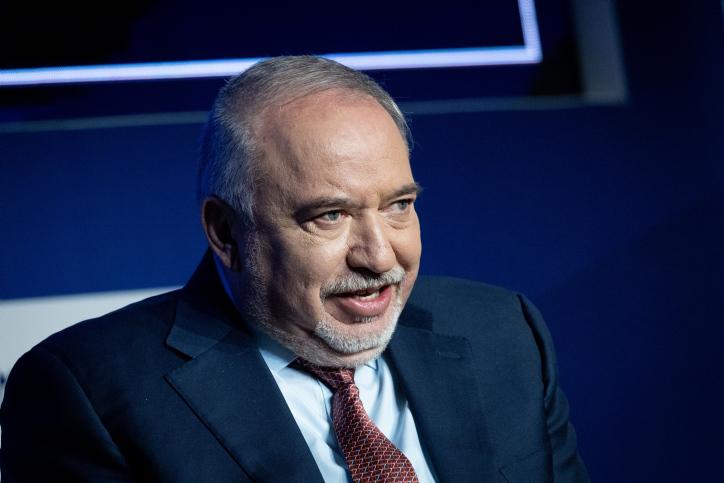

Yisrael Beiteinu Chairman MK Avigdor Liberman stated today (Friday) that he is open to compromises—including regarding the Conscription Law—as part of efforts to form a government that excludes Prime Minister Benjamin Netanyahu. This marks a shift, given that for years he has attacked the ultra-Orthodox (Haredi) parties and opposed making any concessions on this issue. In a post published following the election results, Liberman warned against forming a minority government that would rely on Arab parties; he called for the establishment of a coalition comprising 61 Knesset members, clarifying that—aside from three specific conditions he has set—there is room for flexibility on all other matters. This signals a change in his stance on the Conscription Law, an issue he had previously presented during the election campaign as a non-negotiable condition.
The primary shift in Liberman’s statement concerns the conscription of the ultra-Orthodox—a topic that, for years, has been one of the issues most closely associated with his party. The Yisrael Beiteinu chairman has repeatedly attacked the arrangements proposed by Netanyahu’s governments, opposed concessions to the Haredi parties, and demanded the advancement of IDF enlistment. During the election campaign, on October 11, Liberman presented universal conscription as a condition for forming a government, declaring that “there are no compromises on this clause.”
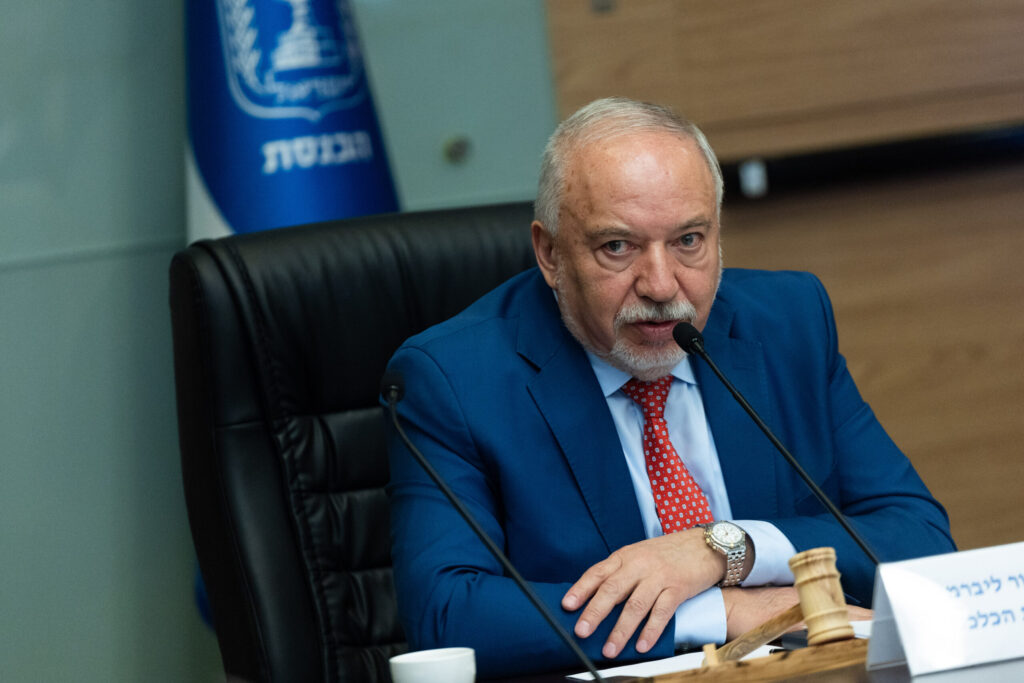

However, now that the election results have been released, he is presenting a different position: “On all other issues, it is permissible—and indeed desirable—to show flexibility, to compromise, and to understand…” “If you try to grasp too much, you grasp nothing. This also applies to the issue of the conscription law,” he wrote. Liberman added that he is aware of the difficulty involved in making concessions on an issue regarding which he has held a firm stance for years. “It is painful for me, and I know it is painful for many others as well. But given the array of challenges we currently face, the national interest of the State of Israel and the Jewish people must take precedence over any other consideration.”
This new statement opens the door to agreements with the ultra-Orthodox (Haredi) parties—who could potentially serve as partners in forming a government without Netanyahu—even though Liberman had previously leveled harsh criticism against any willingness to grant them leniencies regarding military conscription.

Liberman began his post with a warning about the consequences of the political crisis that emerged following the elections. “We must prevent the destruction of the Third Temple,” he wrote. “The election results compel us all to recalculate our course and to realize that there are no good alternatives or magic solutions before us.” “To grasp the magnitude of the responsibility placed upon us—and the price we might pay for poor decisions—it is essential to learn from past mistakes and look several steps ahead.”
He further argued that warnings he had issued in the past proved to be correct, citing his specific alert regarding the infiltration of terrorists into communities near the Gaza Strip. “I know that many dislike my warnings—primarily because, regrettably, they turn out to be accurate time and again,” he wrote. “On December 21, 2016, I warned of an incursion by Nukhba forces into Israeli territory and the seizure of communities near the Gaza Envelope. At the time, everyone dismissed the warning and rejected it outright.” “Unfortunately, my assessment proved entirely accurate.” Liberman used this example to underscore what he describes as the need to prepare in advance for the consequences of political decisions, rather than settling for short-term solutions.

Liberman went on to address the election results, attributing responsibility to the strategy adopted by the parties of the “Change Bloc” during the final days of the campaign. “About 12 days before the last election, I warned that the ‘largest party’ campaign and the talk about forming a minority government were severely damaging the Change Bloc,” he wrote. He stated that he had observed a decline in support for the bloc and attempted to raise the alarm—both in private conversations and publicly. “I realized the bloc was beginning to ‘bleed’ mandates; I tried to explain the danger and stop the bleeding—both through personal discussions and public appeals—but to no avail.”
According to him, the Change Bloc lost between seven and eight mandates during the final ten days of the election campaign. “In the last ten days of the election, the Change Bloc lost between 7 and 8 mandates—including 3 to 4 mandates from Yisrael Beiteinu that returned to ‘Bibi’—and the Likud became the largest party,” he wrote.

Liberman emphasized that this is a lesson that must be taken into account during the negotiations to form the next government. “Therefore, I issue this warning once again: in politics, just as in chess, one must think three or four moves ahead, rather than settling for just a single move.”
Liberman explained that his opposition to a minority government stems from the concern that such a government would not survive for long and would instead lead to a further strengthening of Netanyahu. “The ‘Government of Change’ lasted a little over a year. And what did we get afterward? Netanyahu, with 64 seats, for four years,” he wrote. He further warned: “A minority government would last for far less time, and in its wake, we would see the return of Netanyahu—this time with 70 seats for another four years—setting us on a short path toward the destruction of the Third Temple.”

According to him, the current reality requires party leaders to make difficult decisions and agree to compromises in order to ensure the stability of the next government. “This is precisely why, given the current political landscape, national responsibility demands that we make tough choices and be prepared to accept painful compromises.”
In his post, Liberman outlined three conditions—which he stated he had presented during a briefing this past Monday. The first is ending the Netanyahu era; the second is preventing further elections; and the third is opposing the formation of any government that relies on the abstention of the Joint List or Ra’am. “Regarding a minority government, my position has been—and remains—absolutely clear,” he wrote. “I stated this during the election campaign, close to election day, and reiterated it afterward as well: I strongly oppose the formation of a government that would rely on the abstention of the Joint List and Ra’am, and Yisrael Beiteinu will vote against such a government.”
Immediately afterward, he clarified that compromise is possible on all other issues, including the Conscription Law—in contrast to his explicit opposition to relying on the Arab parties. In his new statement, Liberman did not impose a similar prohibition on cooperating with the ultra-Orthodox (Haredi) parties.

Liberman also presented a framework that he believes could enable the formation of a stable government for a four-year term. “Therefore, a maximum effort must be made to form a coalition of 61 Knesset members, excluding the Joint List and Ra’am,” he wrote. According to him, once the coalition is established, it would be possible to expand the majority by bringing in Knesset members from the Likud party. “Once it is formed, it is highly likely that another three or four Knesset members from the Likud could be added.”
Liberman argued that this is the only path that would allow for the formation of a stable government and prevent a return to yet another round of elections. “This is the only strategy that reflects the best interests of the State of Israel and the Jewish people.” “This is the way to break the deadlock and form a stable government for the next four years—one that will set Israel on the right track.”

Another part of the post was dedicated to refuting reports and analyses published in recent days regarding his political positions and intentions. “In the last few days, I have heard and read quite a few fabrications and interpretations concerning my positions and intentions,” he wrote. “I wish to clarify: all these interpretations are the sole responsibility of the commentators and columnists themselves.” He added that there is no need to attribute positions to him that he has not personally expressed. “In Israeli politics, no one speaks more clearly or directly than I do. Therefore, there is no need for interpretation. I mean exactly what I say.”
He went on to address reports regarding the possibility of a rotation agreement as part of the formation of the next government. “One of the fabrications circulated in recent days concerns the rotation scenario. I haven’t spoken to anyone about this—not even to myself,” he clarified. Liberman added that he opposes the rotation mechanism on principle, arguing that such an arrangement undermines the proper governance of the state. “Furthermore, I believe that the rotation mechanism—from the days of Shamir and Peres to the present—is a harmful system that impairs the proper management of the country and should be consigned to the past.” “Whoever succeeds in forming a government must be granted full authority for the entire duration of the term.”

The issue of Haredi conscription has followed Liberman for years and was a primary source of friction between him, the Haredi parties, and Netanyahu. In 2018, while serving as Minister of Defense, Liberman promoted a conscription framework intended to regulate military service for yeshiva students. The matter subsequently became a focal point of political contention; in 2019, Yisrael Beiteinu refused to join a Netanyahu-led coalition, insisting instead on the passage of a specific version of the conscription law that the party supported.
Throughout the most recent election campaign, Liberman continued to present the conscription issue as a key condition for forming a government. On October 11, he stated clearly that there was no room for compromise on the matter, and later even expressed opposition to serving in a government alongside senior figures from the Haredi parties. Now, following the elections, he indicates a willingness to show flexibility on this issue as well, as part of the effort to form a coalition that excludes Netanyahu.