


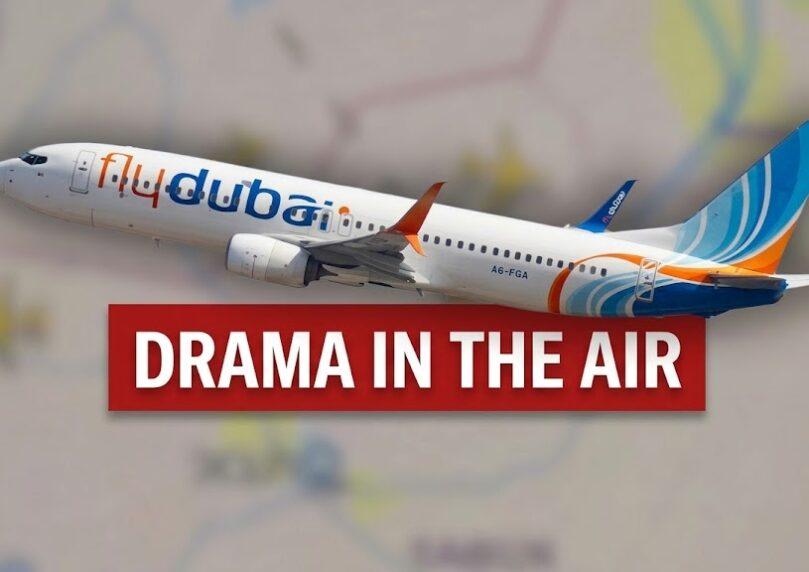

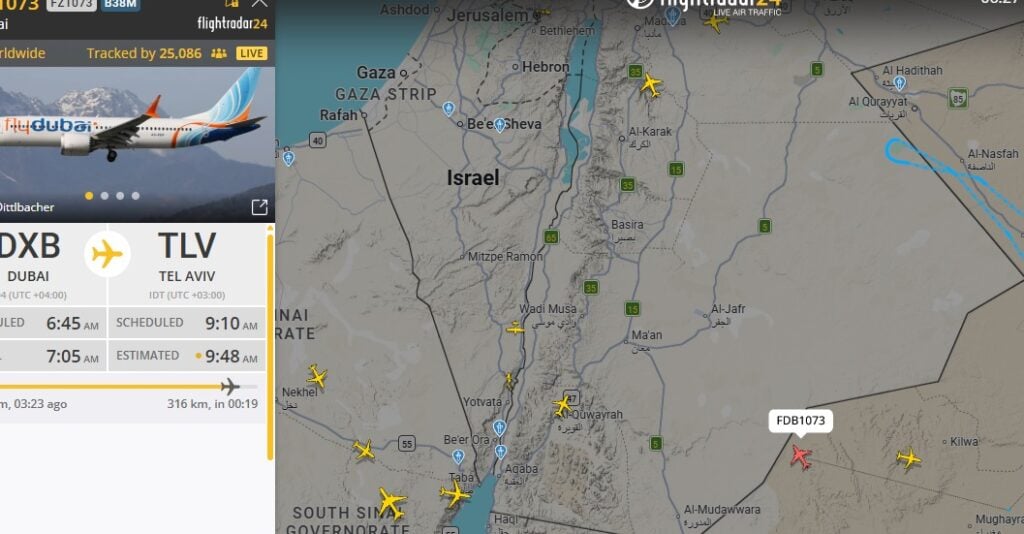
The end of an unusual and embarrassing international drama in Gulf airspace: Fly Dubai flight FZ1073, which took off this morning (Wednesday) from Dubai en route to Ben Gurion Airport carrying about 180 Israeli passengers, landed safely back in Dubai. This followed hours of heavy security tension amid suspicions the plane had been hijacked. It now turns out the reason for the unusual distress signals and the aircraft’s diversion wasn’t a terror attack, but rather an unprecedented violent confrontation that erupted inside the cockpit—between the captain and the co-pilot.
The incident that jolted Israel’s security and aviation systems, as well as the entire region, began just minutes after takeoff. The plane suddenly dropped to an altitude of about 15,000 feet, veered from its original route toward Saudi Arabian airspace, and transmitted the general emergency code 7700.
Shortly after, the drama intensified when tracking systems showed code 7500—an international emergency signal defined as “unlawful interference” and designed to alert authorities to a hijacking or hostile takeover of the aircraft. The code’s appearance triggered maximum alert: police and security officials held urgent situation assessments, and in parallel, all departures from Ben Gurion Airport were temporarily halted.

 1+
1+But as the minutes passed, a stunning picture emerged: it wasn’t hostile actors trying to seize control of the flight, but rather a physical brawl that developed inside the cockpit between the two pilots in charge of the flight. Against the backdrop of the exchange of blows and loss of control in the cabin, the severe distress signal was activated, causing regional authorities to prepare for an extreme scenario.
Ultimately, the plane executed a complete U-turn, retraced its path, and landed back at Dubai International Airport. With the landing, Israel breathed a sigh of relief, and local authorities in the United Arab Emirates began immediate interrogation of the two flight crew members to clarify the circumstances of the embarrassing and dangerous incident.
 1+
1+Code 7500 on an aircraft’s transponder is considered the “doomsday weapon” of aviation communication, and is activated almost exclusively in scenarios of terrorism, air piracy, and armed takeover of aircraft. Its transmission automatically scrambles fighter jets and puts control towers along the entire flight path into wartime emergency protocol.
Incidents in which physical confrontation between crew members themselves reaches the point of activating a hijack code are considered extremely rare in civil aviation. Incidents of this type constitute an unparalleled serious safety violation, as loss of composure and physical fighting at tens of thousands of feet directly endangers the lives of dozens of passengers and the integrity of the aircraft.