


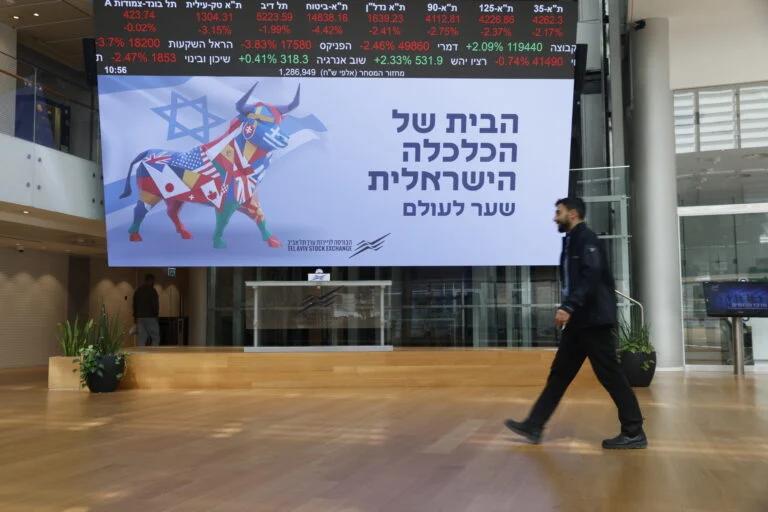

Israel’s economy posted significant gains over the past year, with improvements across key macroeconomic indicators as well as strong performance in financial markets, according to an annual economic summary released Monday by the Finance Ministry. Among the most notable developments were a significant decline in Israel’s risk premium, lower inflation and a strong labor market. Financial markets also recorded major gains, with the TA-125 index surging, the shekel strengthening against the dollar and foreign investment in Israel rising sharply.
According to the ministry, from the eve of Rosh Hashanah 2025 until now, every sector improved—fiscal, monetary, employment, and capital markets:
Macroeconomic Data:
1. Inflation dropped over the year from 2.5% on the eve of Rosh Hashanah 2025, on an annual basis, to 1.5% today.
2. The deficit also improved significantly: the cumulative deficit fell from 4.7% of GDP a year ago to 3.3% today—a drop of 1.4 percentage points. Still, the deficit target for all of 2026 remains at 4.9%.
3. The debt-to-GDP ratio stands at 67.9%—significantly lower than the OECD average of 111%.
4. The labor market remained stable, with unemployment at just 3.3%, compared to the OECD average of 4.9%.
5. Israel’s risk premium dropped 29% and nearly returned to pre-October 7 war levels.
Capital Markets:
6. The main stock index, the TA-125, posted a sharp 35% gain since the start of 2025, while the shekel strengthened significantly against the dollar by 11%.
7. The yield on 10-year Israeli government bonds fell 7.2%, easing financing conditions in the markets.
8. Foreign investment in Israel rose 78% in 2025, reaching $26 billion. At the same time, Israeli tech companies’ capital raising surged 53.6% in the first half of 2026 compared to the first half of 2025.
Israel Also Leading in AI
Another point the ministry emphasized is the hottest sector today—artificial intelligence. According to the ministry, Israel continues to cement its position as a global tech powerhouse, ranking 3rd in the world in AI commerce, 6th in development, and 7th in research (out of 83 countries).