


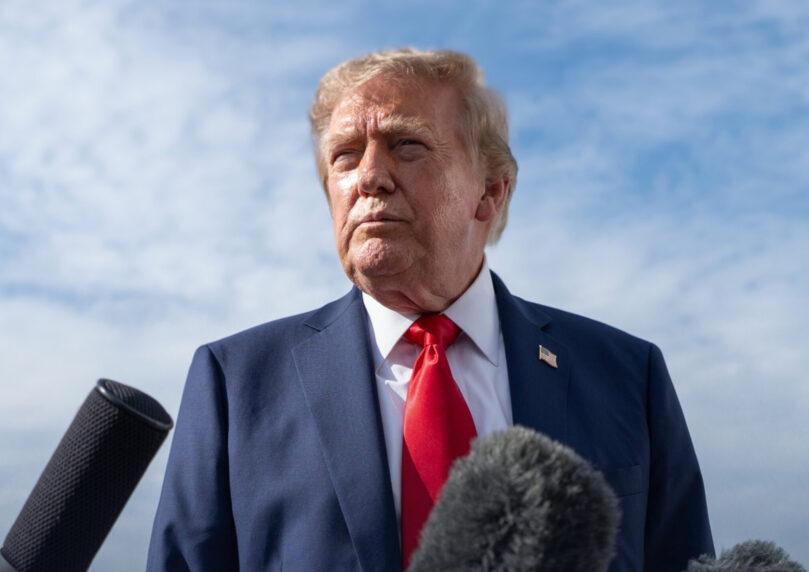

United States President Donald Trump signaled on Wednesday that the American military campaign against Iran is not necessarily over,
walking back statements from earlier in the week in which he suggested that the war had already been decided and that further kinetic strikes were unwarranted at this stage.
In his latest public remarks, the President made clear that Washington has no intention of settling for partial achievements or an inconclusive strategic stalemate. “We want to finish it; we want to make sure we have a total victory. Not a 93 percent victory,” Trump emphasized, framing American military operations as a decisive success while keeping the door open for expanded combat action. “And it’s about time,” Trump continued.
“Somebody fought back, we all fought back. We fought back, and we fought back seriously, and we won. It’s just a question of when we want to finish it. We want to make sure we have a total victory. Not a 93 percent victory. It is going to be total. It’s going to take them 25 years to rebuild what we destroyed.” The hawkish declarations represent a stark rhetorical shift from the positions Trump articulated only two days prior.
During a White House press briefing on Monday following a working meeting with Qatari Prime Minister Mohammed bin Abdulrahman Al Thani—who traveled to Washington as part of regional diplomatic mediation—Trump offered a far more conciliatory assessment. “Iran militarily is basically finished,” Trump said on Monday, adding that the United States was content to hold current positions. At the same time, negotiations progressed in what he described as a positive tone.
The President suggested at the time that the conflict was rapidly winding down, asserting that Washington had achieved its primary strategic objective of denying Tehran a nuclear weapon while working to guarantee that those security gains endure.

When asked earlier in the week why he had not formally declared victory and ordered the withdrawal of U.S. forces, Trump explained that an abrupt departure would expose regional allies to renewed danger, stressing the need for a durable, long-term architecture rather than a temporary pause. He reiterated on Monday that immediate military strikes did not appear vital, though he cautioned that U.S. forces remained on maximum readiness.
Similarly, in posts published on Truth Social, Trump downplayed the likelihood of a major new offensive, noting that Gulf allies favored the existing operational baseline: an ongoing U.S. naval blockade restricting Iranian maritime commerce paired with sustained economic pressure, rather than an expansive ground or air campaign.
Trump affirmed that Israel and the broader Middle East were securely defended against Iranian missile and drone threats, creating the impression that Washington preferred containment over kinetic escalation. In a subsequent telephone interview with CNN, Trump had reiterated that the war was already decided, remarking, “We won in Iran.”
Yet even then, he maintained that the resumption of heavy air raids remained dependent on whether Tehran agreed to sign an agreement satisfying core American demands, noting that critical infrastructure targets, including bridges and supply hubs, remained locked in U.S. targeting sights. Strategic analysts view Trump’s alternating public statements as a classic application of tactical ambiguity designed to create a fog of war.
By delivering de-escalatory statements at the beginning of the week, the administration successfully insulated global equity markets from volatility and checked potential spikes in worldwide crude oil prices.
Simultaneously, by pivoting back to explicit threats of total devastation, Trump ensures that Iranian leadership remains under relentless pressure, leaving Tehran uncertain whether Washington’s next step will be a mediated settlement or another devastating wave of airstrikes.