


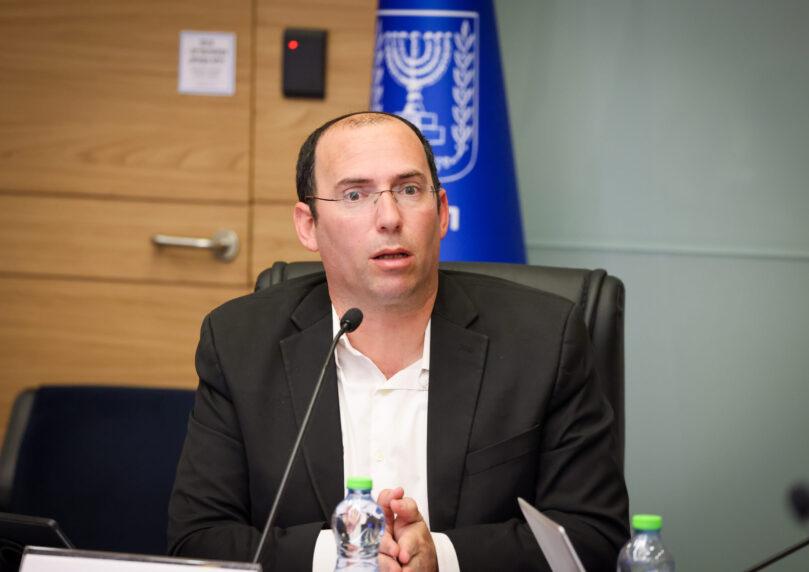

Knesset member Simcha Rotman of the Religious Zionism party opened the 26th Knesset with a sweeping legislative blitz designed to put judicial reform back on the agenda. On Tuesday, immediately after the new Knesset was sworn in, Rotman refiled 85 bills—about 20 of them dealing with changes to the judicial system and law enforcement.


 2+
Rothman, who chaired the Constitution, Law and Justice Committee in the outgoing Knesset, is seeking to advance his “Law and Justice” plan, which includes sweeping changes to the relationship between the Knesset, the government, and the judiciary.
Despite the large number of bills, these aren’t 85 completely new initiatives. According to Channel 7’s report, 82 of them are private member bills and three more were filed by the Constitution Committee in the previous Knesset. Some already were debated and advanced through legislative stages in the 25th Knesset.
Still, the opening of a new Knesset requires renewed treatment of legislative procedures. The fact that a bill passed first reading in the previous Knesset doesn’t guarantee it can automatically continue from that stage in the current Knesset. The ability to apply continuity rules to it is subject to legal provisions and required decisions.
The move comes as talks to form a new government are still ongoing, and the future of judicial reform also depends on the coalition composition that forms and the ability to build a majority for legislation.
Among the bills Rothman refiled are several centerpiece initiatives of the judicial overhaul: splitting the role of Attorney General, limiting judicial review of laws, changing how legal advisers in government ministries are appointed, and restoring the immunity mechanism for Knesset members to the format that existed before 2005.
 2+
“Anyone who thought judicial reform was off the agenda is getting an answer today,” Rothman declared. “The 85 bills refiled with the opening of the 26th Knesset, including about 20 to fix the judicial system, show that the reform continues—not in slogans but in legislation.”
Rothman made clear he intends to push the initiatives forward even if a right-wing government doesn’t form.
Splitting the Attorney General Role and Limiting the High Court
Three of the main bills already passed first reading in the 25th Knesset and were being prepared for second and third readings before the Knesset dissolved. The first is a Basic Law: Authority to Investigate and Prosecute, dealing with regulating powers in the areas of investigations and prosecution.
 2+
The second is a Basic Law: The Judiciary, dealing with judicial review of Knesset laws. The proposal is designed to change the rules allowing the Supreme Court to intervene in legislation.
The third proposal seeks to split the Attorney General position into two separate roles: Attorney General and Solicitor General. The proposed law regulates the appointment of the position holders, their term length, and the powers granted to each.
Sixteen additional Knesset members had signed onto the bill to split the position alongside Rothman, including Hanoch Dov Milwidsky, Yitzhak Kroizer, Ariel Kellner, and Eli Dellal.
Striking Down Laws Only With Unanimous Supreme Court Justices’ Consent
Another initiative refiled is a Basic Law: Override, which seeks to impose strict limits on the Supreme Court’s authority to strike down laws.
According to the reported text, striking down a Knesset law would only be possible with a full panel of all Supreme Court justices and a unanimous decision. This means even one dissenting justice would prevent a law from being struck down.
Rothman also refiled a proposal under which Supreme Court panel compositions would be determined by a computerized system, without human involvement in setting the panel.
In criminal law, Rothman seeks to allow the state to appeal acquittals in criminal proceedings, limit the duration of police investigations and the handling of cases in the prosecution, and allow appointment of an outside prosecutor to investigate the Attorney General and State Attorney in cases where a conflict of interest might arise.
Legal Advisers as Political Appointees and Restoring Immunity
Another set of bills deals with the status of legal advisers in government ministries. Rothman seeks to turn the position into a political appointment of the supervising minister, instead of the current appointment system.
Another proposal seeks to restore the Knesset member immunity mechanism that existed until 2005. Currently a Knesset member must request immunity from prosecution, while the previous arrangement granted immunity from debate as a default, which could be removed through a process set in law.
Rothman also refiled proposals to limit standing to petition the High Court and to abolish the offense of breach of trust, which is at the center of legal disputes due to its broad definition.
Another initiative seeks to establish a three-year cooling-off period for senior Justice Ministry officials seeking appointment as Supreme Court justices. Knesset members Moshe Gafni, Yinon Azoulay, and Amir Ohana also signed the proposal alongside Rothman.