


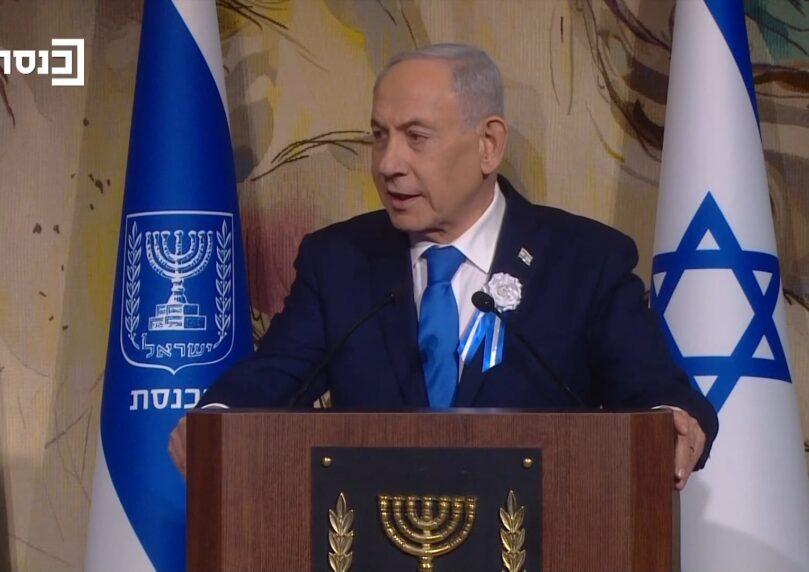

Prime Minister Benjamin Netanyahu spoke today (Tuesday) in the Knesset plenum during the swearing-in ceremony for the 26th Knesset, marking another historic achievement: with his swearing-in, he has served in more Knessets than anyone else in the nation’s history—15 in total—surpassing the record previously held by former President Shimon Peres.
At the start of his address, Netanyahu warned that the Iranian threat has not yet been removed and that Tehran is working to revive its program aimed at the destruction of Israel. “After we dismantled the program, they are now working to restore it. Putting an end to the program depends on bringing down the regime,” he stated.
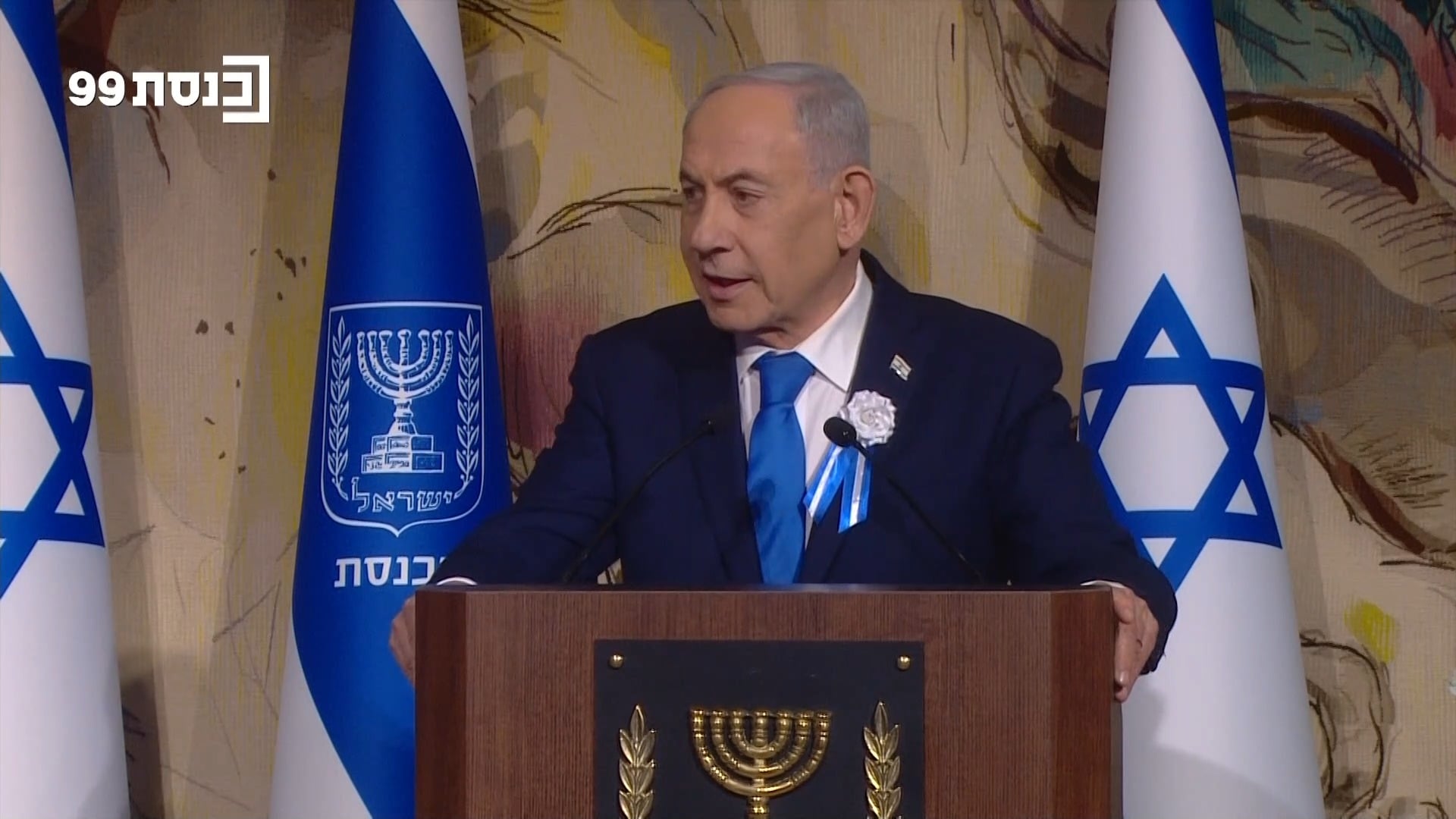
He went on to highlight the achievements of the war: “Thanks to the heroism of our soldiers, the resilience of our people, and the courageous decisions made by the government, we have secured tremendous gains. We eliminated Nasrallah, Khamenei, their entire command structure, and their scientists. We dealt a severe blow to their economic infrastructure and their navy. We have transformed the face of the Middle East.”
Alongside these achievements, Netanyahu warned of the international pressures Israel is likely to face: “In the near future, we will confront pressure to come to terms with a nuclear-armed Iran and the continued existence of a regime that seeks our destruction.” According to him, Israel will also have to contend with attempts to force it to relinquish its military gains: “Pressure is already mounting for us to retreat from our achievements—including the security zones in Syria, Lebanon, Gaza, and Judea and Samaria. They will attempt to dictate the establishment of an Iranian-backed ‘Palestinian’ state—a state designed to destroy Israel. That would be worse than anything we have ever known.”
Amid these threats, Netanyahu called for the formation of a national unity government—a statement that drew applause from the plenum. “We are gathered in this house in the face of these threats, and we must do one thing: set aside all other considerations and form a national unity government,” he said. He added, “Only such a government can tackle these kinds of challenges; it is impossible to address them with a narrow government.”
Netanyahu warned against the formation of a narrow government that would include or rely upon Arab parties. “I am not speaking about Arabs—Arabs vote for the Likud and for all the other parties. I am speaking about individuals whose ideology is hatred of Israel and the destruction of the Jewish state,” he clarified. He went on to attack the positions attributed to members of the Arab parties: “People who claim that Hamas is a charity organization, that Hamas did not slaughter babies or rape women on October 7th; people who demand that Israel be flooded with millions of descendants of ‘Palestinian’ refugees—a move that would bring about the end of the Jewish state—and who speak of granting citizenship to hundreds of thousands of ‘Palestinians’.”
Addressing those considering forming a government with them, Netanyahu posed a series of questions: “What do you think is the true objective of these factions? Do you not understand what they are actually seeking to achieve? What is their national aspiration?”
The Prime Minister quoted Member of Knesset Walid Taha: “The ‘Palestinians’, unlike the Jews, are the rightful owners of this land. With the help of Allah, this occupation will be removed. This is our land.” He then recalled a statement previously made in the Knesset by Jamal Zahalka—”We were here before you, and we will be here after you”—adding, “I replied to him then: the first part is untrue, and the second will not come to pass.”
Netanyahu asserted that the positions of the Arab parties have not changed. According to him, Mansour Abbas states in Arabic that “the Jews have no right to Jerusalem; the Jews are interlopers on this land,” while Walid al-Huwashla claims that “the Jews are settlers in Tel Aviv—not in Kedumim or Nokdim, but in Tel Aviv.”
“There Is No Difference”
Netanyahu addressed those Members of Knesset considering the formation of a government supported by Arab parties, asking: “Are you prepared to be dependent on those whose goal is the destruction of the Jewish state? Do you prefer them over Zionist parties that represent a vast Jewish public—a public of fighters and heroes, of wounded IDF soldiers and bereaved families; a public that is loyal and gives so much of itself?”
The Prime Minister emphasized that the quotes he cited came from Ra’am party MKs, and addressed the claim that a distinction exists between Ra’am and the Joint List: “There are some in this House who, for some reason, believe that regarding the existence of the Jewish state and Zionism, there is a difference between the supposedly ‘moderate’ Ra’am and the ‘extremist’ Joint List. Absolutely not—there is no difference whatsoever. Both agree that the State of Israel must be eliminated; they merely disagree on what kind of ‘Palestinian’ state should be established here.”
Netanyahu compared the prospect of including Ra’am in a government to the conduct of Yasser Arafat following the Oslo Accords. He noted that Arafat had stated in Arabic that “Oslo is taqiya (Muslim deceptive strategy)—it paves the way for us.” Netanyahu argued that, by bringing a branch of the Muslim Brotherhood into the government—or by relying on it—the path is now being opened for that movement. Subsequently, Netanyahu cited remarks allegedly made by Mansour Abbas in 2015, suggesting that a two-state solution is insufficient and that efforts should instead be directed toward establishing a single state—a “democratic caliphate.” Netanyahu added that Abbas saw no contradiction between the concept of a caliphate and the “‘Palestinian’ national project,” concluding: “A democratic caliphate—that is what he is striving for. Not a caliphate alongside Israel, but a caliphate in place of Israel.”
At this point, Netanyahu addressed the newly sworn-in Member of Knesset, Talik Gvili, welcoming her on her first day in the legislature. “Talik—mother of an Israeli hero—asked: ‘How is it possible that they cannot sit with me, yet they sit with people who support those who murdered my son?'” the Prime Minister stated.
Interruption During the Speech
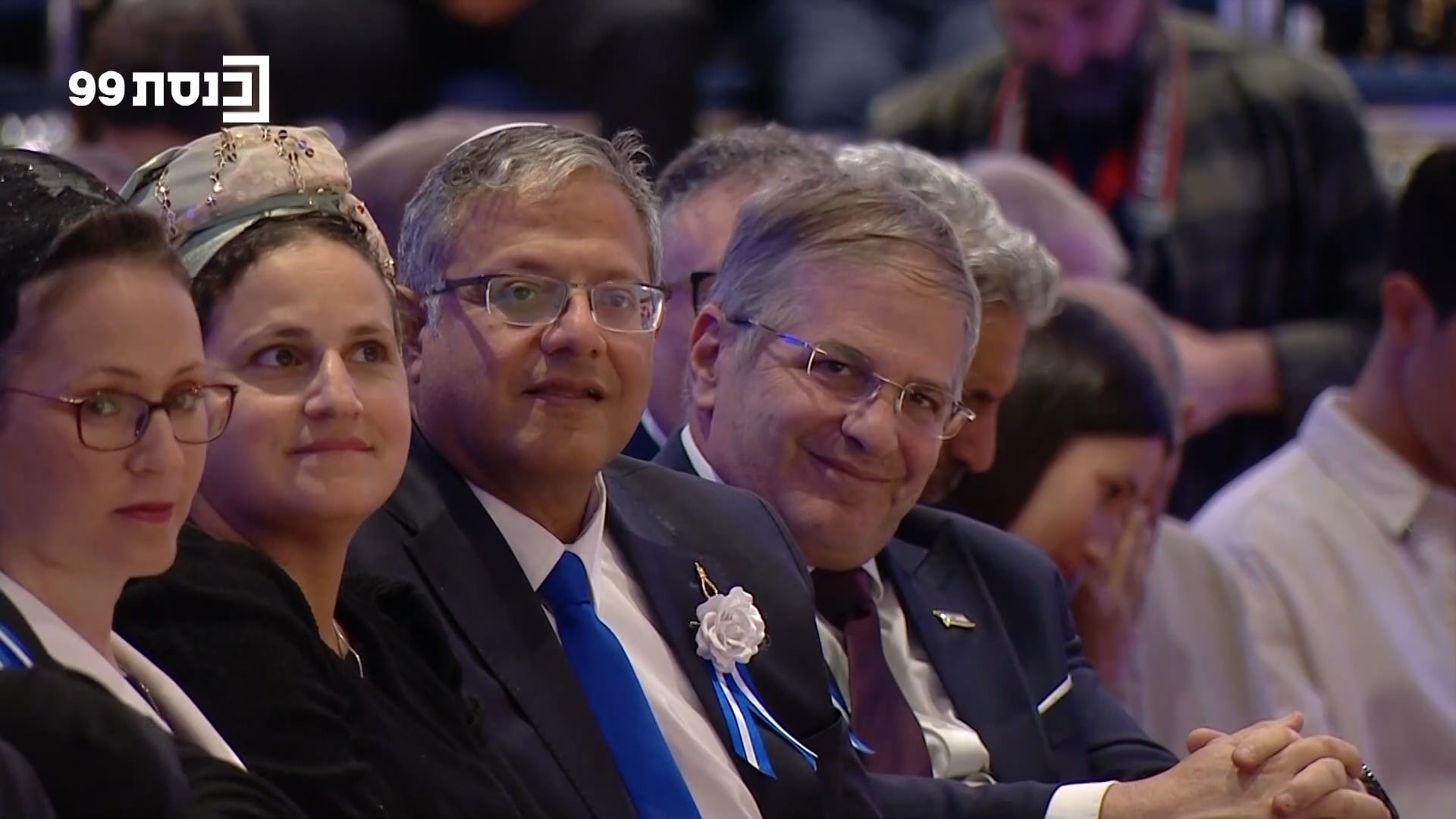
During the address, Former Prime Minister Naftali Bennett interrupted Netanyahu, shouting remarks at him. The Prime Minister ignored the outbursts and continued his speech; however, Itamar Ben-Gvir, leader of the Otzma Yehudit party, confronted Bennett, calling out: “You sit with the Joint List—and you have the nerve to speak? You good-for-nothing, how dare you!” Ofir Katz shouted at Bennett: “Why don’t you investigate that together with your friends Tibi and Abbas?” Addressing the Ultra-Orthodox Parties
Netanyahu then turned to the Ultra-Orthodox parties, urging them not to join a narrow government. “I know what is at stake—not only the immense security challenge, but also the major internal challenge of preserving Jewish identity,” he said.
“You represent a large public that loves Israel and has settled in the heart of the Land of Israel. We are the ‘faith-based bloc’; we have safeguarded, and will continue to safeguard, the sacred values of Israel,” he added. He stated, “We share a common mission: to finalize the formalization of the status of Torah students and to establish a conscription law, in cooperation with your spiritual leadership.”
Netanyahu warned the Ultra-Orthodox parties against promises they might receive from the left-wing bloc: “They will promise you the moon and the stars, but the moment—heaven forbid—that a government led by the Left is formed, all promises will vanish—because they will have a safety net provided by the Arab parties. They will appoint whomever they please and do whatever they see fit.”
The Prime Minister reiterated his call for the formation of a unity government: “In the face of the great challenge—both from without and from within—the solution before us is a national unity government: a government that includes all the factions within our bloc, as well as everyone who wishes to preserve a Jewish state. I called for this when the war broke out, both before and after the elections.”
“A national unity government—this is the imperative of the hour”
Towards the end of his speech, Netanyahu addressed the gravity of the moment and the responsibility borne by elected officials. “I stand here, carrying in my heart generations of Jews who dreamed, prayed, and shed rivers of blood and oceans of tears so that we might return to our land and establish a Jewish state within it,” he said.
Netanyahu quoted his late brother, Yoni Netanyahu, stating that we must ensure the Jewish state “does not become a fleeting episode, but rather endures forever.” He concluded with another appeal for unity: “We must unite and come together to form a national unity government—this is the imperative of the hour. Only through such a government can we ensure our security, expand the circle of peace, and—with God’s help—bring about peace among ourselves.” Member of Knesset Gilad Kariv walked out of the hall in a demonstrative manner after having interrupted a speech. As he was leaving, a confrontation ensued between him and Otzma Yehudit chairman Itamar Ben-Gvir, who called out to him: “Sit down and be quiet—you sit with the Joint List.”