


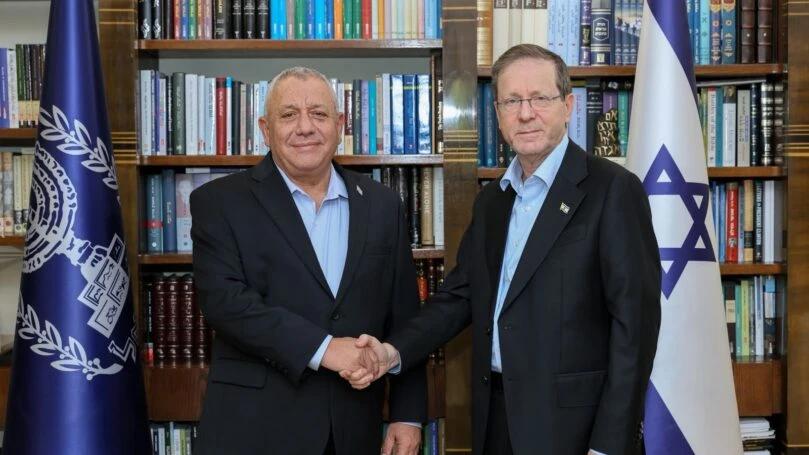

President Isaac Herzog announced Saturday night that he has decided to task Yashar! chairman Gadi Eisenkot with forming the government. The announcement follows the round of consultations the president held with Knesset factions and further inquiries he conducted over the weekend.
The decision came after 67 MKs recommended Eisenkot to the president as their candidate to form a government, while incumbent Prime Minister Benjamin Netanyahu received the backing of only 46. United Torah Judaism chose not to recommend anyone, costing the right-wing bloc seven recommendations. In recent days the president spoke with various figures across the political system and met with both Netanyahu and Eisenkot.
The mandate will be formally presented tomorrow (Sunday) at 5:00 p.m. at the President’s Residence in Jerusalem. From the moment he receives it, Eisenkot will have 28 days to form a new government under Basic Law: The Government. If necessary, the president can grant him a 14-day extension.
Likud and the right-wing bloc believe Eisenkot intends to form a minority government as early as this week. The right has singled out three incoming MKs who could block a minority government relying on the Arab or Haredi parties: Yonatan Shalev of Beyachad, and Inbar Giti and Elyasaf Peretz of Yashar!. Right-wing figures plan to step up pressure on the three in the coming days. So far, all three have stayed silent.
If Eisenkot presents a government that fails to win the Knesset’s confidence, the mandate returns to the president, who can then assign it to another MK. The stakes for Eisenkot extend beyond whether he can secure a majority. Holding the mandate also gives his party the chairmanship of the Arrangements Committee, which sets the Knesset’s working procedures and establishes its committees. Even if he fails to form a government, the move could shift the balance of power in the Knesset and affect legislation planned there.
Two main scenarios shape the path forward. The first is a left-Haredi government that would include Shas, which recommended Netanyahu at the President’s Residence. The second is a left-Arab government relying on the Arab factions and United Torah Judaism, without Avigdor Liberman. Eisenkot’s camp prepared for both scenarios in advance and ruled out a unity government with Netanyahu altogether.
Earlier Saturday evening, before the president’s announcement, Eisenkot signaled he is not entirely shutting the door on Likud, though he set steep conditions for its entry into a government under his leadership. Responding to Netanyahu’s call for a broad national unity government, Yashar! said Likud could join only if it broke off its alliance with parties Yashar! described as “extremist,” adopted Eisenkot’s four principles and agreed to serve in a government he leads.
Netanyahu, for his part, warned Saturday night against a government relying on Arab parties he said support terrorism. “A government that depends on Hamas supporters will not fight Hamas. A government that depends on those who hate Judaism will not preserve Israel as a Jewish state,” he said. He added that such a government would be unable to confront the Iranian threat or protect IDF soldiers, and called for a broad national unity government made up of the national camp and the Zionist parties.
Liberman’s remarks last week, in which he signaled openness to compromise on religion and state, could also influence coalition talks. In the background is an assessment that Liberman may demand a rotation in the premiership as his price for joining such a government.
Eisenkot’s associates have described a repeat election as the worst possible outcome. Once he formally receives the mandate, the Yashar! chairman will need to open talks with faction leaders and determine whether either scenario can be turned into a coalition that wins the Knesset’s confidence.