


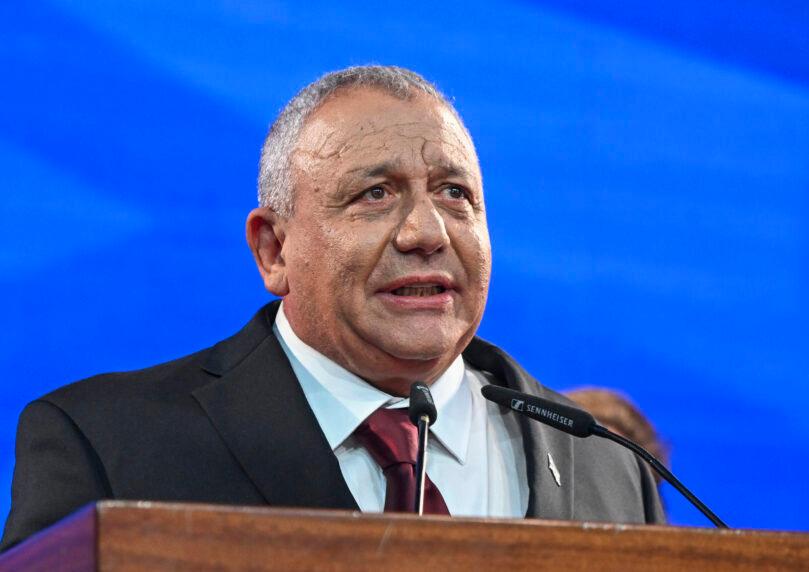

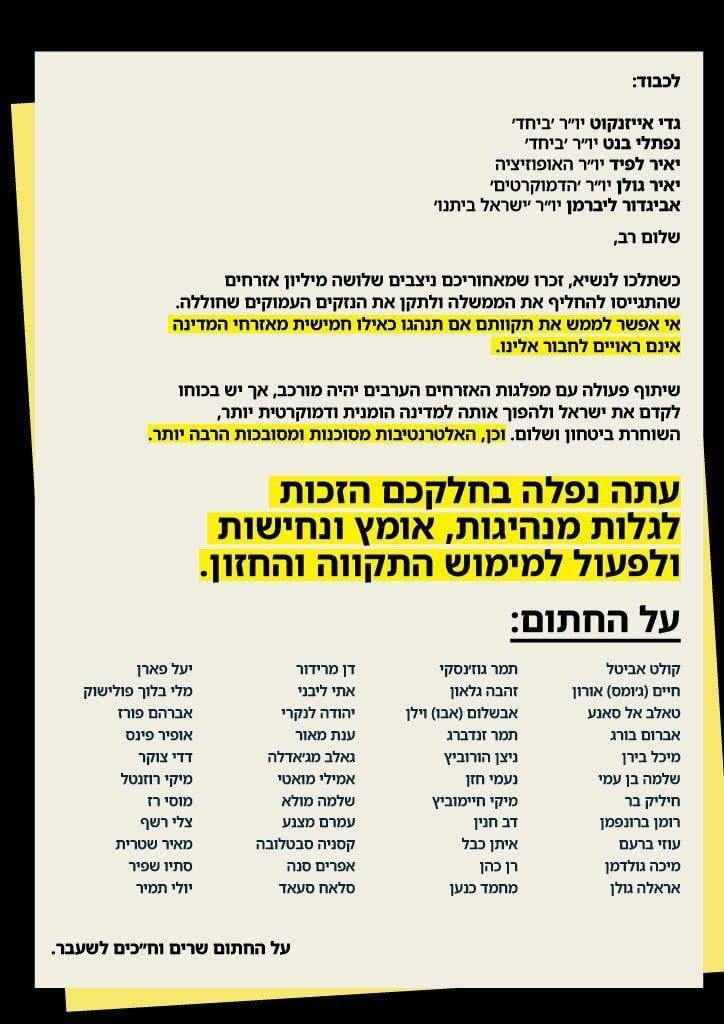
Dozens of former government ministers, Knesset members, and prominent public figures released an urgent open letter on Sunday addressed to the leadership of the parliamentary opposition—Gadi Eisenkot, Naftali Bennett, Yair Lapid, Yair Golan, and Avigdor Liberman—calling on them not to rule out forming an alternative governing coalition reliant on Arab political factions. The roster of signatories spans veteran figures from across Israel’s center-left establishment as well as prominent former Likud moderates.

 1+
Among the signatories are former justice minister Dan Meridor, former Knesset speaker Avraham Burg, former government ministers Zehava Galon, Tamar Zandberg, Shlomo Ben-Ami, and Colette Avital, along with veteran legislator Haim (Jumas) Oron and numerous academic, cultural, and public figures. Formulated in urgent language, the letter argues that the mandate to unseat the current government cannot be realized while maintaining traditional political boycotts against Arab representatives.
“Behind you stand three million citizens who mobilized to replace the government and repair the profound damage it has wrought,” the letter states. “It is impossible to realize their hope if you conduct yourselves as though a fifth of the country’s citizens are unworthy of partnering with us.” The signatories openly acknowledged that forging a working alignment with Arab factions—which currently hold 19 seats in the 26th Knesset between the Joint List (12) and Ra’am (seven)—presents formidable ideological and political friction. However, they argued that building such a partnership is vital to preventing the right from retaining power.
 1+
“Cooperation with the parties of Arab citizens will be complex, but it possesses the power to advance Israel and transform it into a more humane, democratic country that pursues security and peace,” the authors wrote, adding that “the alternative is dangerous and far more perilous.” Concluding the letter, the signatories challenged the opposition chiefs to take decisive risks: “Now the privilege has fallen to your lot to demonstrate leadership, courage, and determination, and to act to fulfill this hope and vision.” The appeal’s publication comes amid intense backstage maneuvers within the anti-Netanyahu bloc and escalating debate over the mathematical necessity of relying on non-Zionist factions.
With the national camp commanding 53 mandates and the Zionist opposition parties holding only 48 seats, any theoretical alternative government requires the active participation or external parliamentary support of either Ra’am or the Joint List. While figures such as Yair Golan have openly advocated for full partnership with Arab parties, leaders like Bennett, Eisenkot, and Liberman have faced intense resistance from their voter bases against legitimizing factions that reject the Jewish character of the state. The joint letter is an organized public-pressure campaign aimed at softening resistance among right-leaning opposition figures and legitimizing the inclusion of Arab slates as formal coalition arbiters ahead of presidential consultations later this week.