


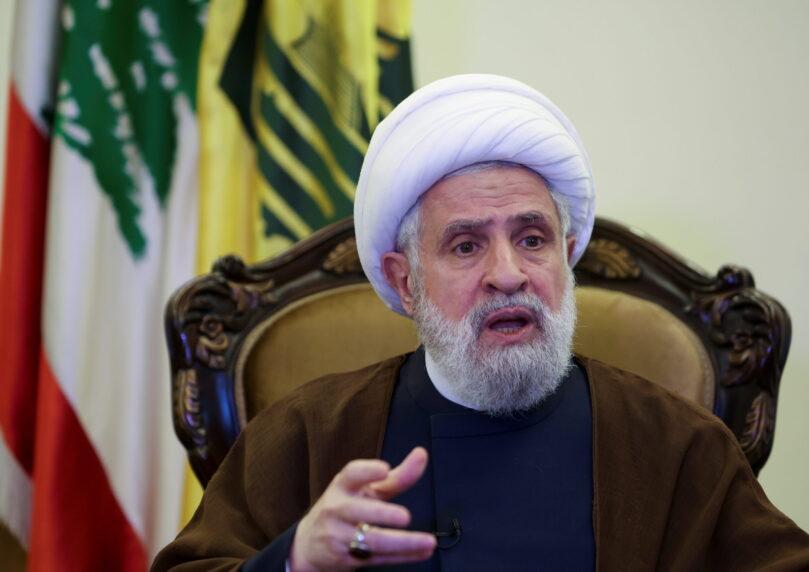

Hezbollah Secretary-General Naim Qassem announced on Wednesday that the terrorist organization will refuse to engage in any dialogue regarding the decommissioning of its weapons stockpile as long as Israel maintains an operational presence and continues conducting targeted strikes within Lebanese territory, Lebanese news outlet This Is Beirut reported.


 2+
In public remarks, Qassem dismissed the proposed diplomatic framework to stabilize the northern border, calling the draft agreement invalid and lacking legal or constitutional legitimacy. According to Qassem, the terms of the arrangement directly contravene the Lebanese constitution, the historic Taif Agreement, prevailing national laws, the constitutional oath taken by the Lebanese president, and the government’s official baseline positions in Beirut.
The terror chief justified Hezbollah’s armed posture by framing its arsenal as a response to Israeli military activity supported by the U.S. and other international powers. Acknowledging that the confrontation imposes substantial costs on Lebanon, Qassem insisted that political concessions or territorial compromises would yield no tangible advantages for the country, stating that Israel must withdraw entirely from Lebanese soil irrespective of which governing coalition takes power in Jerusalem.
 2+
Qassem also weighed in on the results of Israel’s 26th Knesset elections, portraying the emerging political fragmentation and coalition stalemate as tangible evidence of strategic defeat. He claimed that the U.S. faces parallel political constraints, framing internal political turbulence in both Jerusalem and Washington as byproducts of the wider multi-front conflict with the Islamic Republic of Iran.
Focusing on Tehran, Qassem praised the clerical regime, asserting that the Iranian leadership has successfully neutralized repeated U.S. and Israeli attempts to dismantle the Islamic Republic. He argued that Washington remains incapable of dominating Iran or compelling Tehran to abandon its regional strategy.
 2+
Furthermore, Qassem claimed that bilateral understandings between Iran and the U.S. had curbed the scope of Israeli actions against Lebanon. Concurrently, the terror leader reiterated Hezbollah’s strategic alliance with the Amal Movement and its domestic political allies, insisting that the group’s armed apparatus operates in concert with Lebanese sovereignty and the armed forces rather than in subversion of them.