


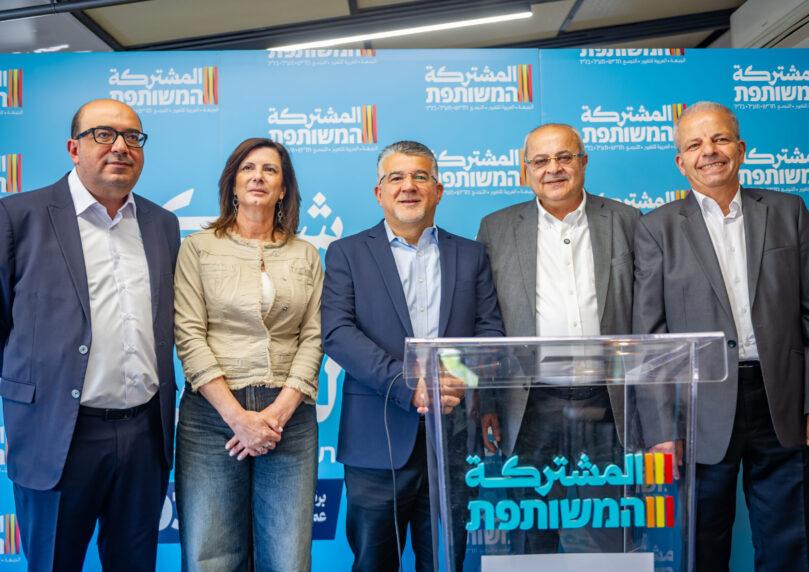

The Joint List (Hadash-Ta’al) and Ra’am accumulated a combined 729,855 votes in the elections for the 26th Knesset, setting an all-time record for Arab political slates in Israeli electoral history, according to official interim data published by the Central Elections Committee Wednesday afternoon. Based on returns verified across 11,168 polling stations representing 4,854,102 valid ballots, the Joint List secured 446,240 votes (9.19% of valid ballots), while Ra’am captured 283,615 votes (5.84%). Together, the two factions command roughly 15% of all valid votes counted nationwide, establishing an unprecedented high-water mark for Arab party representation in the Knesset.

 1+
A historical review of Knesset election cycles underscores the magnitude of the current mobilization:
-
In the 2013 elections, the three independent factions running at the time—Ra’am-Ta’al, Hadash, and Balad—accumulated a collective total of 348,919 votes.
-
In 2015, uniting for the first time under the banner of the Joint List, the factions expanded their footprint to 446,583 votes.
-
In the April 2019 elections, after dividing into two separate tickets (Hadash-Ta’al and Ra’am-Balad), aggregate support dropped sharply to 337,108 votes.
-
By September 2019, following reunification, the Joint List rebounded to 470,211 votes.
-
The previous record was set in 2020, when the unified four-faction slate reached an unprecedented 581,507 votes—12.67% of valid ballots—translating into a historic 15 Knesset seats.
-
In 2021, Ra’am split from the alliance to run on an independent platform, resulting in a steep contraction that reduced the two tickets’ combined strength to 379,647 votes.
-
In the 2022 elections, the Arab political arena fractured into three separate components: Ra’am secured 194,047 votes (5 seats), Hadash-Ta’al garnered 178,735 votes (5 seats), and Balad took 138,617 votes, falling below the statutory 3.25% threshold. In total, the three slates garnered 511,399 votes.
 1+
The current 2026 election returns outstrip the 2022 total across all three factions by 218,456 votes—a dramatic 42.7% increase. Furthermore, the results eclipse the previous unified record from 2020 by 148,348 votes, marking a 25.5% expansion over the sector’s prior historical ceiling. While the Central Elections Committee continues processing external double-envelope ballots, the sheer volume of valid votes secured by the two slates establishes the Arab factions as a transformative mathematical weight in the incoming 26th Knesset.