


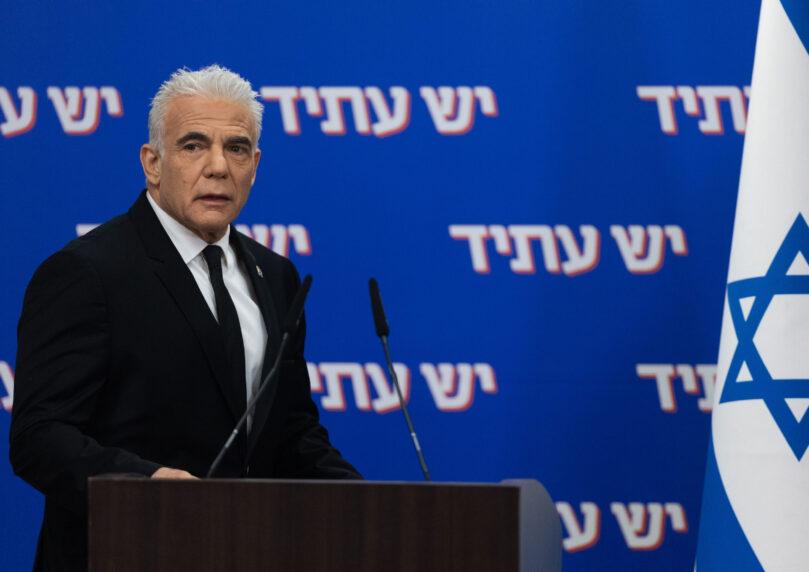

Yesh Atid Chairman Yair Lapid is projected to enter the 26th Knesset with only three or four additional party lawmakers,
marking the most restricted parliamentary presence for his political movement since its inaugural run in 2013.
The sharp contraction follows Lapid’s decision to forgo an independent campaign and run on the joint BeYachad ticket led by former Prime Minister Naftali Bennett.
With verified interim tallies leaving the BeYachad alliance with only 11 to 12 mandates, Yesh Atid’s share of legislative representation has fallen sharply.

 1+
Under BeYachad’s candidate placement structure, Lapid will be accompanied into parliament by Meirav Ben Ari, Noam Tibon, and Meirav Cohen.
The parliamentary future of veteran lawmaker and former Mossad Deputy Director Ram Ben Barak remains precarious,
contingent entirely on whether remaining double-envelope tallies secure a 12th mandate for the faction under statutory quota calculations.The projected outcome represents a steep downturn in Lapid’s parliamentary trajectory:
-
Lapid entered national politics in the 2013 elections for the 19th Knesset, when Yesh Atid stunned observers by winning 19 mandates and emerging as the second-largest party in the plenum.
-
In the 2015 elections, the party contracted to 11 seats—its previous historical low as an independent faction, yet still nearly triple the representation it is projected to hold in the incoming chamber.
-
Over the three election cycles between 2019 and 2020, Lapid merged his faction into the Blue and White alliance alongside Benny Gantz and Moshe Ya’alon, securing 35 seats in April 2019, 33 in September 2019, and 33 in March 2020 across the joint slate.
-
In 2021, returning to an independent run, Yesh Atid captured 17 seats.
-
In the 2022 elections for the 25th Knesset, the party achieved its all-time zenith, winning 24 mandates and consolidating its standing as the unchallenged anchor of the opposition.
 1+
Four years after that peak, the alliance with Bennett has caused severe fallout within Yesh Atid’s ranks.
The impending drop from 24 seats down to four or five represents an estimated loss of 19 to 20 seats—a contraction of 79% to 83% in the party’s parliamentary delegation.
The outcome also accounts for the wave of resignations that hit the party ahead of the election,as senior stalwarts and younger activists walked away after realizing their prospects of reaching parliament had been closed off.
Furthermore,the combined BeYachad list, which won only 11 to 12 seats, secured less than half the legislative strength Yesh Atid commanded
on its own in the outgoing Knesset.