


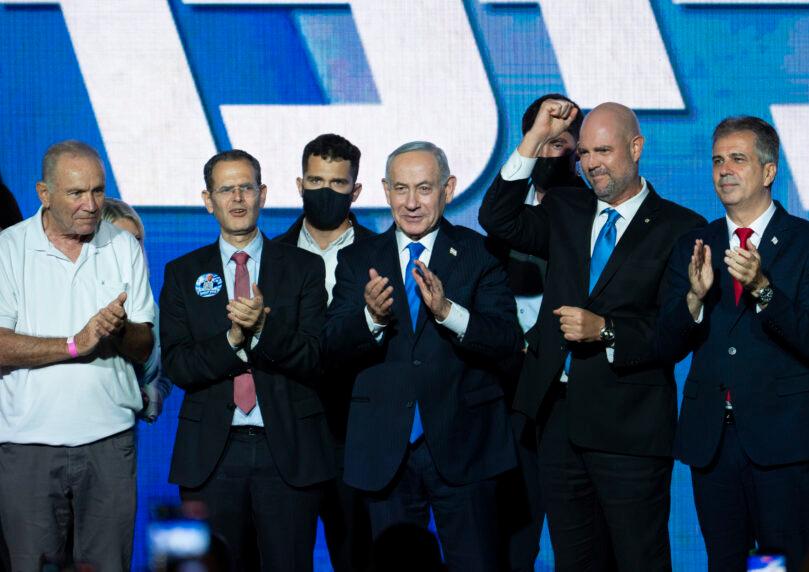

Despite dramatic television exit poll projections placing the national camp between 52 and 60 seats, the Likud leadership remains convinced that the formal mandate to form the incoming government will fall to Prime Minister Benjamin Netanyahu.
The institutional rationale inside Likud headquarters is straightforward: Likud has preserved its position as the largest faction in the Knesset by a considerable margin, and no single consensus candidate across the divided center-left and Arab lists can present 61 recommendations to President Isaac Herzog. Having previously demonstrated an ability to maneuver narrow numbers into viable governing coalitions, Netanyahu now faces three core strategic options—all of which require breaking outside the parameters of his traditional right-wing, religious bloc.


 1+
The first option centers on a broad national unity government with Gadi Eisenkot’s newly formed Yashar! party. Viewed as the preferred outcome by the President’s Residence and institutional circles, the alliance would combine Likud, Religious Zionism, the Haredi factions, and Yashar! would produce a robust majority of 65 to 68 seats. For Netanyahu, such a construct offers domestic stability, elevated international standing, and reduced reliance on ultra-Orthodox demands. However, the price would be steep: Eisenkot would undoubtedly insist on a rotational premiership, an immediate and formalized freeze on judicial reform legislation, and consensus-based defense policies. For Eisenkot, entering such an arrangement carries existential political risk, exposing him to charges of betraying his core campaign pledge to replace Netanyahu.
The second path involves peeling away entire factions from the opposition, focusing on Avigdor Liberman’s Yisrael Beytenu or Naftali Bennett’s BeYachad. This classic divide-and-conquer maneuver would see Netanyahu dangle the Defense Ministry and softened military draft legislation before Liberman, or offer Bennett senior economic and security portfolios alongside future joint electoral slates. The main barrier to this approach is a severe lack of trust. Both leaders campaigned aggressively on an absolute refusal to sit under Netanyahu, and their respective electorates remain deeply resistant to any accommodation with the Likud leader.
 1+
The third alternative is a targeted political operation to recruit individual defectors. Should party-level agreements prove unattainable, Likud operatives will focus on peeling away two to three individual right-wing lawmakers from the benches of Yisrael Beytenu, Yashar!, or BeYachad—specifically targeting figures who have publicly balked at participating in an executive framework reliant on Hadash-Ta’al or Ra’am. While statutory hurdles complicate formal factional splits involving fewer than one-third of a party, external support or deliberate abstentions remain constitutionally viable. Inducements would include guaranteed slots on future Likud electoral lists, cabinet portfolios, and appointments via the expanded Norwegian Law.
Political strategists call this the “59-seat trap.” Should final verified ballot counts leave the right-wing bloc at 59 seats or below, the combined opposition factions alongside the Arab parties will command a technical majority of 61 seats or more. Under that distribution, the opposition could convene the newly elected 26th Knesset before government formation concludes and vote to replace Knesset Speaker Amir Ohana with a candidate of their choosing. Controlling the Speakership would give the opposition mastery over the legislative agenda, enabling them to block bills, dictate the pace of parliamentary proceedings, and exert immense leverage over Netanyahu. In a scenario of complete paralysis, where all sides refuse compromise, the political system could be propelled back into the recurring election cycles witnessed in 2019—an outcome several battered opposition factions may be desperate to avoid.