


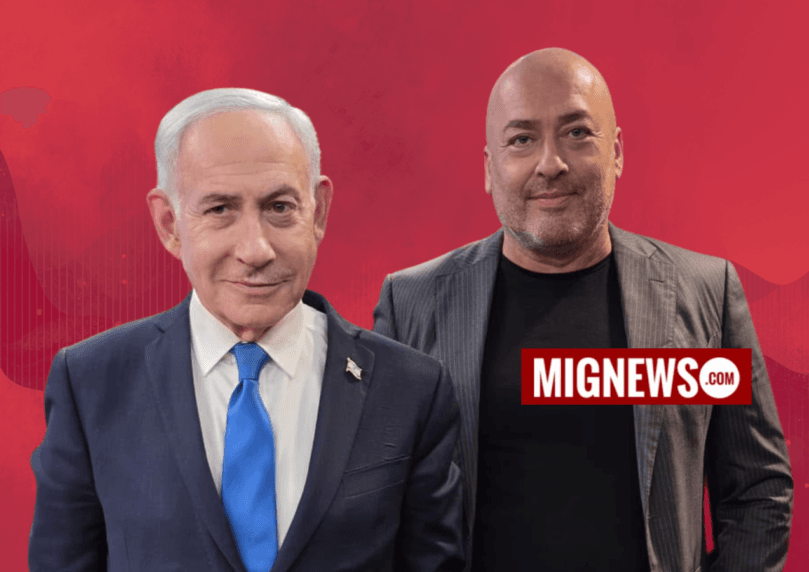
Prime Minister Benjamin Netanyahu’s recent remarks on possible sanctions, blockchain and the outlook for the Israeli economy sparked a heated debate and raised many questions. How justified are the fears for the country’s economic future? Is Israel prepared for mounting international pressure? And what really lies behind the prime minister’s words, which alarmed many Israelis?
In an exclusive phone interview with Boris Mirkin for Mignews on October 26, 2026, Prime Minister Netanyahu answered these questions, commented on the economic situation and explained his position on the challenges Israel may face. The conversation went beyond the economy. The prime minister also addressed his relationship with Donald Trump, the Iranian threat, the upcoming election and the investigation into the events of October 7.
Below is the full version of the exclusive interview with Israeli Prime Minister Benjamin Netanyahu.
BORIS MIRKIN, MIGTV: President Trump has once again called on people to support you and has given you his unequivocal backing. There has simply never been support on this level in the history of the State of Israel. How do you respond to that?
PM: Well, I really appreciate it. I think President Trump understands that we are facing a historic decision that will affect, first and foremost, what I will do, and in turn, the security of the United States.
We hit Iran hard. We hit them very hard, as he also noted regarding the two major operations we carried out. In the first, we went in alone and he joined us; in the second, we went in together and dealt them a heavy blow, preventing them from developing nuclear weapons that were on the verge of completion. In other words, we saved Israel from an immediate existential threat, but the regime still exists. It is battered and bruised, but like a wounded scorpion that will try again before it dies, it will try once more. And it is trying again to produce nuclear bombs, there is no doubt about that. And I have no doubt that if it gets its hands on one, it will use it against us. That is why what is at stake in these elections is the very existence of Israel.
If we hadn’t carried out the “Rising Lion” and “Roaring Lion” operations, we might not be here together right now, because we would be dead. We are currently fighting for our lives, using all our strength to eliminate this threat once and for all.
The directive I gave to the IDF and the Mossad is to finish the job: to topple the regime. It won’t take much more effort, and it’s possible. Now the big question is whether the people will give us the power to do so. That’s essentially what Trump is saying. I am ready to carry out this operation, as he said in his previous statement, but there is only one person with whom I will do this, and he was referring to me. That is why he is calling on the public to come and support me so that together we can eliminate the Iranian threat once and for all. That is the real issue in these elections. Everything else is secondary.
Blockchain, sanctions and the economy
MIRKIN: I want to ask you one more question now. I saw that you spoke about blockchain and about how we’ll have to live under sanctions. I think that 99.99 percent of the Israeli public doesn’t even understand what blockchain is, and everyone has started to panic a little. Now, we certainly won’t… we won’t turn into Sparta. We’ll be somewhere between Sparta and Athens. We won’t become the West’s crazy democracy, but we won’t be Sparta either. But people have panicked a bit. Could you calm people down a bit and explain what this is all about?
NETANYAHU: Yes, it’s an empty and foolish statement, just like the media channels tend to make every day, more or less every half hour.
First of all, you have to understand that our economy is very strong. They’ve tried to impose sanctions on us over the past three years, and we’ve thwarted every single one. We’ve thwarted them, first and foremost, because we have our own strengths: significant economic, technological, and other strengths. Our economy is now rebounding after three years of war, with the International Monetary Fund ranking Israel’s growth as the highest in the West, or more accurately, among the developed OECD countries. We will likely exceed their forecast, reaching close to 6.5 percent. They rank 4.5 percent as the highest among OECD countries, after three years of war.
Exports are at an all-time high. Imports, or rather, foreign investment into the country, are at an all-time high. The shekel is stronger than it has been in decades. Inflation stands at 1.5 percent. Excuse me. The average wage has risen by 6 percent. These are very, very strong indicators.
Israel is ranked by The Economist, the world’s most important economic newspaper, as one of the three most dynamic economies in the world, and this is after… Take note, take note, this is after three years of war. So I think I know, my colleagues, Finance Minister Smotrich, and I, as partners, that we’ve managed the economy excellently, just as we did during the COVID-19 pandemic, when we were the first to emerge from that crisis. We were the first economy in the world to emerge from the pandemic.
Therefore, there’s nothing to fear here. The attempts to impose sanctions failed, not only because of our capabilities and assets. They also failed because we waged a counter-campaign. Take the UK, for example, which wanted to impose sanctions on us: we closed its consulate and opened up many other large markets, such as India and others. I’m giving this as an example.
Now, it’s clear that we’re always preparing for situations that might arise. For example, there might be a drought; you prepare for it by storing water. That doesn’t mean there will be a drought, but you take steps to prepare for that possibility. We have considered and are considering dozens and dozens of measures, among which the topic of blockchain has come up. It’s too technically complex to explain here. It’s not important right now, but no decision has been made on this matter. It’s another possibility…
MIRKIN: …that’s clear.
NETANYAHU: I was simply asked about it, so I mentioned it as one of the things.
Pensions and the stock market
MIRKIN: Mr. Prime Minister, I have two more questions, if I may. Now, the question…
NETANYAHU: …the economy is very strong. By the way, do you have a pension?
MIRKIN: I… of course, of course I contribute to a pension.
NETANYAHU: Okay, so here’s another figure. As it turns out, when it comes to pensions, yes, people’s pensions, for middle-aged individuals, the average family will see massive sums added to their pensions over the course of three, or four, years of my administration. I want to check the exact number. It’s over 100,000 shekels, and it might even be 200,000 shekels. I’ll check the exact figure and I’ll be able to give it to you.
MIRKIN: Yes, definitely, I… I’ve also seen the results of our stock market over the last three years. I was invested there, so yes, it’s extraordinary.
NETANYAHU: No, you didn’t lose money.
MIRKIN: I didn’t lose money. Listen, I transferred everything to Israel. I no longer invest in the U.S. stock market.
Liberman and “Israel’s enemies”
MIRKIN: Now, Mr. Prime Minister, I have two more questions. Yesterday I saw Avigdor Liberman go on a rant, and this morning he went on a hysterical rant demanding investigations and accusing you of completely delusional things: that you spoke with the Chief of Staff and that you’re warning about what’s happening… it’s possible. I mean, how do you respond to that?
NETANYAHU: That’s borderline insane. The Chief of Staff himself said what we’ve all heard. I, the Defense Minister, and the Chief of Staff, we heard from the head of Military Intelligence and the head of the Mossad that Iran and its proxies will try to attack us and are trying to attack us, before the elections to influence them, and perhaps during them, to influence the course of the elections.
It’s no secret that all of Israel’s enemies want me to lose. Without exception. They say so themselves. Iran, Hezbollah, Hamas, Erdoğan, Mamdani in New York, Abu Mazen, here, and Mansour Abbas. Mansour Abbas and Mahmoud Abbas. They all want me to lose. Why do they want me to lose? Because they know they don’t have Israel’s best interests at heart. They want Israel’s destruction. They know that I will fight very hard, and together with President Trump, we will truly put the Iranian axis in its place. They understand this very well.
Now, as for Liberman, I think he’s in a panic. To be honest. Look, he pretends to be on the right. He has prevented a right-wing government time and time again. He systematically blocks the formation of a right-wing government. He talks like the right but acts like the left.
He said, when he joined the government that he himself had established, that it was with the Muslim Brotherhood. Benny Gantz said that the architect of this alliance between the Israeli left, Liberman, and the Muslim Brotherhood was Liberman. He just asked to be left out of the picture, out of the photo, but other than that, he was behind it.
Later, he explained why he took the Finance Ministry portfolio in that dreadful government. He explained that when there is a government dependent on the Muslim Brotherhood and Mansour Abbas, it leads to security paralysis, and that is why he took on the role of finance minister. As finance minister, he acted as the banker, the banker for Mansour Abbas, and transferred billions to pro-Hamas organizations that call for…
MIRKIN: Yes.
NETANYAHU: …which call Hamas a charitable organization.
So I’m just adding here that he’s probably really lost it, because a few days ago he said that what’s needed to maintain our security in Judea and Samaria is to bring in an Arab army: the Jordanian army.
MIRKIN: Yes, yes.
NETANYAHU: You heard all that.
MIRKIN: Yes, yes, of course, of course. We also published that.
NETANYAHU: Liberman, Liberman has lost it. He… I think he’s simply, simply pretending to be on the right. He’s entirely consumed by a lust for power that isn’t working out for him, and I think that… I call on people on the right: Don’t vote for him; don’t vote for Liberman.
MIRKIN: Mr. Prime Minister…
NETANYAHU: If you want a strong government, vote for me.
MIRKIN: Yes.
NETANYAHU: A strong right-wing government. And vote for the party…
The October 7 commission of inquiry
MIRKIN: Mr. Prime Minister, if I may, one last question, and it’s very important; it’s also a source of great concern for many people. Now, I remember that after 9/11, after what happened, the disaster in the United States, a decision was made there to establish a commission of inquiry, but the commission was supposed to be balanced. Fifty percent Democrats and fifty percent Republicans, so that no one in the country would be able to say they don’t trust the committee’s findings.
I also thought that the event that took place on October 7 was an extraordinary event. That is to say, it cannot be managed and investigated by a regular committee. Now, that’s one of the reasons… I understand that you also wanted to do this, but it didn’t pass. Now the opposition is still insisting that they want a State commission of inquiry. Now, how do you respond to that? When will you establish it, and in what form?
NETANYAHU: Look, first of all, I think you’re absolutely right. That was my proposal, and we’ll establish it after the elections. God willing, we’ll win, so we’ll be able to do it.
What’s important is to understand this: we’re proposing a commission of inquiry where half of the members will be appointed by the opposition and half by the coalition, and each side will be able to bring in whoever they want and address any issue they want.
What they’re calling a “state commission of inquiry” is anything but state-run. This means that Supreme Court Justice Yitzhak Amit will chair, yes, he will chair, the committee. It’s a committee that’s entirely politically dictated. Its outcome is a foregone conclusion, and besides, the court itself, the judicial system itself, needs to be investigated. So the proposal we’re putting forward is the only thing that will truly reveal the whole truth.
And by the way, just to illustrate this, there was also a commission of inquiry, or rather, a mechanism, a review committee led by the State Comptroller. That’s his role, alongside everything else he does. He investigated for a year, requesting materials from the Chief of Staff. The then-Chief of Staff, Herzl Halevi, played games and didn’t want to cooperate; he also requested materials from the then-head of the Shin Bet, Ronen Bar. He played games, trying to prevent it. He turned to me, and I said, “Please, take it all.” I brought him nearly a thousand documents, a thousand documents that would show exactly what happened, how it happened, and who did it.
And there was a revelation there, because it was so completely the opposite of everything presented on the left-wing TV channels. And then something amazing happened. A few days after I gave the documents to the State Comptroller, the High Court of Justice, the very same High Court headed by Yitzhak Amit, ordered the State Comptroller to immediately cease the investigation. For a whole year, they had done nothing. The moment I brought the documents proving exactly what happened there, they stopped the investigation.
What does this mean? It means we don’t need an investigative committee, which they call “state-level,” established by the High Court of Justice, where the results are predetermined. I could also have established a government investigative committee where I determine who the members would be. I said neither one nor the other. An equal, parity-based commission of inquiry in which the opposition appoints half of the members and the coalition appoints the other half. That’s the right thing to do, and we’ll do it if we truly win. If the people who are reading this or listening to us right now truly give me their vote, that’s exactly what I’ll do.