


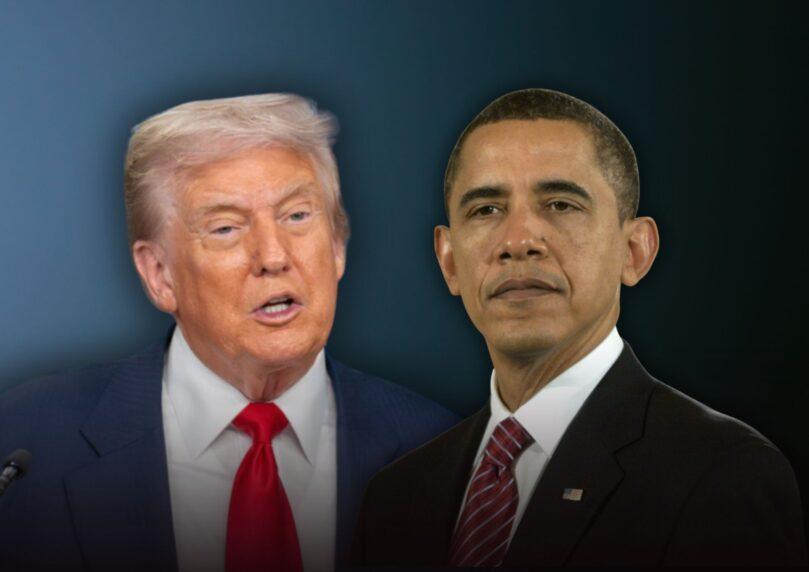

Former U.S. President Hussein Barack Obama ridiculed President Donald Trump during a campaign rally in Cleveland, Ohio, on Saturday evening, comparing the administration’s White House architectural renovations to an ostentatious restaurant chain commissioned by an Iraqi dictator.
Appearing to bolster Democratic candidates ahead of the upcoming midterm elections—specifically Ohio gubernatorial nominee Amy Acton and incumbent Senator Sherrod Brown—Obama delivered a speech skewering Trump’s executive priorities, his management of the economy, and his military campaign against the Iranian regime.


 3+
Turning his attention to the ongoing infrastructure and aesthetic modifications across the executive mansion complex, Obama told an audience of thousands: “I don’t know if you’ve noticed, but he seems very focused on home renovations. He should be on HGTV.” Referencing the popular American home improvement cable channel, Obama listed several marquee projects initiated by Trump, including the construction of a permanent event ballroom, alterations to the historic Rose Garden, and the installation of a fortified helicopter landing zone on the South Lawn.
Mocking Trump’s well-documented preference for gilded finishes and imposing visual displays, Obama added: “He made the White House look like Saddam Hussein opened a branch of The Cheesecake Factory”—drawing laughs by blending the eclectic, heavy interior styling of the American restaurant chain with the gaudy palace aesthetics associated with the former Iraqi dictator.
 3+
Since returning to office, Trump has carried out a series of structural modifications to the executive residence. In 2025, the administration directed the paving of the Rose Garden’s central lawn with limestone pavers, turning the space into a permanent plaza for official state receptions, international press briefings, and bilateral summits, while leaving original rose plantings along the perimeter.
This past September,
Trump formally dedicated a newly upgraded Marine One landing pad featuring dedicated granite paving and an inlaid presidential seal,
where the presidential aircraft was photographed operating during an official unveiling ceremony on September 21.Another flagship project involves replacing the temporary canvas pavilions traditionally pitched for state dinners with a permanent,
fully enclosed, and secure ballroom on the grounds—a requirement first documented in National Park Service environmental impact studies as early as 2000. 3+
Obama seized upon the construction works to argue that the administration’s focus was detached from the economic concerns of ordinary voters. However, critics quickly contrasted Obama’s barbs with the contentious construction of his own presidential center in Chicago.
The sprawling compound, centered around a towering granite structure that critics labeled the “Obamalisk,” has drawn severe domestic scrutiny.
Fox News reports indicated that construction costs for the Obama Presidential Center have eclipsed $1 billion—nearly triple the initial $350 million estimate.
The development has also been dogged by allegations from local trade subcontractors who said they were left with millions of dollars in unpaid balances, along with criticism over the spending of hundreds of millions in municipal public tax dollars on environmental remediation and transportation re-routing around the site. 3+
Beyond architectural jibes, Obama devoted a major segment of his address to the escalating military conflict with Iran, holding Trump directly accountable for domestic inflation. “Most importantly, he decided to start an unnecessary war that nobody asked for and nobody voted for,” Obama declared,
arguing that military operations in the Persian Gulf directly fueled spikes in global oil benchmarks and burdened working-class American households at the gas pump.
Obama defended the Joint Comprehensive Plan of Action (JCPOA), the nuclear agreement negotiated by his administration in 2015: “Iran didn’t have a nuclear weapon because I negotiated a deal that everybody knows stopped them from getting a nuclear weapon.”Trump formally withdrew the United States from the JCPOA during his first term in 2018, citing fundamental structural deficiencies in the pact, including sunset provisions that lifted restrictions over time and the treaty’s total failure to restrict Iran’s ballistic missile development or its funding of regional terrorist proxy networks across Lebanon, Yemen, and the Gaza Strip. Following Washington’s exit and the reimposition of primary energy sanctions, Tehran systematically breached enrichment thresholds, advancing fissile purity levels far beyond the limits established in the original 2015 framework.