




With just six days remaining until the election for the 26th Knesset, a new Channel 14 poll conducted on Wednesday by NEXT DATA and analyzed by Shlomo Filber outlines a precarious trajectory for Yisrael Beitenu chairman Avigdor Liberman. The veteran politician, who has campaigned to position himself as a pivotal powerbroker and prospective prime minister, has seen his party drop toward the electoral threshold danger zone.
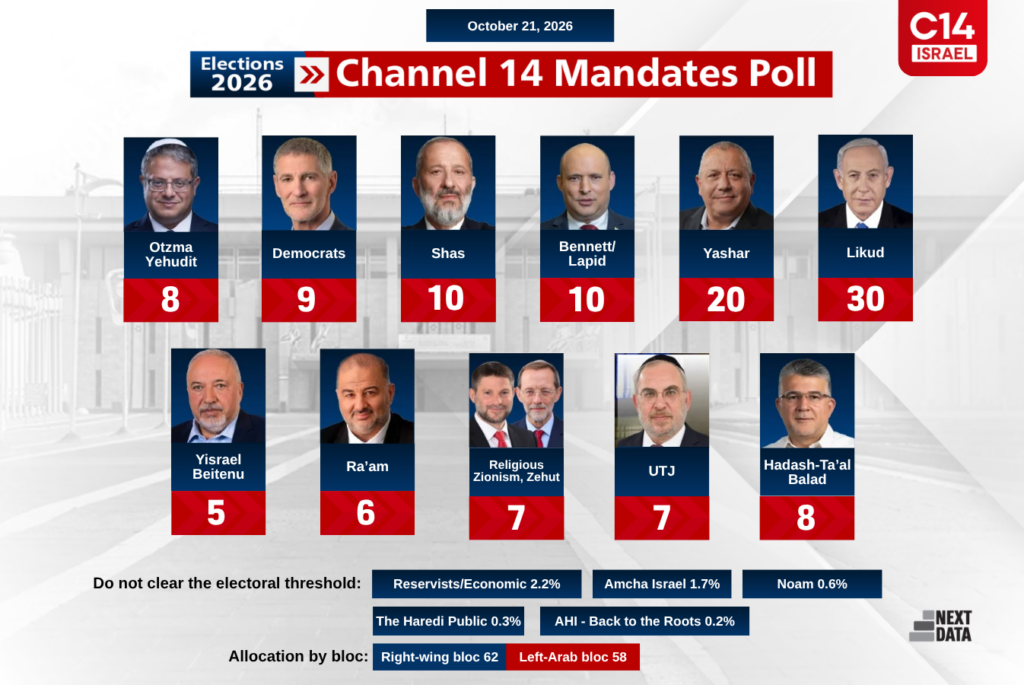
According to the survey, Yisrael Beitenu slips to just 5 mandates, down from 6 seats recorded in Tuesday’s poll. Liberman’s standing is similarly diminished in prime ministerial suitability metrics. When respondents were presented with four leading candidates, Prime Minister Benjamin Netanyahu commanded 53% of public support, followed by Gadi Eisenkot at 33%, Naftali Bennett at 9%, and Liberman capturing a meager 5%—dropping from 6% a day earlier. While Liberman weakens, the national right-wing bloc maintains a solid governing majority of 62 seats, mirroring earlier projections. Likud under Benjamin Netanyahu remains Israel’s largest party with 30 mandates, preserving a ten-seat advantage over Gadi Eisenkot’s Yashar party at 20 mandates.
The primary beneficiaries in Wednesday’s survey are Aryeh Deri’s Shas and the Beyachad list, both crossing from single digits into double digits to secure 10 mandates each. Yair Golan’s Democrats hold at 9 seats, while Itamar Ben-Gvir’s Otzma Yehudit and the joint Hadash-Ta’al-Balad slate each secure 8 mandates. United Torah Judaism (UTJ) registers a slight decrease from 8 to 7 seats, matching the 7 mandates recorded for the joint Religious Zionism and Zehut slate. Mansour Abbas’s Ra’am faction retains 6 seats, while Yisrael Beitenu closes out the parliament with 5 seats.


In the broad bloc allocation, the right-wing camp commands 62 seats, non-Arab opposition parties stand at 44 seats, and Arab factions represent 14 seats. The continuous model compiled by Filber shows an unencumbered path for Netanyahu to form a stable right-wing coalition without relying on external political support. In the direct two-way prime ministerial suitability contest, Netanyahu preserves a ten-point lead over Eisenkot, garnering 55% compared to Eisenkot’s 45%.
Among parties failing to clear the 3.25% electoral threshold, further compression was noted: the Reservists/Economic list dropped to 2.2% (down from 2.5%), Ofer Winter’s Amcha Israel fell to 1.7% (down from 1.9%), Noam registered 0.6%, The Haredi Public drew 0.3%, and AHI – Back to the Roots recorded 0.2%. The survey was conducted on October 21, 2026, by polling institute NEXT DATA, sampling a representative cross-section of 1,954 eligible voters across the Israeli adult population, with data analysis provided by Shlomo Filber.