


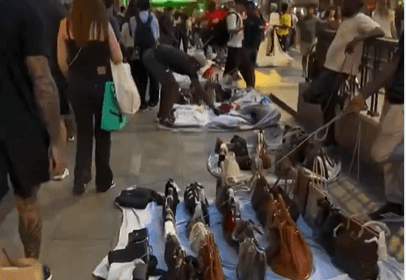

The sidewalks of the French capital have transformed into open-air black markets in the aftermath of another weekend of widespread civil unrest and commercial pillaging. Video documentation circulating across social media platforms shows vendors in Paris openly hawking luxury apparel and designer accessories looted from commercial boutiques directly to pedestrians on city streets. The footage depicts hawkers laying out high-end handbags and branded garments along makeshift ropes, hurriedly packing up their merchandise whenever police details approach.
Video: social media
The illicit trade in stolen merchandise has also rapidly expanded into the digital sphere. Within hours of the retail break-ins, digital secondhand marketplaces—most notably the Vinted mobile platform—were inundated with thousands of fresh listings offering luxury perfumes, designer handbags, high-end skincare, and even rare collectibles at rock-bottom prices. Bulk cosmetic bundles plundered from Sephora beauty outlets were listed for as little as 10 to 15 euros, with several sellers explicitly or implicitly advertising the inventory as goods acquired during the street riots.
In response to the brazen fencing of stolen property, Minister for Digital Affairs Anne Le Hénanff issued an urgent demand to senior executives at Amazon, eBay, Meta, and TikTok, instructing them to purge their platforms immediately. Meanwhile, the Ministry of the Interior and the Ministry of Justice began legal proceedings to compel technology providers to surrender user identification records and IP addresses to help arrest and prosecute online fences.
Video: social media
The nationwide wave of unrest, which drew over 500,000 individuals into the streets across multiple French metropolitan centers, initially surfaced under the banner of high school and university protests against inflation and degrading public services. However, the rallies rapidly devolved into coordinated mass looting, the arson of vehicles and civic infrastructure, and violent clashes with security personnel. More than 3,000 commercial enterprises and retail establishments have been broken into and ransacked, leaving hundreds of police officers and gendarmes injured.
After the unprecedented escalation, French Interior Minister Laurent Nuñez publicly acknowledged that law enforcement elements had lost control of the streets and were unprepared for the scale of urban chaos. Nuñez tendered his official resignation to President Emmanuel Macron, who refused to accept it. To stem the looting, Prime Minister Sébastien Lecornu instituted localized curfews in severely impacted municipalities. Police forces have arrested over 2,400 rioters to date, and the government announced emergency legislation designed to force convicted offenders to cover property restoration costs directly.
Video: social media
Beyond the physical devastation and severe economic fallout—which includes hundreds of millions of dollars in damages, domestic stock market volatility, and spiking French sovereign bond yields—the disorder has laid bare profound ideological fractures and an assertive Islamist street presence. A recent investigation by Fox News established that an organized umbrella network of 54 radical organizations deliberately stoked the unrest, including radical Islamist movements, far-left factions, communist organizations, and pro-Palestinian activists waving PLO banners throughout Paris to sow civil disorder ahead of upcoming presidential elections.
The ongoing lawlessness has also drawn sharp international rebuke, including from former U.S. President Donald Trump, who criticized Macron’s accommodating immigration policies and warned that at this trajectory, “Paris will become a Muslim city quite soon.” Macron himself faces fierce domestic criticism for traveling abroad at the height of the domestic security crisis. In the meantime, the local French Jewish community has borne the brunt of the street radicalization, finding itself caught in the crosshairs of an escalating wave of anti-Semitism. Jewish citizens across major French cities have voiced genuine fears for their physical safety amid targeted intimidation by radicalized rioters exploiting the pervasive vacuum in civil law enforcement.