


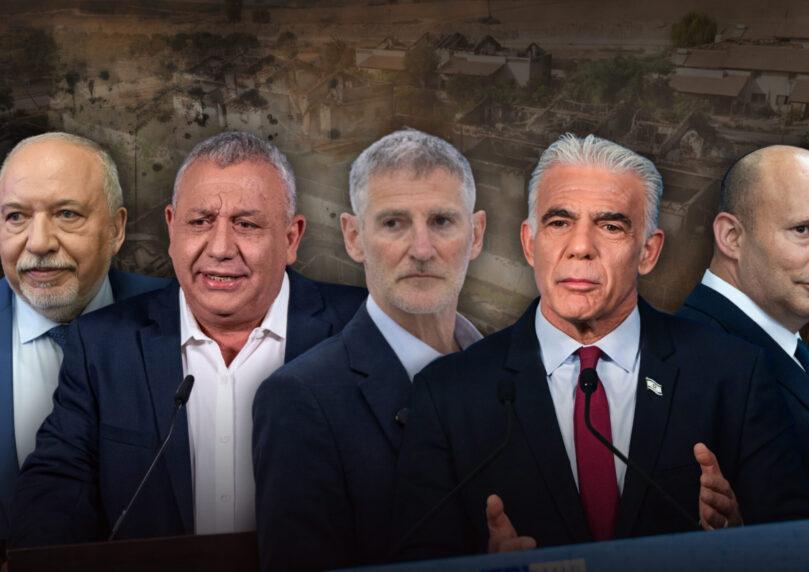

The battle within the opposition bloc is intensifying: The “largest party” campaign led by Yashar party chairman Gadi Eisenkot continues to draw fire from opposition party leaders opposing Prime Minister Benjamin Netanyahu. After a sharp attack by Yisrael Beiteinu chairman Avigdor Liberman, Yesh Atid chairman Yair Lapid and Democrats chairman Yair Golan joined the criticism Saturday of the strategy Eisenkot is pursuing ahead of the elections.
In an interview on “Meet the Press,” Lapid criticized the attempt to make Yashar the largest party in the Knesset, noting that similar strategies have failed in the past to replace the government. “We’ve tried the largest party campaign four times—and in all of them Netanyahu ended up as prime minister,” he said.
Democrats chairman Yair Golan was even more blunt. In a post on X, he made clear that in his view, the political battle shouldn’t focus on the size of a single party, but on the overall strength of the bloc. “The bloc decides. Not the largest party,” he wrote.
Lapid and Golan’s statements join Liberman’s criticism and illustrate the widening dispute within the opposition over how to run the election campaign: whether to work to increase the bloc’s overall strength, or concentrate as many seats as possible in one party.
The Campaign Stirring Up the Opposition
In recent days, the Yashar party has begun promoting a campaign aimed at making it the largest party in the Knesset, attempting to overtake Likud in the number of seats. The campaign’s central message is that only a large party can receive the mandate to form a government and lead to replacing Netanyahu.
But the strategy is drawing opposition from opposition parties, which fear the move will mainly lead to voter migration between the anti-Netanyahu parties, rather than transferring votes from the coalition bloc.
The possible implication is that Eisenkot will indeed grow stronger at the expense of his potential partners, but the bloc’s total number of seats won’t necessarily change. According to the campaign’s critics, this could create a situation where the Yashar party grows without improving the bloc’s ability to form a government.
It’s important to note that contrary to the message emerging from the campaign, the law doesn’t require the president to assign government formation to the head of the largest party. The decision is made after consulting with the factions and according to the president’s assessment of the candidate’s chances of forming a government.
Liberman: “Gadi Eisenkot—Benny Gantz 2”
The sharpest criticism of Eisenkot came Friday from Yisrael Beiteinu chairman Avigdor Liberman, who published a direct attack against him under the headline “Gadi Eisenkot—Benny Gantz 2.” Liberman argued that the “largest party” campaign isn’t designed to transfer voters from Netanyahu’s bloc to the opposition bloc, but to pull votes from other parties within the bloc itself.
“The ‘largest party’ campaign that Eisenkot is running isn’t designed to transfer a single vote from the draft-dodgers bloc to the serving bloc, but is designed to siphon votes within the bloc itself,” Liberman wrote. According to him, the move contradicts the understandings reached between bloc leaders at their last meeting on September 26, and undermines the attempt to present a united front ahead of the elections.
Liberman raised an even sharper claim—that Eisenkot wants to become larger than Likud in order to reach a possible government formation negotiation with Netanyahu from a position of strength. “Gadi Eisenkot is planning for the day after the elections, and what interests him is not being the largest party in the serving bloc, but being larger than Likud and reaching a position of strength for negotiations to form a government with Netanyahu,” Liberman claimed.
Eisenkot Rejects the Claims: Voters Are Coming from Likud
For his part, Eisenkot rejects the criticism and argues that his party’s growth isn’t happening only at the expense of his opposition partners. In an interview he gave this week to Ben Caspit at Walla, Eisenkot claimed that according to internal surveys his party conducted, about 18% of Yashar voters come from coalition parties, mainly from Likud.
Eisenkot explained that his goal is to create a party significantly larger than Likud, which can demand the mandate to form a government and lead to establishing a stable government. He also claimed that none of the four main parties in the bloc is in danger of the electoral threshold, so there’s no obstacle to focusing on increasing Yashar’s strength.
The Battle for Seats—and the Fight Over Bloc Leadership
Behind the dispute over the “largest party” campaign also stands the question of leadership the day after the elections. While Eisenkot seeks to establish his position as head of the largest party, his potential partners in the opposition aren’t committed to accepting his leadership. Lapid, Golan and Liberman are now presenting, each in his own way, a position that the bloc’s total number of seats is more important than the size of a single party.
This debate isn’t merely semantic. Even if Yashar becomes the largest party in the Knesset, it will need the support of additional parties to form a government. On the other hand, even a party that isn’t the largest can receive the mandate to form a government if it succeeds in building broader political support.