



The Ministry of Transport, through its Emergency, Security, Information and Cyber Division and the Aviation Security Operations Center (ASOC), issued an official clarification to its 2026 security directive on October 7, 2026, setting stringent regulations for crew vetting and nationality restrictions. Effective immediately, the requirements apply to all aircraft operators and commercial airlines operating flights to Israel or transiting its sovereign airspace.
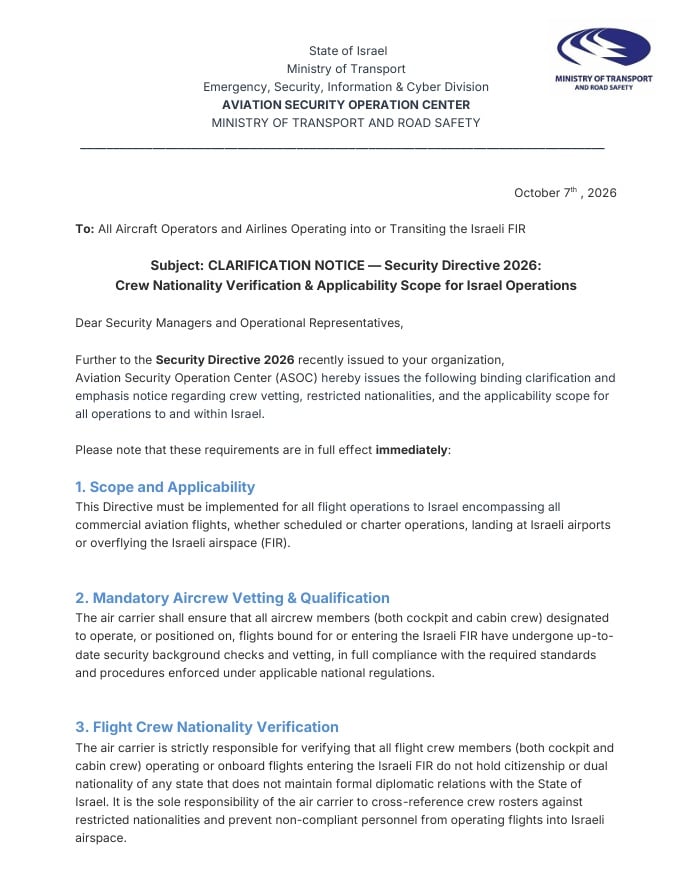
According to the official circular, the requirements govern all commercial flights—both scheduled passenger routes and charter services—landing at Israeli airports or traversing Israeli airspace. Airlines must immediately align crew rosters and operational protocols with the updated criteria as part of heightened security readiness for Israel-related flights.
-
Mandatory Background and Security Checks for All Crew Members
Airlines must verify that all crew members assigned to operate flights, in both the cockpit and the passenger cabin, have undergone updated background and security vetting. Screenings must comply fully with current national standards and regulations. The mandate applies to crew members on flights arriving in Israel or entering its airspace.
-
Nationality Verification and Barring Restricted Citizenships
Airlines must ensure that crew members do not hold citizenship, including dual citizenship, from any state that does not maintain formal diplomatic relations with Israel. Under the directive, the carrier bears sole operational responsibility for auditing crew rosters against the restricted nationality registry and preventing the deployment of non-compliant personnel.
-
Immediate Operational Alignment
Airlines must immediately adapt crew scheduling and operational protocols to meet the directives across scheduled timetables, charter operations, and overflight clearances. Airlines must ensure assigned personnel meet all prerequisites before dispatch.

The directive assigns airlines sole legal and operational responsibility for conducting background vetting, validating nationalities, and cross-checking crew rosters against restricted lists. However, the document does not specify whether crew manifests must be transmitted to a specific security agency, how they must be submitted, or the exact reporting protocols required. Consequently, the document does not identify the data recipients.
The Ministry of Transport cautioned that failure to adhere to the directives may lead to the immediate revocation or suspension of permits to enter Israeli airspace. Airlines are instructed to execute the guidelines across all relevant flight operations with immediate effect.

-
Extension to Cabin Crews: In the initial phase immediately following the terror incident, the Ministry of Transport mandated that foreign airlines perform background checks on all personnel, while nationality bans—covering states lacking diplomatic ties with Israel, such as Oman or Syria—applied strictly to cockpit crews (captains and first officers). In the updated October 7 clarification, authorities significantly tightened the rules, extending the blanket nationality ban to cabin crews as well.
-
Pre-Clearance Digital Visas in Progress: Against the backdrop of the directives, Israeli authorities are advancing a technological and regulatory system that requires foreign aircrews (and passengers) to obtain an electronic pre-clearance permit (aviation visa) 24 to 48 hours before takeoff. This mechanism will permit Israeli intelligence and security bodies to independently screen manifests rather than relying exclusively on carrier oversight.
-
Expanded Scope to Overflights: While past supervision focused primarily on flights landing at Ben Gurion Airport, the updated guidelines expand screening mandates to overflights. Airlines must now ensure flight crews meet all security checks and nationality restrictions even when merely cruising through Israeli airspace.