


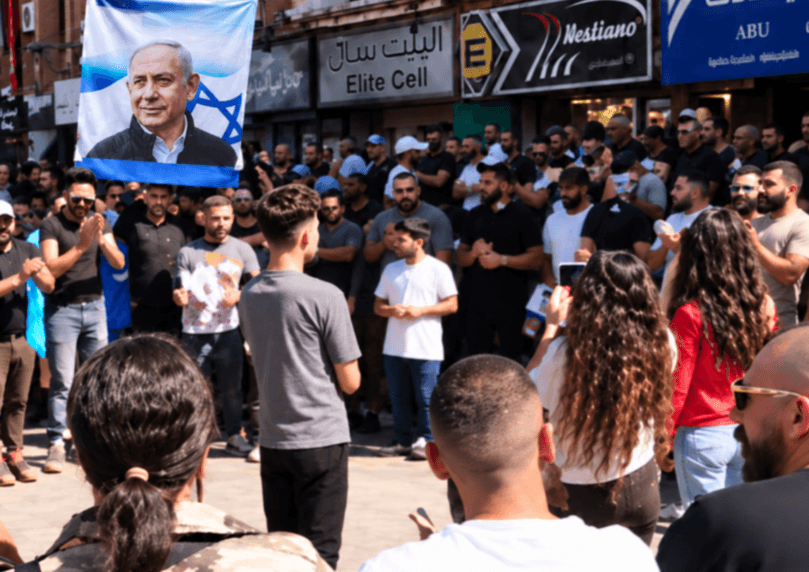

While anti-Israel demonstrations erupted in several corners of the globe marking the anniversary of October 7, non-Jewish minority communities across the region stepped forward in a historic display of solidarity with Israel and the Jewish people. While Jewish communities worldwide gathered in solemn prayer and commemoration, the most striking scene took place on Wednesday in the Suwayda Governorate of southern Syria.
Video: social media
Marking three years since the October 7 atrocities, thousands of Druze gathered in Al-Karama Square, the heart of the Druze provincial capital, openly expressing solidarity with Israel and vocal support for Prime Minister Benjamin Netanyahu. Demonstrators drew an explicit line connecting the victims of the October 7 massacre to their own community’s victims slaughtered in July 2025, when thousands of Druze were butchered and hundreds abducted by forces aligned with extremist Islamist factions. Such an overt demonstration of public solidarity is unprecedented in modern Middle Eastern history.
Participants carried signs declaring solidarity with Israel, with messages such as: “The massacres and violence that targeted civilians in Israel” paired alongside the fallen of Suwayda, emphasizing that both nations confront “religious and political extremism and brutality.” Another widely displayed banner read: “The massacres are numerous; the perpetrator is one.”
Video: social media
During the march culminating in Al-Karama Square, marchers waved Israeli national flags alongside the multi-colored Druze banner, brandishing portraits of local Suwayda leader Sheikh Hikmat al-Hijri, Prime Minister Benjamin Netanyahu, and Sheikh Mowafaq Tarif, the spiritual leader of the Druze community in Israel. One prominent sign placed adjacent to Netanyahu’s portrait proclaimed that the “Druze of the Bashan (Suwayda) stand with you.” At the same time, other banners stated firmly: “We will not forget, we will not forgive.” Senior regional figures and local National Guard commanders were among the crowd.
The direct comparison drawn throughout the gathering framed the July 2025 Druze massacre in southern Syria as identical in nature and barbarity to October 7. In the summer of 2025, Druze villages across the governorate were invaded, enduring mass executions, kidnappings, and systemic displacement. Following those attacks, Israel targeted Damascus in a stated bid to safeguard the besieged Druze population. The rally’s message was unmistakable: those who murdered families on the mountain and those who slaughtered Israeli citizens represent the same brand of violence. Demonstrators carried photos of local victims alongside portraits of Israelis butchered on October 7.
A Divided Germany
A similar phenomenon played out in Europe. While anti-Israel marches in Berlin accused the Jewish state of atrocities, thousands of counter-demonstrators from diverse ethnic and cultural backgrounds organized massive rallies supporting Israel. Middle Eastern minority communities with historical experience facing persecution and massacres—including Kurds, Alawites, and pro-Israel Iranian dissidents—marched through German streets to condemn the October 7 atrocities.
The pro-Israel rallies featured the national flags of Kurdistan, Alawite community symbols, and the historical pre-revolutionary Iranian Lion-and-Sun flag. Each of these communities shares an intimate historical trauma: Kurds murdered in the hundreds of thousands under Saddam Hussein’s regime; Iranians persecuted by the Islamic Republic; Alawites targeted by extremist factions in Syria; and the Druze enduring persistent jihadist assaults.
Video: social media
Israel Defends Minorities in the Middle East
Through shifting geopolitical realities, Israel is increasingly positioned as a natural protector and strategic partner for vulnerable minority populations across the Middle East. This dynamic mirrors historical precedents, such as Israel’s clandestine support for the Kurds in Iraq when they faced existential threats, and its strategic alliance with Lebanese Christians during the First Lebanon War. Facing regional extremism, these communities view the alliance with Israel as a vital safeguard for survival.