


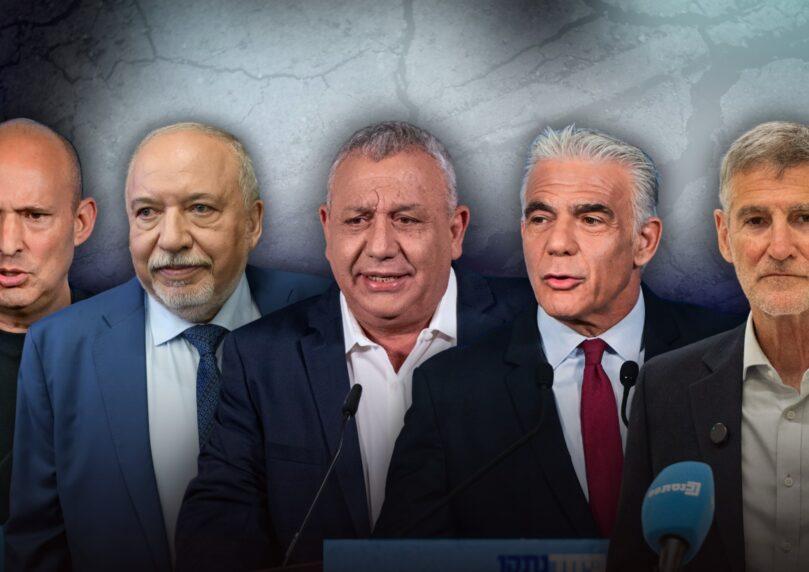

Just weeks ahead of Israel’s 2026 general election, and coinciding with the third anniversary of the October 7 massacre, an exclusive Channel 14 poll evaluated how recent security developments and political maneuvering are shaping voter preferences—and what the electorate thinks of various post-election coalition scenarios. When asked whether opposition parties are exploiting October 7 memorial events for political campaign propaganda, 55% of respondents answered yes, 40% said no, and 5% expressed no opinion.


 2+
Respondents were also asked: If it emerges that Gadi Eisenkot cannot establish a governing coalition without the support of Arab parties, which option would you prefer? 52% indicated they prefer a government led by Benjamin Netanyahu, compared to 43% who prefer an Eisenkot-led minority government backed from the outside by Arab factions. 5% remained undecided.
 2+
Marking three years since the massacre in the Gaza envelope, voters were asked which primary factor will determine their choice of political bloc: 48% stated that accountability for the failures leading to October 7 will dictate their vote, 47% cited the management of the war from October 7 onward, and 5% had no position.
In the event of an electoral deadlock, voters were asked what outcome they would prefer to see:
-
26% favored the formation of a coalition backed by Arab parties
-
23% preferred a national unity government
-
21% favored a party defecting from the center-left to the right
-
21% preferred heading to another round of elections
-
9% favored a party crossing over from the right to the center-left
 2+
Addressing retired Brig. Gen. Ofer Winter’s pledge to drop out if his party consistently polls below the electoral threshold, respondents were asked whether he should withdraw immediately. 58% said yes, 25% said no, and 17% had no opinion. Asked whether aggressive campaigning against the ultra-Orthodox community would influence their ballot choice, 75% said it would not affect their decision, 22% said it would, and 3% held no view.
Regarding the recent security scare involving an attempted hijacking on a flydubai flight to Tel Aviv, participants were asked who bears principal responsibility for the oversight: 41% pointed to Transportation Minister Miri Regev, 29% blamed the Shin Bet and the Mossad, 8% faulted the Prime Minister, and 22% attributed blame to none of the above. Finally, when asked to rate Minister Regev’s overall performance in handling security screening for inbound international flights to Israel, 63% rated her management as poor, 23% rated it as good, and 14% said they had no stance on the matter.