


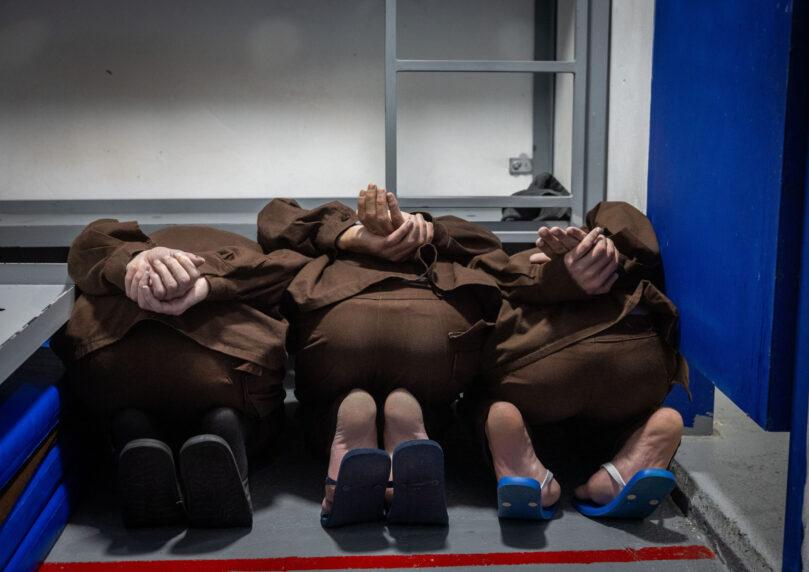

Three years after the October 7 atrocities, the Knesset Constitution, Law and Justice Committee convened Wednesday for an urgent follow-up hearing on implementing the special law to prosecute Hamas terrorists—a legislative initiative jointly launched by committee chairman MK Simcha Rothman and MK Yulia Malinovsky. The session, which opened with a moment of silence and prayer, revealed a complex picture of progress in building the judicial apparatus and the enormous challenges still facing law enforcement.


 3+
Alongside briefings from professional officials on infrastructure development, staffing, and coordination with Israel Police, the hearing exposed a troubling figure: beyond the roughly 400 terrorists already interrogated, there are hundreds more individuals against whom there is clear and prominent suspicion of direct involvement in the massacre, but whose interrogations have not yet been completed.
Contrary to popular perception, the new apparatus doesn’t focus solely on Nukhba force terrorists, but is meant to exercise jurisdiction over all terrorists who crossed the border into Israel that day, as well as terrorists who held Israeli hostages—even if the captivity occurred at later dates. The scope of potential crime victims connected to these proceedings is estimated at around 12,000 people.
 3+
MK Yulia Malinovsky drew a firm, uncompromising line during the hearing, demanding an end to all bureaucratic delays: “If there are problems we’ll solve them and if we need to pound the table we will, but we want results. The people of Israel deserve answers. We did what we needed to do, we passed the law, and now every official needs to put aside personal whims and disputes and rise to the magnitude of the hour. Regardless of election results and who sits in this chair, we won’t let up. We owe this to the families.”
For his part, committee chairman MK Simcha Rothman emphasized the significance of holding the session on the anniversary itself: “On this day, October 7, three years after the event, this is an important point in time to understand where the State of Israel stands in light of the verse we just read—’Avenge the blood of your servants which has been shed.’ The very important mission regarding the blood of our sisters and brothers who were murdered is that the state ensures it doesn’t let this pass.”
 3+
Rothman praised the unity in the Knesset, noting that the coalition and opposition are working together as one out of supreme national urgency. Similar sentiments were voiced by MK Moshe Saada, who emphasized the explanatory and moral dimension of the proceedings: “The voice of our brothers’ blood cries out from the ground, the images cry out, and what lies before us is doing justice and through the trial also telling the world. Today we see other narratives in the world and the time has come for us to show and tell the unequivocal truth.”
As mentioned, the law establishing the special tribunals was approved last May by an overwhelming majority of 110 Knesset members. Since then, the IDF has taken responsibility for three critical areas: the prosecution apparatus, the judicial apparatus, and handling crime victims.
 3+
Physically and from an infrastructure perspective, the dedicated court is planned to operate in the Atarot area of Jerusalem, with proceedings conducted before three-judge panels. To fund the massive project, the government approved a budget in June of over one billion shekels (~$325 million) spread across 2026–2029, including construction of buildings, development of information systems, tight security, and establishment of a complex logistical mechanism for transporting the terrorists.
However, given mountains of investigative materials, numerous testimonies, and the enormous number of defendants, the timeline is expected to be lengthy: 2027 has been designated as the main preparation year for appointing judges and building the framework, while the trials themselves are expected to begin only during 2028—a process that will naturally last several long years. The figure about the hundreds not yet interrogated only illustrates the magnitude of the challenge facing authorities: completing investigations while simultaneously building a court system from scratch.