


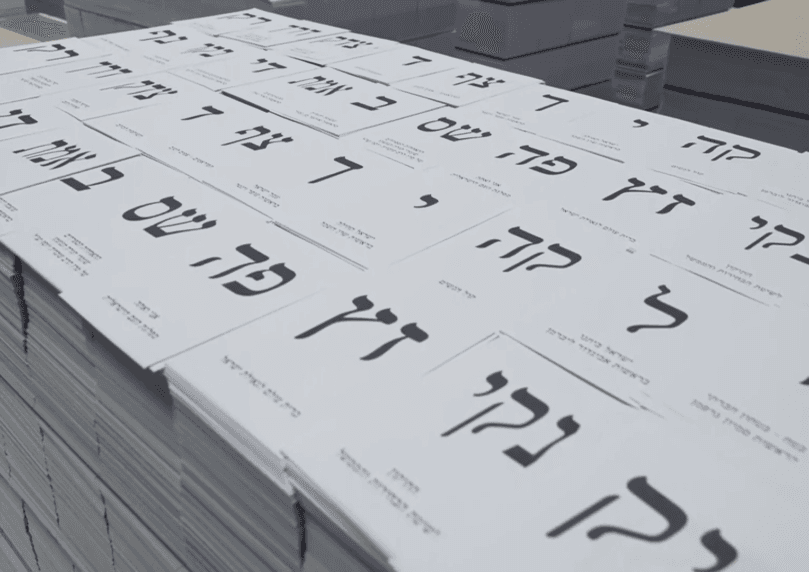

Every few years, the familiar Israeli ritual returns: walk into a neighborhood school, show ID, receive a blue envelope, and stand before a tray piled with paper slips. In a country where you can transfer money, order a passport, and sign documents from your phone, the most important decision a citizen makes still happens with a piece of paper.
The scene raises a simple question: Why doesn’t Israel, which prides itself on being the “Start-Up Nation,” allow voting with the click of a button? Moving to computerized voting could speed up counting and save printing millions of slips. But when it comes to elections, what looks outdated may actually be an advantage.
The Digital World Is Still the Minority
Several countries have moved significant parts of their election systems into the digital world. Brazil and India vote using machines placed in polling stations, and Estonia allows internet voting alongside the option to go to the polls.
But these are still not the accepted methods in most of the democratic world. About 84% of democratic countries continue to rely on paper ballots, including countries that returned to paper after experimenting with electronic voting.
The main reason is a danger Israel knows well: cyberattack. A digital system could be a target for hacking, disruption, or attempted interference by a foreign state. Even if the attack didn’t succeed in changing a single vote, the mere suspicion could cause millions of citizens to doubt the result.
The Advantage Hidden Inside the Envelope
The paper slip has a simple feature that computers struggle to replace—you can go back to it. When a claim of fraud, error, or irregularities is filed, you can open the ballot box and count the slips again.
 2+
2+In a digital system without physical documentation, there’s essentially nothing to recount. If suspicion arises that the computer recorded a different vote than the voter intended, it’s hard to prove what actually happened—especially since voting must be secret and you can’t create a database linking each citizen to the party they chose.
Even in the upcoming elections, no technological revolution is expected behind the curtain or anywhere else. Israel continues to deal with concerns about foreign interference attempts, and the law itself stipulates that voting for the Knesset will be conducted using slips and envelopes.
More Than 7.3 Million Voters—Plus 30%
The Central Elections Committee explains that Israel’s voting method isn’t just a longstanding tradition, but a system anchored in law. It’s based on slips and envelopes, and allows maintaining voting secrecy and conducting physical counting and verification of every vote.
 2+
2+“This method is simple and accessible,” the committee said, and it allows “conducting the vote secretly and performing counting and verification of votes physically.” According to them, using paper slips also “prevents cyber threats or election manipulation through technological means.”
Maintaining the system has a noticeable environmental cost. The law requires printing slips according to the number of eligible voters—more than 7.3 million Israelis—plus an additional 30%. That means millions of slips, alongside envelopes and other election materials.
 2+
2+The committee emphasizes that it operates according to law, but tries to minimize the environmental damage caused by the printing volumes. After the election, they say, “over 40 tons of paper and cardboard will be sent for recycling.”