


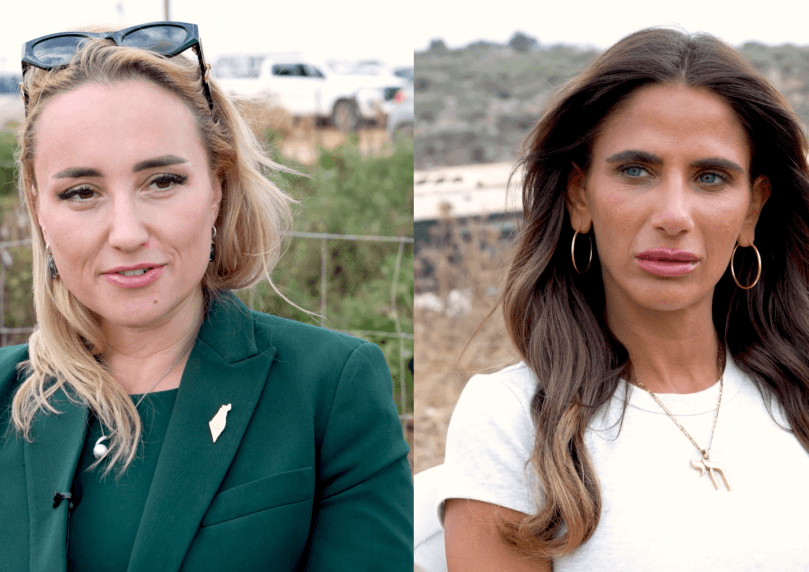

Prominent American Zionist influencer and advocate Lizzy Savetsky spent an immersive day traveling across Samaria, using the opportunity to spotlight the Jewish people’s unbreakable historical roots in the region, its indispensable military topography, and the growing disconnect between American media narratives and the reality on the ground.
EXCLUSIVE: “I realized after October 7th that there was never going to be a two-state solution.” American Zionist activist @LizzySavetsky goes over the ‘Green Line’ with C14’s @SophiaTupolev, straight to the booming ranches in Judea and Samaria – where 100K Israelis spent this Sukkot holiday.
“What is ‘Palestine?’ – They don’t even know what they mean when they say ‘Free Palestine'” – Savetsky slams useful idiots, Jewish institutions, and Mamdani, and talks about the personal toll of activism. Link to full interview below.
— C14 News | EN (@c14english) October 6, 2026
Beginning the day on the heights of Peduel, known as Israel’s Lookout, Savetsky looked out over Israel’s narrow central waistline, which directly commands views of the coastal plain, hotels, and Ben Gurion International Airport.
“I felt so incredibly blessed to be a Jewish person in this lifetime, looking out at this beautiful land that God promised to Abraham,” Savetsky remarked. “Standing where our Patriarch stood brings an unbelievable feeling of pride. But looking down from here, you immediately understand the immense danger if Israel did not maintain control over this terrain. You can literally see everything.”
Shattering Media Caricatures
Savetsky, who grew up in Fort Worth, Texas, expressed unexpected delight at seeing cattle grazing alongside centuries-old olive orchards, but reserved her strongest observations for the ideological and physical reality of the communities across Judea and Samaria.
“If I was just to watch CNN and only get my information from MSNBC, I would think that every Israeli out
here, every Jewish person out here, was a violent, you know, ill-motivated person.”
Savetsky noted that the trauma of the October 7 massacre permanently shifted internal Israeli perceptions regarding the region. “Prior to October 7, some people still harbored the illusion of a two-state compromise. That concept has been completely squashed. Even among more secular and liberal Israelis, visiting across the Green Line has ceased to be taboo. People increasingly recognize the strategic imperative of our presence here.”
Confronting Radicalism and Complacency in the US
Turning her focus toward developments in the United States, Savetsky voiced profound concern regarding the normalization of anti-Israel extremism across domestic politics, particularly in New York City. She cited the visible mainstreaming of figures like New York’s Zohran Mamdani as an alarming indicator of political complacency.
Holding Jewish Legacy Organizations Accountable
Savetsky was equally candid regarding the performance of established American Jewish institutions, arguing that despite substantial financial endowments and vast community apparatuses, major organizations have failed to wage an effective battle against skyrocketing antisemitism.
“This has been the single greatest disappointment,” Savetsky said. She noted that the Jewish community has unmatched financial resources, yet legacy organizations have achieved very little of measurable impact in safeguarding our communities or preventing radical candidates from rising in the most Jewish cities in America. There is an obsession with maintaining an artificial appearance of bipartisanship and bureaucracy, while true leadership is absent.
She specifically addressed controversial funding allocations: “For a long time stayed silent about it because I didn’t want to come out against my own, but I just can’t do that anymore. It’s just these are precious dollars, and the fact that UJA could give a million dollars to Gaza when our own safety is at risk in New York City, it’s disgusting, it’s infuriating, and you know they continue to. Platform politicians who have endorsed Zohran Mamdani at their rallies and events, and what are we doing? What are you doing?”
“We Are Fighting the Same War”
Acknowledging the personal toll of high-stakes public advocacy—a journey she describes as leaving an indelible mark on her heart—Savetsky affirmed her resolve to keep advocating for the Jewish state from abroad, expressing pride that her children aspire to future IDF service.
Addressing Israeli viewers directly, Savetsky delivered an emotional message of solidarity:
“But we’re fighting the same fight. You know, it’s it’s a global fight for the Jewish nation. I just want to say thank you to every Israeli. For weathering a very, very, very difficult storm, nobody can understand what it was like the past few years to be here, and how challenging it was. And every time that you ran to the bomb shelter, every time that you stayed put when you had an opportunity to leave to escape, you said to the world, “We are resilient. This is our home, and we are not going anywhere.” And on behalf of the Jewish people, I just have to say thank you. We have such a beautiful partnership, and I know that we have a lot of conflict within ourselves, but at the end of the day, we know that we are one family, and there’s nothing that we wouldn’t do for each other. And I just, I feel so grateful. Like I’ve never felt more connected to the Israeli people, even though I I need to work on my Hebrew. So pardon my English and Thank you for always making me feel so at home here, cause it is my home.”