




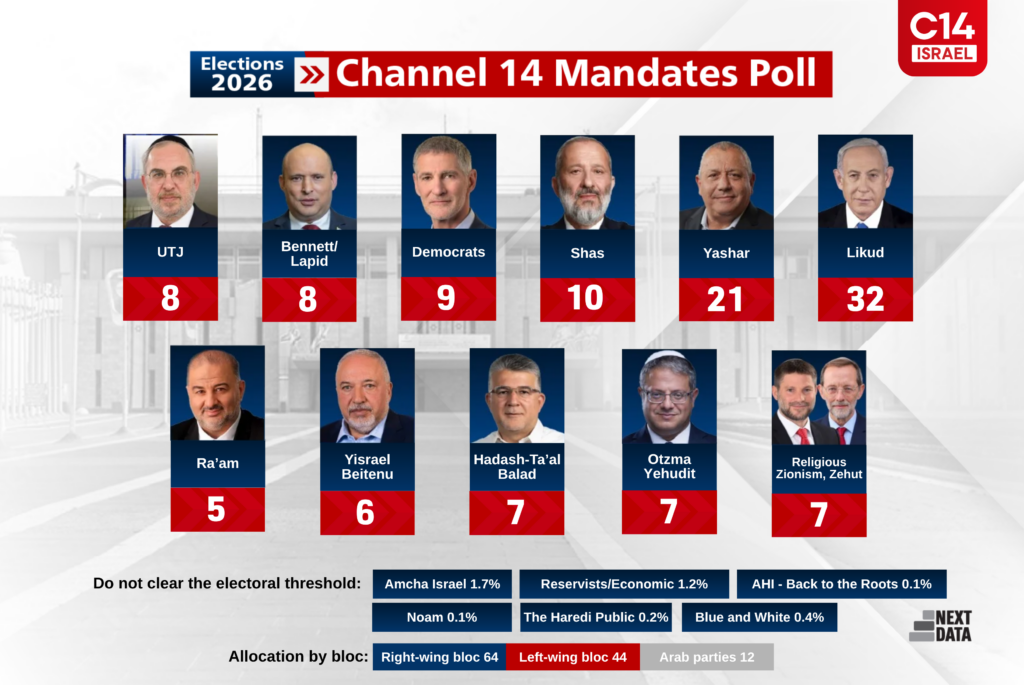
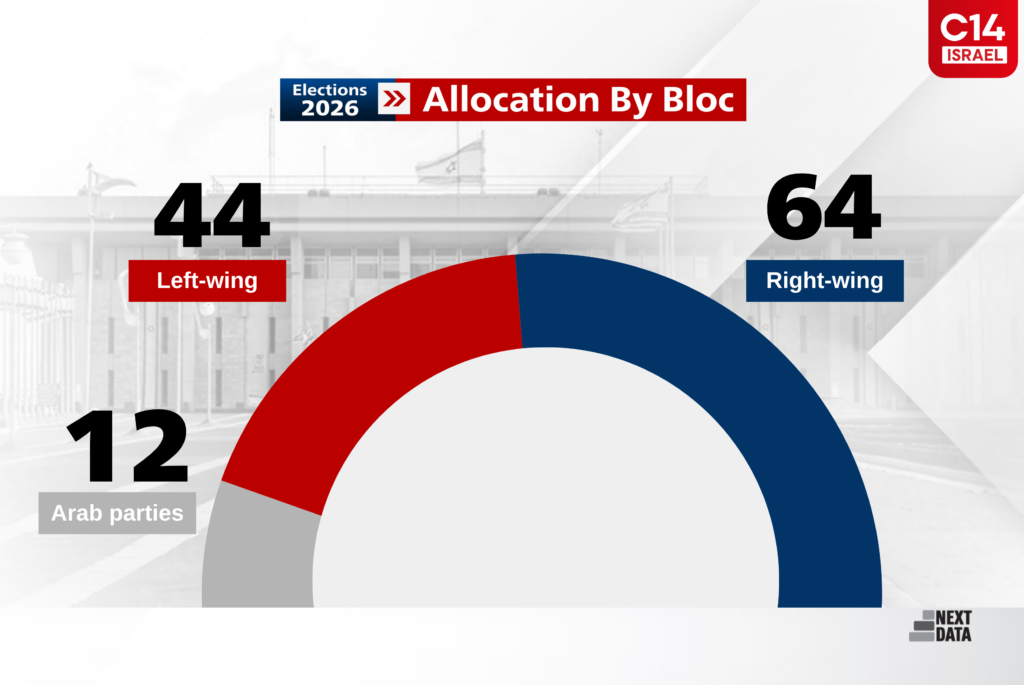
A new Channel 14 poll released Thursday shows incremental shifts in Israel’s political map: Likud strengthens by one seat to reach 32, Naftali Bennett’s party loses a seat and drops to 8, while Gadi Eisenkot’s Yashar holds steady at 21. The right-wing bloc now stands at 64 seats, compared to 44 for the left-wing bloc and 12 for the Arab parties.
If elections were held today, Likud would win 32 mandates—up one from the previous poll’s 31. Yashar! remains unchanged at 21 seats, and Shas also holds its strength at 10. The Democrats stay at 9 mandates. Bennett’s party weakens by one seat, dropping from 9 to 8. United Torah Judaism maintains 8 seats, while Religious Zionis- Zehut hold 7, as do Otzma Yehudit and the Joint List. Yisrael Beiteinu continues with 6 seats and Ra’am with 5.

 1+
1+Below the electoral threshold, additional movements were recorded. Ofer Winter’s Amcha Israel receives 1.7%, up from 1.6% in the previous poll—a slight increase of one-tenth of a percent, though still far from the threshold. The Reservists-Economic party drops from 2.1% to 1.2%. Blue and White weakens from 0.6% to 0.4%, while the Haredi Public rises from 0.2% to 0.2%—essentially no change according to the data provided. Noam drops from 0.2% to 0.1%, and AHI – Back to the Roots receives 0.1%.
In terms of bloc division, a one-seat shift was recorded: the right-wing bloc rises from 63 to 64 mandates. The left-wing bloc drops from 45 to 44, while the Arab parties remain at 12 seats.
 1+
1+On the question of suitability for prime minister, Benjamin Netanyahu maintains 53%—the same figure he received in the previous poll. Eisenkot also stays at 32%. Bennett strengthens by one percent, from 10% to 11%, and Avigdor Lieberman drops from 5% to 4%.
In the head-to-head question between Netanyahu and Eisenkot, there was no change from the previous poll: 54% of respondents chose Netanyahu as more suitable to serve as prime minister, compared to 46% who chose Eisenkot—a gap of eight points.
Disclaimer: The poll was conducted today, October 1, 2026, by NEXT DATA among 2,175 adults from the general population. Data analysis was performed by Shlomo Filber.