



Newly revealed intelligence presented by Prime Minister Benjamin Netanyahu to United Arab Emirates President Sheikh Mohamed bin Zayed paints an alarming picture of Tehran’s accelerating military and atomic ambitions. Israel has identified a significant acceleration of underground construction at a heavily fortified subterranean site known as “Pickaxe Mountain,” located approximately 225 kilometers south of Tehran and adjacent to the primary nuclear enrichment complex at Natanz. According to intelligence dossiers shared with Gulf counterparts, the fortified complex represents a tangible Iranian effort to rehabilitate and shield its nuclear capabilities beneath deep bedrock, accompanied by an urgent tactical warning that Iran may initiate a broad regional military assault within the coming weeks, CNN reported on Wednesday.
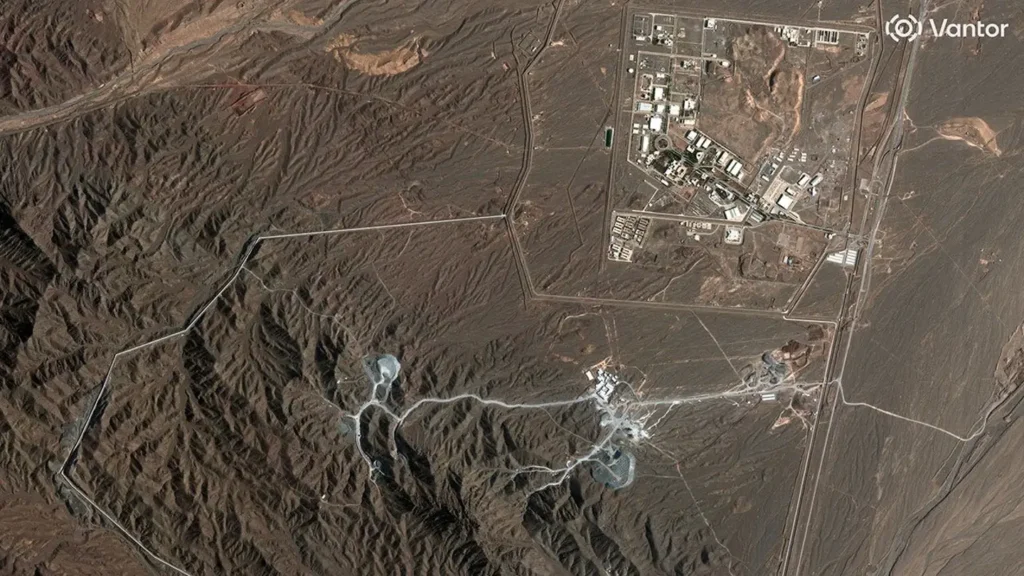
At the core of the intelligence presentation lies the intensified construction activity at “Pickaxe Mountain.” A comprehensive six-year satellite imagery assessment conducted by the Center for Strategic and International Studies (CSIS) in Washington corroborates Israeli intelligence, identifying a dramatic leap in operational activity throughout 2026. According to the analysis, Iranian engineering teams have largely completed rough excavation and shifted to accelerated internal infrastructure work, including reinforcing tunnel entry portals and sharply increasing vehicular and heavy engineering equipment traffic in the sector.
The primary operational feature alarming defense planners in Jerusalem and Washington is the complex’s unique geological setting: the installation is carved deep inside a solid granite mountain, extending dozens of meters beneath the surface. Joseph Rodgers, deputy director of the Project on Nuclear Issues at CSIS, explained on CNN that the site represents a deliberate Iranian effort to construct a nuclear installation virtually invulnerable to aerial bombardment—its depth and surrounding granite density placing it beyond the penetration capabilities of some of the heaviest conventional bunker-buster munitions deployed by the U.S. Air Force.
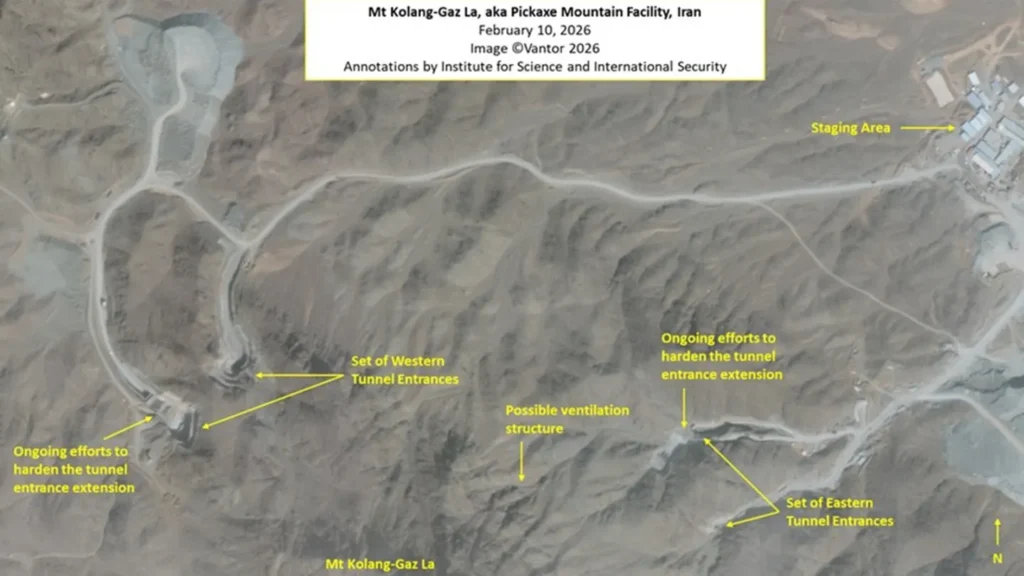
Strategic analysts assess that the complex is designated to assemble advanced centrifuges, store critical components that survived previous targeted strikes, and potentially house a deeply buried enrichment hall insulated from precision-guided munitions. While technical assessments clarify that an active enrichment plant is not yet operational at the location, the rapid pace of construction signals Tehran’s clear strategic shift: moving sensitive nuclear activities away from exposed surface facilities into the reinforced belly of the mountain.
President Donald Trump has previously addressed activity in the sector, issuing explicit warnings of massive strikes if established red lines are breached, with the United States evaluating specialized munitions designed to defeat ultra-deep targets. However, the data concerning Pickaxe Mountain was not the only urgent warning delivered in the talks: Netanyahu presented attendees—including a senior Saudi security official participating in the discussions—with an urgent Israeli intelligence assessment indicating that Iran is actively preparing to execute a large-scale regional attack in the immediate timeframe of the coming weeks.

The operational warning comes amid heightened mobilizations among Iranian-backed regional militias, persistent ballistic threats from the Houthi terror apparatus in Yemen, and volatile friction along critical maritime chokeholds in the Strait of Hormuz and Bab el-Mandeb. The Pickaxe Mountain installation has remained under close international surveillance for years, following previous Iranian declarations of intent to establish a subterranean centrifuge production facility after prior sabotage incidents at Natanz. Nevertheless, the construction pace recorded in recent months indicates a definitive strategic pivot: Tehran’s realization that surface or shallow bunkers offer no defense against precision-guided ordnance, driving a transition to ultra-deep fortifications inside solid granite.
Israel’s decision to present this actionable intelligence directly to the UAE President and Saudi leadership aims to demonstrate to Gulf partners that Tehran is not merely engaged in conventional regional attrition, but is racing to establish irreversible underground facts that would severely complicate any future preemptive strikes against its nuclear infrastructure. The targeted intelligence sharing highlights how Pickaxe Mountain has shifted from a localized technical concern into one of the most critical and urgent priorities anchoring defense coordination between Israel and its regional allies.