


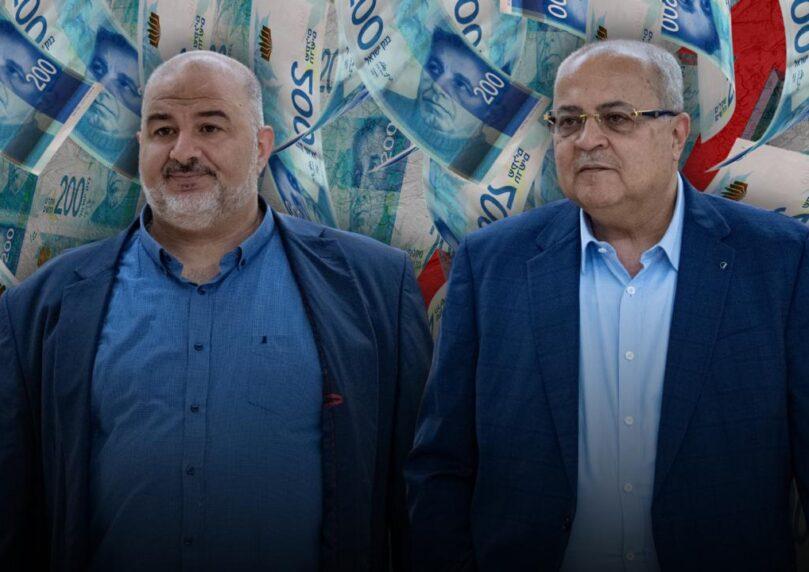

How much does the gap between taxes paid by the Arab sector and the budgets and expenditures attributed to it cost the State of Israel? A C14 analysis, based on data published in research by consulting firm Shaldar and additional official sources, produces an estimate reaching around ₪40 billion (~$13B) annually.


 3+
This estimate expands on the baseline data that was published and updates it for recent years. According to the calculation, the cost attributed to each person in Arab society comes to roughly ₪19,000 (~$6,000) per year. Important to emphasize: ₪40 billion is not an official figure published by Shaldar or the Israel Democracy Institute, but rather the result of a calculation based on the data they published and its expansion to additional components.
The Numbers Behind the Calculation
The starting point is found in work by consulting firm Shaldar, which mapped the balance between what Israeli households pay the state versus what the state spends on them.
The calculation included on one side payments like income tax, National Insurance, and VAT, and on the other side expenditures and services the state provides, including education, health, allowances, and a proportional share of spending on infrastructure and security.
 3+
According to the published data, an Arab household pays the state an average of roughly ₪10,250 (~$3,300) per month, while the state spends about ₪15,300 (~$5,000) on it. This means a gap of just over ₪5,000 (~$1,700) per month per household.
When applying this gap to the number of Arab households, already in the 2019 data a cumulative deficit of around ₪25.6–25.8 billion ($8.43B) per year emerges. This is a calculation derived from Shaldar’s data and not a number they published as an independent finding. But since 2019 the Israeli economy has changed—and so has the scope of expenditures and budgets.
From ₪26 to Around ₪40 Billion
C14’s analysis updated the baseline data for economic growth and expanded the calculation to additional components. Updating the fiscal gap brings the amount to around ₪30 billion (~$10B) per year.
 3+
To this was added an estimate of roughly ₪5.6 billion (~$1.8B) for non-military service, based on a proportional expansion of the cost estimate used in the parallel calculation made regarding the ultra-Orthodox community, minus the Druze population that serves in the IDF.
An additional component is the Five-Year Plan for Arab society. Through the end of 2024, around ₪13.1 billion ($4.3B) was allocated within it, a figure reflecting an average of roughly ₪4.4 billion ($1.44B) per year in the years 2022–2024. It should be noted that these are budgetary allocations, not the entire amount actually spent.
Combining the three components brings the estimate to around ₪40 billion per year. According to the various assumptions on which the calculation is based, the possible range moves around ₪37–42 billion. When dividing the total estimate, around ₪40 billion, by the roughly 2.1 million members of Arab society, an attributed cost of about ₪19,000 per year per person emerges.
From Haredim to Arabs: The Number That Stayed Out of the Discussion
₪36 billion ($11.3B)—that’s the number attached in recent months to the ultra-Orthodox community that quickly became a headline. But when returning to the data on which the calculation rests, one discovers that Shaldar’s work also included Arab households. The data was there—but a parallel calculation of the total cost for the Arab sector wasn’t published.
 3+
Already based on 2019 data, a cumulative deficit of around ₪26 billion ($8.5B) for Arab households can be derived—compared to ₪23.3 billion ($7.65B) calculated that same year for ultra-Orthodox households.
When updating the data for recent years and adding additional components, the estimate already reaches the vicinity of ₪40 billion per year. This creates a striking gap: while the Haredim’s ₪36 billion became a headline and part of public discourse, the parallel numbers for the Arab sector remained in the spreadsheets.