


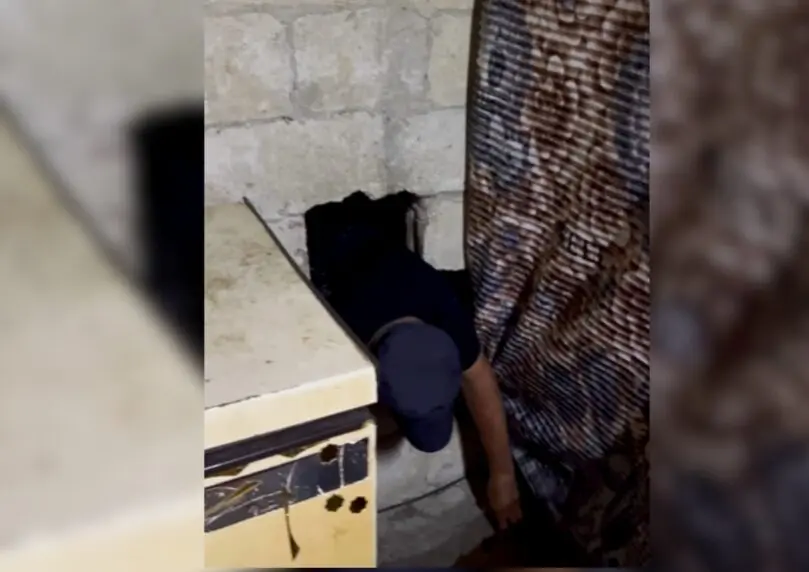

The saga of Muhammad Zakour stands as one of the most astonishing disappearances in modern Syria. Zakour, a resident of the Mediterranean coastal city of Latakia, spent more than 13 years confined within a concealed space barely one meter wide, hidden behind a false wall inside his grandfather’s house. It was not a state dungeon, but rather a self-imposed prison where he took refuge out of mortal terror of being apprehended by the security apparatus of ousted Syrian dictator Bashar al-Assad—while his own children grew up believing their father was dead.
Video: Arab media
According to Zakour’s account, the ordeal began after he was arrested twice by security forces during the early years of the Syrian civil war. After his release, he said a relative warned him that security forces were looking for him again. Rather than risk a third arrest, he decided to vanish.
Zakour didn’t choose a location far from his family. With his wife’s help, he bought construction materials and built a wall inside his grandfather’s house, concealing a very narrow space behind it. From then on, the house itself became his hiding place, with his wife the only person who knew he was still alive. Reports indicate his wife passed him food, water, clothing, and medicine through a small opening. When he was sick, he would describe his symptoms to her, and she would go to a doctor, relay his condition, and return with medication. Throughout all those years, he couldn’t come out and see his family normally.
Video: Arab media
But the strangest part of the story involves his children. His wife hid their father’s existence behind the wall, fearing one of them might accidentally reveal the secret. As the years passed, the children grew up believing their father was dead. According to reports, Zakour’s brother, who lives in Turkey, even held a mourning tent for him—while the man was still alive, just meters away from his family members.
Media sources note that Zakour could hear his children growing up on the other side of the wall, unable to appear before them. He recounts that his eldest son left him as a child and had become a grown teenager by the time he emerged from his hiding place. Those years weren’t just an absence from the world, but an absence from his children’s lives specifically, even though he was present in the same house. The end came on December 8, 2024. That morning, Zakour heard shouts of “Allahu Akbar” from outside and asked his wife what was happening. When he learned of the fall of Bashar al-Assad’s regime, he understood that the reason that had led him to hide all those years no longer existed, and he emerged from his hiding place after more than 13 years.