


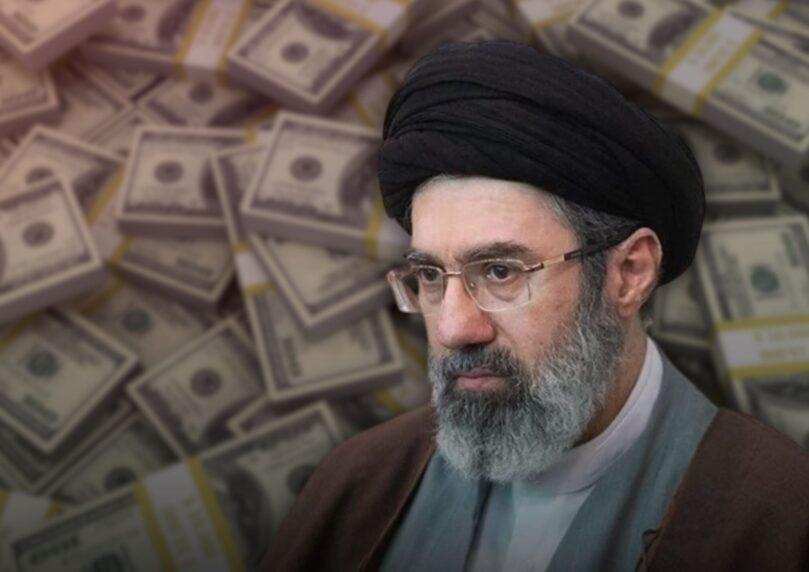

Against the backdrop of intensifying efforts by President Donald Trump’s administration to clamp down on the economic lifeline of the Ayatollah regime, a gaping and deeply troubling vulnerability has been exposed at the very core of the American financial system. According to official figures and Western intelligence officials cited by The Wall Street Journal, the U.S. Department of the Treasury identified approximately $9 billion in illicit Iran-linked funds that coursed directly through American banking institutions in 2024 alone, alongside an additional $1.8 billion routed between 2024 and June 2026 via offshore branches of a prominent Egyptian state lender.

 5+
5+The illicit laundering architecture operates through an intricate web engineered to completely camouflage the beneficial owner. The Islamic Republic avoids maintaining overt accounts in its own name within American institutions; instead, it orchestrates a network of front companies incorporated in Dubai and Hong Kong, money exchange houses, and third-party intermediaries. These proxies interface with foreign commercial banks across various jurisdictions to execute transactions disguised as legitimate trade.
Because any international transaction conducted in U.S. dollars must ultimately be cleared and settled within an American financial institution—an established global practice known as “correspondent banking”—illicit capital lands directly in accounts on U.S. soil. The clearing American bank sees only the foreign correspondent bank and the ostensible corporate entity, remaining completely blind to the fact that an operational arm of the Tehran regime controls the transaction chain. Financial crime specialists stress that closing this pipeline requires American mega-banks to enforce drastically tighter audits of their foreign correspondent banking relationships.
 5+
5+Elaine Dezenski, a former senior Department of Homeland Security official now serving as a senior director at the Foundation for Defense of Democracies (FDD), addressed the enforcement challenge: “Covert banking networks are notoriously difficult to detect, but tracing Iran’s illicit money flows is by no means impossible. American clearing banks and their correspondent partners are directly in the crosshairs, and this scrutiny will only intensify.”
The Trump administration has signaled zero tolerance for the exploitation of American financial rails. Gene Lange, a senior official at the U.S. Department of the Treasury, issued a blunt warning: “Under President Trump, the Treasury Department has made it unmistakably clear that adherence to U.S. sanctions and legal statutory obligations is non-negotiable, and non-compliance will carry severe consequences. Financial institutions have been put on notice. The Department is moving faster and more aggressively than ever before to identify, disrupt, and penalize any bank or intermediary that continues to facilitate commerce with the Iranian regime.”
 5+
5+A prime case study of this financial warfare surfaced in late August, when the Treasury Department took sweeping action against the United Arab Emirates branches of Banque Misr, an Egyptian state-owned bank. According to Treasury findings, between January 2024 and June 2026, these Gulf branches processed an eye-popping $1.8 billion for 103 front companies suspected of serving as operational nodes in Tehran’s covert shadow banking apparatus. The administration moved to terminate their access to U.S. dollar clearing corridors.
The Egyptian lender maintained dollar accounts across three major American institutions, with public records identifying JPMorgan Chase and Citigroup as primary correspondent clearinghouses. Both Wall Street banks declined to comment. While the Egyptian Foreign Ministry confirmed it is holding talks with Washington officials, the bank insisted it strictly adheres to all regulatory frameworks.
 5+
5+Intelligence dossiers also laid bare how these clandestine clearing operations directly accelerate Iran’s military build-up. In one documented case, an Iranian engineering front procured roughly 150,000 circuit boards and sensors valued at $650,000 from a Chinese supplier—components ostensibly manufactured for the automotive sector but desperately sought after for Iranian suicide drone fleets and precision-guided missile platforms. The transaction invoice explicitly required payment to clear through a financial institution in New York, and the Iranian buyer agreed to transfer funds through Bank Tejarat, an Iranian financial entity under comprehensive U.S. counter-terrorism sanctions.
 5+
5+These revelations emerge at the height of a sweeping economic offensive launched by Washington against Tehran. On August 24, the Treasury Department formally activated Operation “Economic Outcast,” a campaign designed to systematically cut off the Iranian regime from international revenues, clearing corridors, and global capital markets, delivering an ultimatum that any financial institution aiding Tehran will be permanently expelled from the American market.
Building directly upon the actions against Banque Misr, the administration widened the crackdown on September 4 to Turkey, imposing crushing sanctions on Turkish-based Golden Global Yatirim Bankasi and two subsidiaries. The bank is accused of facilitating transactions between Chinese entities and the Islamic Revolutionary Guard Corps (IRGC) Quds Force, laundering illicit Iranian oil revenues into physical cash and gold reserves—allegations the Turkish lender denies. U.S. Treasury Secretary Scott Bessent stated that Washington intends to roll out secondary sanctions on a strict weekly rhythm, zeroing in on financial conduits enabling Iran’s international operations.
 5+
5+Tehran’s exploitation of the dollar system confronts Washington with a strategic double-edged sword. An overly aggressive, blanket severance of foreign correspondent networks could accelerate de-dollarization, pushing international institutions toward rival payment systems such as China’s yuan and eroding the dollar’s status as the global reserve currency. Furthermore, completely severing these channels would strip Western intelligence of its primary monitoring window, as the passage of funds through New York clearinghouses provides Western agencies with visibility into covert Iranian financing networks.
The battle to choke off the Ayatollahs’ terror apparatus extends beyond issuing press releases on new sanctions—it depends on the West’s ability to unmask illicit transactions passing as legitimate global trade, even as Tehran works relentlessly to exploit the very dollar clearing system built to isolate it.