


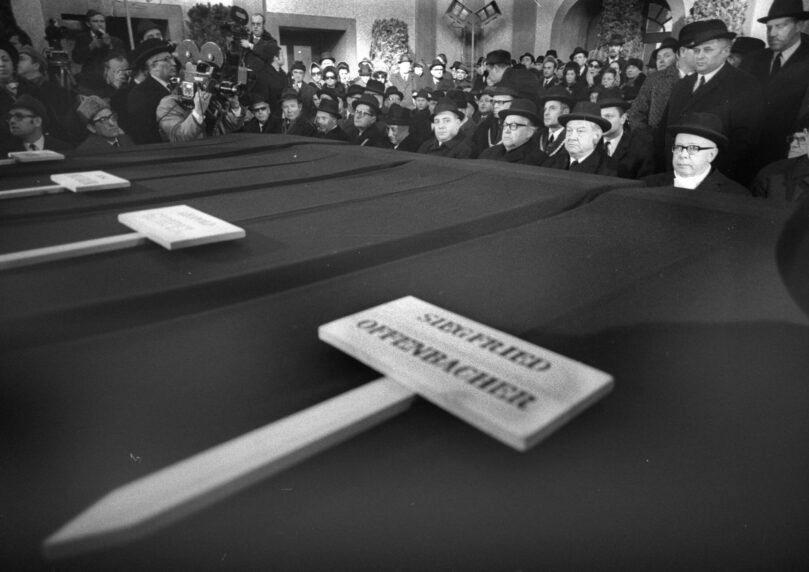

German investigators announced Thursday that they have identified the suspected arsonist behind the 1970 attack on a Jewish community center in Munich that killed seven Holocaust survivors, apparently solving a case that remained a mystery for more than half a century. Prosecutors now believe the perpetrator was a 25-year-old lone neo-Nazi with known Jew-hating views, according to the BBC.
 4+
4+The seven victims, all Holocaust survivors between the ages of 59 and 71, were killed in the deadly fire, while another 15 people were injured. The breakthrough comes too late to bring the suspected killer to justice. The man, identified by Der Spiegel as Bernd W., died in 2020. According to prosecutors, at approximately 8:40 p.m. on February 13, 1970, the killer poured gasoline into the wooden stairwell of a retirement home located inside the Jewish community building on Reichenbachstrasse and set it ablaze. The fire quickly spread to the building’s upper floor.
 4+
4+Many residents managed to escape onto the roof or were rescued by firefighters, but four victims died in the stairwell and another died after jumping from a window. Prosecutors now say there are “compelling grounds” indicating that the deceased suspect was responsible, based on what they described as “credible information” provided by a woman. The woman approached authorities last year following the death of a relative who had known the suspect well. According to prosecutors, the suspect was heard near the Jewish community building saying that “the Jews have everything” and that he wanted to “burn them.” Fifteen minutes later, the building was in flames.
 4+
4+Authorities note these remarks were corroborated by other family members of the witness. Other witnesses described the suspect as having a “Hitler fixation,” and said that in his youth he would listen to recordings of the Nazi dictator’s speeches. One school principal said the suspect apparently used a Hitler Youth dagger, which he received from his father, during a confrontation. He was later convicted of blowing up two telephone booths.
 4+
4+Der Spiegel reports that the witness’s relative was formerly a member of a burglary gang, and on the night of the nursing home arson they participated in a failed robbery of a jewelry store at nearby Gärtnerplatz. The relative said the failed robbery angered Bernd W. and triggered his antisemitic rage. The arson investigation was closed in 2017 due to lack of conclusive evidence, and reopened last year. Prosecutors emphasize that the presumption of innocence still applies, even after the suspect’s death, and that there is no credible evidence pointing to another person’s involvement in the attack.
 4+
4+Fifty-six years later, German authorities are now certain they’ve cracked the notorious Jew-hatred crime. However, the case will likely be considered a historic police failure, as Bernd W.’s name was brought to investigators’ attention as early as the 1970s by a prisoner who shared a cell with him.