





 6+
Voices across the Arab world are growing louder, calling for regime change in Israel and the rise of a government open to establishing a “Palestinian” state. An Al Jazeera analyst lays out a scenario where Netanyahu’s fall triggers Likud’s collapse and the end of the right: “The Israeli left will seize power.” And what’s the connection to the vision Yair Lapid presented at the UN?
Full disclosure: The author is a Likud party member and is running in Likud’s primaries.
In recent years, and especially since the October 7, 2023 massacre, voices in Arab countries—both at the official level and in public discourse—have been expressing hope for a change of government in Israel more loudly than ever.
This isn’t necessarily ideological support for the “Israeli left” in its classic form (which is currently very weak), but rather a clear preference for a government less identified with the right and more open to political dialogue with the ‘Palestinians’. Dialogue that would ultimately lead to the establishment of a ‘Palestinian’ state. Benjamin Netanyahu, as the symbol of the current right-wing government, is seen by many in the Arab world as a central obstacle to this goal.
Ehab Jabareen, a regular guest on Al Jazeera and an expert on Israeli affairs, recently made striking statements about Prime Minister Benjamin Netanyahu’s current situation and the Likud party. Jabareen, in interviews on various Arab channels, noted that the current moment represents the greatest periods of humiliation and disgrace for Netanyahu since he entered politics over 43 years ago, and perhaps even more than his 1999 defeat.
 6+
The idea Jabareen raises in one phrase: “If Netanyahu falls—Likud falls.” “Likud will collapse and even the Israeli right won’t recover after the Netanyahu era, and the Israeli left will seize power. This isn’t wishful thinking or analysis but an organized plan that Arab states are working on, led by Qatar, Saudi Arabia, and Egypt.” Jabareen’s claim is that Netanyahu has controlled the party since the 1990s, turned it into a personal tool, ousted internal rivals, and tied it to coalitions with the far right and ultra-Orthodox parties. Likud’s electoral identity became linked to his persona more than to traditional Jabotinsky ideology.
According to the reporter, Netanyahu’s political fall (in the upcoming elections) could lead to Likud’s dissolution, since the party’s senior members and ministers depend on his survival and the Israeli party system leans on the charismatic leader. History shows, according to Jabareen, that Israeli parties are heavily affected by the departure of dominant leaders.
 6+
Qatar, through Al Jazeera and its diplomatic discourse, promotes a narrative against Netanyahu’s government and frequently hosts guests from Israel who sharply attack Netanyahu. Even Egypt, which doesn’t typically host Israeli guests, recently hosted Israeli journalist Gideon Levy, who harshly criticized Netanyahu’s policies and the government.
Such criticism joins media and diplomatic pressure that weakens the prime minister’s international image. Other Arab states see his government as an obstacle to regional stability and possible normalization or a political solution. Many Arab governments prefer an Israeli government from the left, which the Arabs claim is capable of negotiating and even establishing a ‘Palestinian’ state, because the right in Arab eyes threatens the ‘Palestinian’ Authority’s interests.
 6+
The Arabs believe—and rightly so—that Netanyahu’s governments, especially since 2022 together with his right-wing partners (Ben-Gvir and Smotrich), are promoting massive construction in Judea and Samaria, de facto annexation of territories, and open rejection of the idea of a ‘Palestinian’ state. Netanyahu himself has repeatedly declared his opposition to a ‘Palestinian’ state west of the Jordan River, and even spoke about connecting to the vision of “Greater Israel.” Arab states see this as a direct threat. They demand a “credible path” to a ‘Palestinian’ state as a condition for deepening relations or normalization (with Saudi Arabia, for example).
A left-wing government in their eyes is more flexible and would be open to negotiating with the ‘Palestinians’ and even willing to discuss territorial concessions (as was once “land for peace”) or at least a construction freeze—something that makes it easier for Arab leaders to justify cooperation with Israel to their own public.
 6+
Arab states’ preference for toppling Netanyahu doesn’t stem from love for the Israeli left, but from cold calculation of interests: internal stability, reducing public pressure, opening the door to broader normalization, and reducing escalation risks. Netanyahu, as someone identified with right-wing principles, has become a symbol of policies that make things difficult for Arab partners. A governmental shift toward the left is seen in their eyes as an opportunity to reset relations and advance toward a more stable regional order.
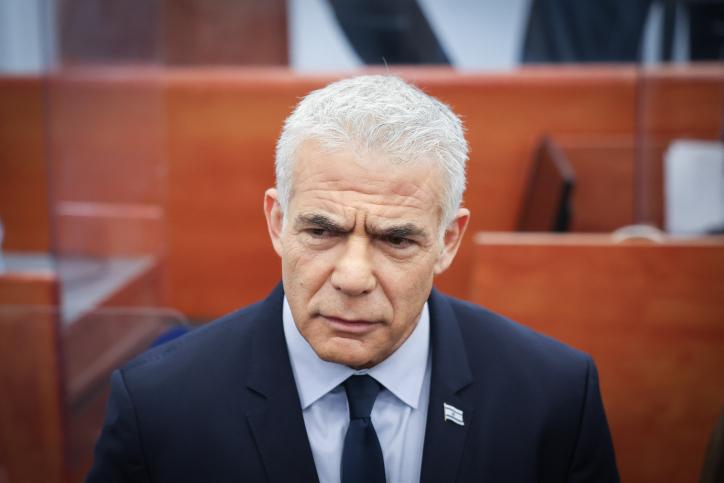
Arab states haven’t forgotten the vision of Israel’s transitional prime minister Yair Lapid when in his UN speech in September 2022—a year and change before the October 7 massacre—he said the following: “Israel’s economic and military strength allows us to defend ourselves, but it allows us something else: to aspire to peace with the entire Arab world and with our closest neighbors—the ‘Palestinians’.
 6+
An agreement based on two states for two peoples is the right thing for Israel’s security, for the Israeli economy, and for our children’s future. Peace is not a compromise, it is the bravest decision we can make. Peace is not weakness, it embodies all the strength of the human spirit. War is surrender to everything evil in us, peace is the victory of everything good.”
In practice, this speech essentially aligns with the vision of the ‘Palestinians’ and Arab states. Eisenkot and Bennett, Lapid’s partners, are considered center-left figures who might adopt this vision. Therefore Qatar and Arab states are working to topple Netanyahu and crush Likud in particular and the right in general. This isn’t personal against Netanyahu but against the entire right, to put an end to right-wing rule in Israel and replace it with left-wing rule.
 6+
Arab states should know that the political reality in Israel is determined primarily by the Israeli voter and not by Arab states or their propaganda. The Israeli voter is sharp and knows what’s good for Israel.