


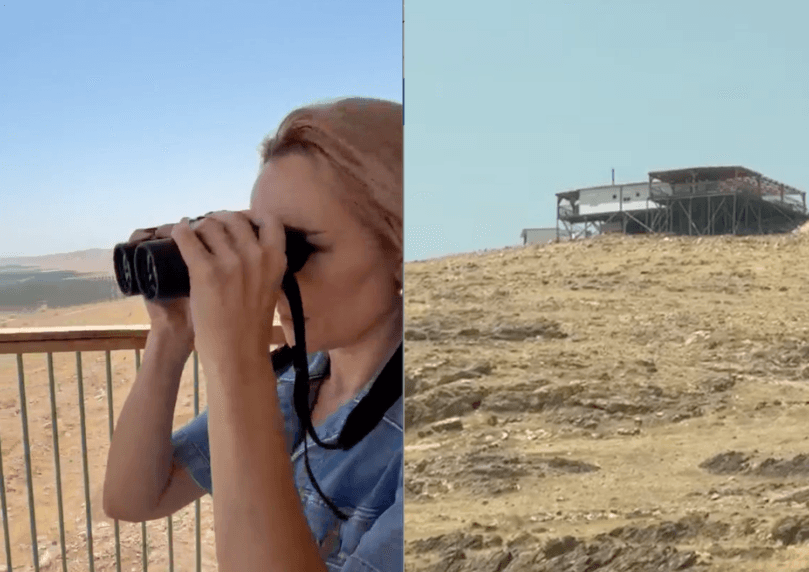

A network of 31 Jewish ranches now maintains security control over more than half the land in the Jordan Valley, some 400,000 dunams, an area larger than the Gaza Strip, according to the region’s governor, David Elhayani, speaking to C14 on the ground today. These ranches rely in part on a fleet of heavy tractors funded through AFJS, an organization that has now delivered its seventh $100,000 machine to strategic farms across Judea and Samaria and the Jordan Valley. The latest arrived this week at one of the ranches, where officials say it will serve both as farming equipment and as a tool for holding territory.
AFJS CEO Yigal Dilmoni framed the initiative in explicitly military terms. “This is weapons. This is a tank. This is a jeep. This is a soldier of Am Israel, the soldier of the people of Israel,” he said, describing the tractor’s security function.
Governor Elhayani told C14 today that the presence of the ranches and their machinery has coincided with Arab residents voluntarily leaving the surrounding area, and no longer posing a threat to Jews. Israel’s Diaspora Affairs Minister Amichai Chikli, addressing the broader strategic significance of the ranch program, said: “It’s our duty to make sure that we are governing and we are sovereign in these areas. And one of the most powerful tools to do it is the project of the farms.”
Chikli added, “For many years there was a, dispute regarding the legitimacy of the villages in Judea and Samaria in Jordan Valley. The heart of our homeland is Mount Eval, Shiloh, Hevon, obviously Jerusalem, Judea and Samaria. This is the core. This is the heart of our homeland. And if you cannot justify, what are we doing in Mount Yval, Shiloh or Hevon, so the sands of Rishon, Letzion or Tel Aviv, well, obviously you won’t be able to justify why are we there?”
There is growing support for Israeli ranches in American and Israeli society. Supporters say that that the Jewish presence in the Jordan Valley cannot be separated from de-facto Israeli sovereignty more broadly. AFJS has described the initiative as a continuation of early Zionist land settlement practices, positioning agricultural infrastructure as a form of territorial control in areas where sovereignty will one day be applied by Israel.