


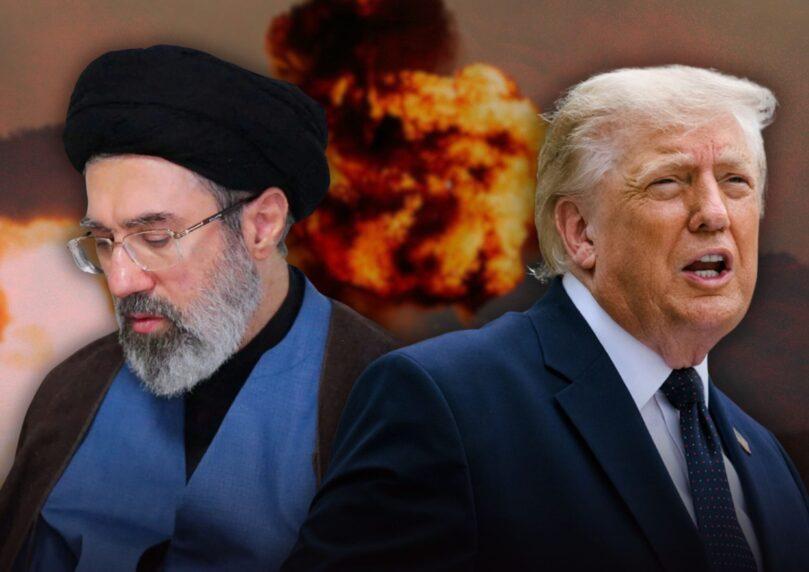

Iran’s leader, the terrorist Mojtaba Khamenei, who hasn’t been seen or heard from since the start of Operation Lion’s Roar and the elimination of his father, the terrorist Ali Khamenei, issued a statement Saturday directly threatening the United States. The warning came after a full week of continuous American strikes against Iran’s terror regime and the completion of a seventh round of attacks over the weekend.
The statement claimed that “the repeated violations of commitments by the United States regarding the memorandum of understanding have proven once again to everyone how worthless and unreliable the signature of the President of the United States is.” It then added a direct threat: “Now, as the American enemy seeks to ignite war and bear heavier costs and greater disgrace, it must know that the Iranian people and the resistance front have unforgettable lessons for it.”
Seventh Round of Strikes
The United States launched its seventh consecutive night of strikes against Iran late Friday into Saturday, continuing attacks on the Iranian terror regime that has repeatedly violated its commitments—particularly regarding opening the Strait of Hormuz. In a statement released Friday evening, CENTCOM said “the strikes are designed to continue degrading Iranian military capabilities at the Commander in Chief’s direction.”
Later reports and the U.S. statement revealed that overnight strikes hit numerous strategic targets in Iran, including surveillance sites, military logistics infrastructure, underground weapons depots, and naval capabilities. According to the Americans, the strikes involved fighter jets, drones, warships, and “additional assets.”
CENTCOM launched a round of strikes against Iran at 3 p.m. ET today for the seventh consecutive night. The strikes are designed to continue degrading Iranian military capabilities at the Commander in Chief’s direction.
— U.S. Central Command (@CENTCOM) July 17, 2026
According to Iranian sources, the U.S. struck a tunnel on a highway and three different bridges overnight. Tehran also reported strikes on an underground “missile city,” various targets in western Iran, and several military sites in southern Iran and the Shiraz area—from which Iran had launched missiles in recent days.
Iranian Response
In response to the American attacks, the terror regime stepped up strikes against various targets across the Middle East, including Kuwait and Jordan, as well as a particularly significant wave of attacks on Saudi Arabia—which drew sharp anger from the Arab state. As part of the overnight retaliation, the Americans took two direct hits at a military base in Jordan. The strike killed two American soldiers and left one missing, according to the U.S. military.
According to a Reuters report, Kuwait experienced one of the worst nights of Iranian retaliatory attacks since the conflict began: a second power station was hit within two days, and flights in the country were suspended. Beyond that, the Iranian attack targeted electricity, water, and oil infrastructure in Kuwait and other Gulf states.
The terror regime said after the strikes that “so far we have attacked only military targets, but the American terror army is attacking civilian targets. Therefore, we suggest that the countries hosting American forces in the Gulf prepare to absorb similar blows against their civilians.” Tehran was effectively threatening its neighbors with strikes on civilian targets throughout the Gulf states. Later Saturday, Iran announced “suspension of the memorandum of understanding with the U.S. due to failure to comply with all its provisions.”
Gulf states didn’t remain indifferent to Iranian aggression. Qatar said “the attack on power stations and desalination plants in Kuwait crosses all threshold limits” and called for an immediate ceasefire. Pakistan’s foreign minister also tried to calm tensions: “The memorandum of understanding must be adhered to and escalation prevented.”