



The term ‘settler violence’ shows up constantly in international reporting, UN dashboards, and sanctions announcements targeting Israelis in Judea and Samaria. But when researchers actually went looking for the data behind the term, they found a system that counts terrorists eliminated mid-attack as victims, relies on a single unverified source while claiming two, and applies a standard nowhere else in the democratic world.
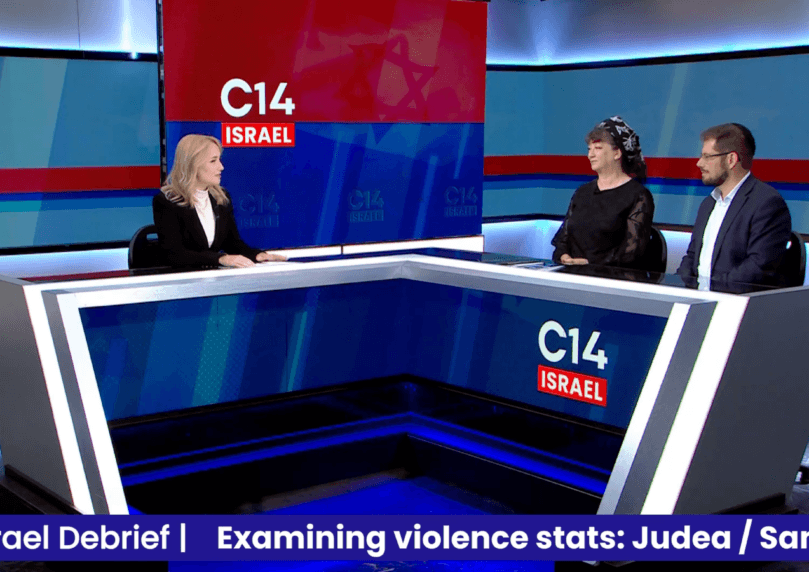
Professor Eugene Kontorovich of George Mason University Law School and the Kohelet Policy Forum, and Naomi Kahn of Regavim’s International Division joined C14’s Israel Debrief.
The data problem
Kahn recounted that OCHA, the UN’s Office for the Coordination of Humanitarian Affairs, publishes an online dashboard tracking violence involving Israelis and ‘Palestinians.’ When Regavim requested the raw incident data behind the dashboard, the UN declined. The organization obtained it anyway through a French criminologist and analyzed more than 8,300 incident reports spanning seven years.
The first finding: over 2,000 entries labeled as settler violence were, on inspection, cases of Arab violence against Israelis. Of the roughly 6,300 reports that remained, Kontorovich and Kahn say more than 95 percent either did not involve settlers, did not involve violence, or did not take place in Judea and Samaria. Of the small number left, most could not be distinguished from acts of self-defense by Israelis under attack by Arab terrorists.
https://x.com/c14english/status/2072382610295108084?s=20
Buried in OCHA’s own fine print is a definition that reframes the entire category. ‘Palestinians’ eliminated while carrying out attacks against Israelis are recorded as victims of settler violence. Kahn pointed to real cases in the data of an attacker eliminated while attempting to murder Israeli civilians in their home, logged the same way.
OCHA also states its data comes from two independent, verifiable sources. Kontorovich and Kahn say the reports show the opposite: the same single source appears repeatedly, sometimes under two different names.
Vandalism, graffiti, and trespass, which would not meet the legal definition of violence in most jurisdictions, are counted as settler violence in the dataset. Israelis ascending the Temple Mount has also been logged as an incident. Meanwhile, attacks against Israelis are tracked under a separate “nationalist crime” category that only registers when there are casualties.
Kontorovich argues that even taking the data at face value, the numbers do not support the narrative built on top of them. Using B’Tselem’s own reported figure of ‘Palestinians’ killed by Israelis in Judea and Samaria last year, he calculated a rate that would put the region roughly on par with Omaha, Nebraska, and far safer than most major American and European cities.
Sanctions built on flawed data
That dataset has real consequences. During the Biden administration, the US Treasury’s Office of Foreign Assets Control introduced a sanctions program targeting what it called West Bank violence. Kontorovich and Kahn were both involved in a lawsuit challenging sanctions issued under the program. Of the sanctions orders issued under the program, Kontorovich says all were directed at Israelis. An entire IDF unit was placed under sanction before the designation was later reversed. The European Union runs a parallel sanctions track that, according to Kahn, has named Regavim itself, along with groups engaged in litigation and construction advocacy, not violence.
The Trump administration rescinded the executive order behind the US program on its first day in office. Kontorovich and Kahn continued their lawsuit regardless, reaching a legal settlement (not that kind).
But sanctioned Israeli organizations are cornered at home. Kahn says Israeli banks and credit card companies, wary of losing business tied to the EU market, have moved to restrict groups like Regavim from processing donations or transactions, despite no Israeli law requiring them to enforce foreign sanctions. Kontorovich warns that without government action to limit automatic compliance with foreign sanctions lists, similar to protections other countries have adopted, Israel risks a future round of sanctions cutting off far more of its banking system.
Sovereignty and the two state question
The conversation also touched on Prime Minister Netanyahu’s recent remarks rejecting a two state solution. Kahn noted that no Israeli government, across the political spectrum, has ever endorsed an independent ‘Palestinian’ state between the Jordan River and the Mediterranean, calling the statement a restatement of longstanding policy rather than a shift.
Kontorovich argues that applying Israeli civil law to Area C, the portion of Judea and Samaria under full Israeli administrative and security control, is legally straightforward but has been withheld due to anticipated international backlash, pointing to the response when Israel applied its law to Jerusalem.
Both guests framed the sanctions themselves as a deterrent to that step, arguing that international pressure, more than legal or logistical obstacles, has been the primary force holding Israeli sovereignty in Judea and Samaria in place since 1967.