


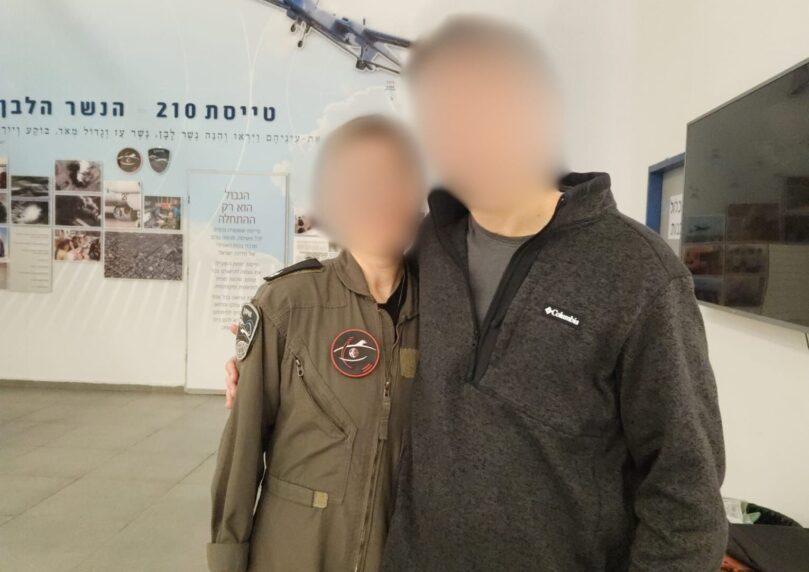

R. and T.’s story started long before the war, at a party back in 2016. They’ve been together nearly ten years now, moving through military service and civilian life side by side. R. serves as a major in the reserves with Squadron 210, and T. as a major in the reserves with Squadron 161. “We’ve been together for a decade, and this year it’ll be official,” R. tells C14. “We met when we were in different roles, moved in together in Tel Aviv, and today we’re in a different place in life. Even though we’re each stationed in different squadrons, our operational world is the same world, which creates a deep understanding that’s hard to find elsewhere.”


 2+
For outsiders, the role of drone operator can seem sterile—sitting in an air-conditioned trailer in front of screens—but the reality is far from that. T., who’s already logged over 740 reserve duty days, describes it as an impossible transition between worlds. “The point is, you enter a trailer, which is basically a door that leads us into war,” he explains. “We finish a shift, open the door, and return to routine and civilian life. That’s the biggest challenge, these transitions from one extreme to another, from the battlefield to a home front that’s carrying on as usual. The privilege is that we have each other for this understanding.”
The couple’s family challenge peaked during the war. R. was in advanced pregnancy while conducting intense operational activity, and shortly after giving birth, as tensions heated up with Iran, she found herself back in the trailer. “The moment a child entered the picture, it became much more complex,” R. shares. “We do a kind of ‘hot swap’—someone goes out to reserves, someone comes home. We made sure there was always one parent at home. When we both had to be at the squadron simultaneously, the grandparents were drafted into reserves of their own to help us.”
 2+
Though they operate in separate squadrons, sometimes their missions intersect in Gaza’s airspace. “We’ve talked to each other on the communications network during flight,” R. says about the small moments of coupledom inside the operation. “Of course, it depends on the phase of the mission, and if there’s nothing critical, but if possible, we ask for a moment how things are and move on. It’s something very unique to us, knowing the other side is there, in the same sky, understanding exactly what you’re going through in the complex moments of making fateful decisions.”
Those decisions often translate into deeply satisfying mission closures for the two. T. describes immense professional satisfaction that’s accompanied by complete secrecy in civilian life. “We recently had missions eliminating significant senior figures who were responsible for holding hostages,” he shares about the sense of mission. “No one at my civilian job knows what I did last night. People can talk next to me in the hallway about the eliminations published in the news, and I just smile to myself. Knowing we settled accounts with those who hurt us gives tremendous strength to keep going.”
 2+
The close connection with ground forces is a critical component of their service, and sometimes it becomes very personal. T. recalls meeting a family member serving as a Golani fighter, where they discovered T. had provided air cover for his unit. “He told me about a situation where they were fired on with an RPG, and he saw a terrorist aiming at him from close range, and suddenly the terrorist just exploded,” T. recounts. “In hindsight, he realized it was the air support we provided. Hearing him say ‘thank you, you saved us’—that’s the moment that clarifies the entire meaning of our service.”
In closing, T. wants to convey a message to Israeli society about the importance of awareness regarding reservists. “There’s something dangerous about the fact that the war continues within routine, and that people are getting used to reservists being absent,” he concludes. “We’ll keep coming as long as the soldiers are in the field, but it’s important that the environment continues to show understanding and doesn’t take it for granted. In the end, the fighters in the field are the real heroes, and we’re here to do everything to protect them and defend the country in every sector where we’re needed.”