


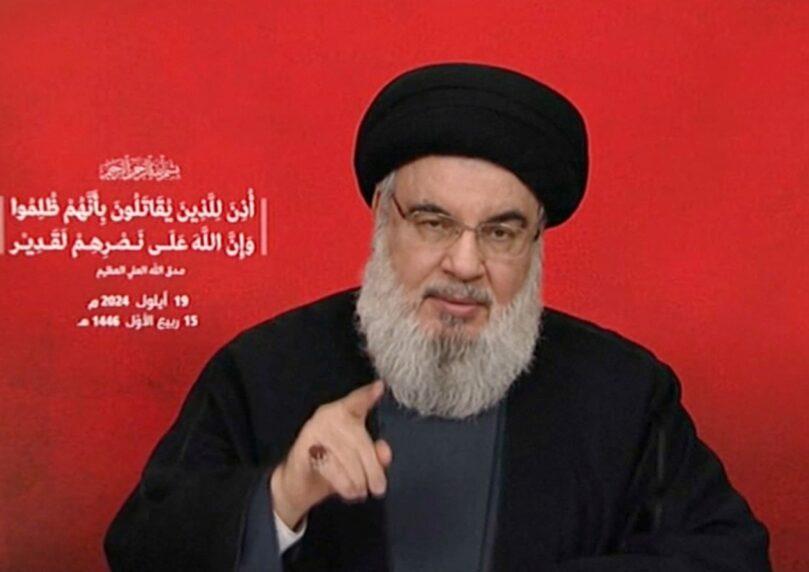

New details are emerging about Hassan Nasrallah’s final days following his assassination by Israel, revealing how deeply the pager attack attributed to Israel affected the longtime Hezbollah chief.
Wafiq Safa, considered one of Nasrallah’s closest associates, described in an interview their last conversation on the day of the pager attack—just ten days before Nasrallah was killed.
The attack marked a turning point for Nasrallah, Safa said. “It was no longer the same Hassan Nasrallah,” he said. “With everything Hezbollah went through over 40 years, this was something completely different. The mistake of the people around him was showing him the footage of the pagers exploding on people. The moment he saw the images, he couldn’t bear it.”
After seeing the scale of casualties and the nature of the injuries, Nasrallah’s behavior changed dramatically, Safa said. “He became a different person. It wasn’t a medical event, but he certainly wasn’t the same person we knew, even in his appearance. He stopped eating, and at first only drank water. I think he didn’t eat for about 24 hours. For him, it was the end of the world.”
Safa acknowledged the attack represented a significant achievement for Israel. “We need to be realistic. This was an intelligence penetration, and it’s credited to Israel. We admit that,” he said.


He also described the last phone call he had with Nasrallah that day. “I heard it in his voice. He didn’t ask me what was happening, because he already knew. He called to reassure me, to ask how I was and comfort me. I told him: ‘The main thing is that you hold strong.’ He replied: ‘God comforts me.’ From that moment, Nasrallah was no longer the same Nasrallah.”
According to Safa, the severe damage to Hezbollah’s infrastructure and military capabilities was as difficult for the organization’s leader as the attack itself. “He couldn’t bear the images of the pager attack and also couldn’t bear the blow to the military force that Hezbollah built over years and disappeared like that,” he said.
At the end of the interview, Nasrallah’s associate revealed his impression from their final meeting. “The last time I saw him, he still believed Israel wouldn’t succeed in reaching him. At the same time, he understood that Hezbollah’s leadership needed to prepare for the possibility of becoming an Israeli target. His assumption was that Israel wouldn’t launch a wide war, partly because of the capabilities Hezbollah possessed. In practice, Israel succeeded in reaching him, and also in hitting the organization’s missile capability.”