


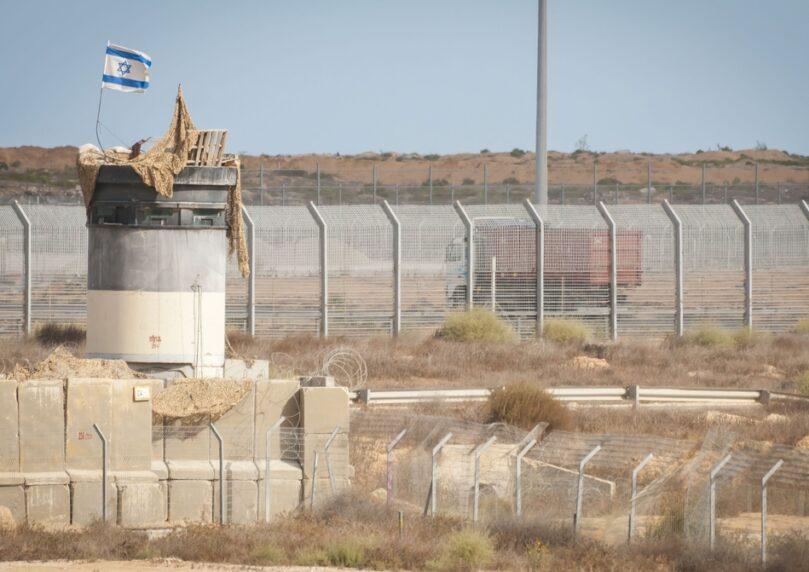

At the Kerem Shalom crossing, where the devastated Strip meets the outside world, a quiet but significant event unfolds each week: a steady trickle of Gazans choosing to leave everything behind. This isn’t just fleeing war—it’s a search for life itself. In rare, exclusive footage we published tonight (Monday) on Channel 14 News, they describe despair that’s become a chasm between them and the regime’s promises, and the realization that Gaza’s future has simply ceased to exist.


 3+
“We Were Completely Burned by the Sun”
For Hiba, a Gaza City resident, today marks the end of an exhausting journey that began last January. “Seven, eight months we’ve been waiting,” she says with tired eyes. “We would have been devastated if we hadn’t left. We waited for approval on hot coals! For them to tell us ‘yes,’ because enough. Now it’s summer, we don’t want to stay in tarps and tents—we were completely burned by the sun.”
Hiba isn’t just talking about the heat. She describes a physical reality of “disgust and destruction,” of mice and rats that became roommates in the tents. She’s leaving with her husband and children, driven mainly by the next generation’s future. “My children suffered so much in the war. I told myself the best thing is to travel, because there are no houses for us to be in. People got very tired, and I’m among them.”
 3+
This feeling isn’t Hiba’s alone. When asked what would happen if all the crossings opened now, her answer is decisive: “Most people would leave. Everyone would choose to leave. Most people don’t have a home, they say—what do I have to do here? Why should I wait?”
The exit from Gaza is carried out according to a framework Israel established, under which Gazans emigrate to third countries like the Netherlands, Slovakia, Switzerland, Jordan, and Canada. Among those leaving was Mohammed, an educated young man from Gaza City, who insisted on being interviewed in English to get his message to the world.
 3+
“It’s inhumane to live in Gaza right now,” Mohammed says. “You feel like you’re living in 1933, while people outside are living in 2026.” Mohammed, who describes himself as someone who was stuck for a long time and tried desperately to leave, hopes this opportunity will be given to more students. “You don’t have any resources, you don’t have any suitable environment to support you.”
Mohammed and Hiba’s words reveal a surprising point: longing for life before October 7th massacre carried out by Gazans. If in the past we grew accustomed to hearing complaints about “siege” and harsh conditions, today, facing total destruction, those days look to them like “a life of plenty.” “Before this it was amazing, everything was accessible,” Mohammed says. Hiba adds: “We lived very well, the war destroyed us. There was electricity, there was water, the children went to schools. Now there isn’t even a way to teach a child to read.”
Fear of Hamas and the Numbers Behind the Despair
Talk of voluntary emigration isn’t new, but it seems to be gaining renewed force from the ground. Defense Minister Israel Katz recently spoke on the issue and said that “the solution in Gaza is only emigration, there is no other solution in the end.” Data from the Coordinator of Government Activities in the Territories (COGAT) supports this: in a post COGAT uploaded to its Facebook page, where Gazans were asked what they’d prefer—infrastructure improvement or opening crossings for emigration—about 80% of respondents chose the option of leaving for a third country.
 3+
Yet despite the despair, fear of Hamas rule is still very present. When Mohammed is asked about the current government’s responsibility for the situation, he carefully chooses his words: “I don’t feel safe talking about this because it could be very dangerous for me. I think we as Palestinians must resist, but in smarter ways. You don’t go and sacrifice everything.”
Since the war began, about 50,000 people have left the Strip—only about 3% of the Strip’s population. While Israel and the world have yet to find a framework that would absorb such a large mass of people, the voices from the ground are clear. The Gazans, those who experienced Hamas rule and its destructive results, aren’t looking for rehabilitation of what exists—they’re looking for a door out. As Hiba summed it up moments before crossing the fence: “Gaza was completely destroyed. Everything here is exhausting.”