


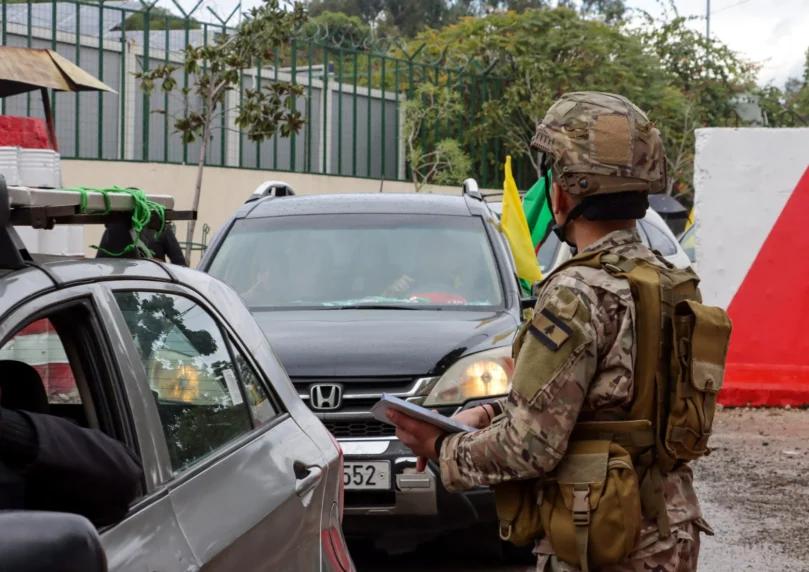

Since efforts to disarm Hezbollah began last year, the Lebanese army has been mentioned again as the body that should lead the mission. Washington has gone the extra mile and given the Lebanese army public backing. The US envoy to Lebanon, Morgan Ortagus, said in an interview: “The United States has provided (the Lebanese army) support, training, and equipment for decades. We continue to do so. We have even added military advisors on the ground in Lebanon.”
This month, at the end of the round of talks in Washington, Israel, Lebanon, and the United States presented a joint document of understanding, according to which the Lebanese army will be allowed to control field cells in southern Lebanon, instead of Hezbollah. However, more and more evidence indicates that elements within the ranks of the Lebanese army operate who maintain ties with Hezbollah, and sometimes even cooperate with it.
M, an anonymous Lebanese citizen who agreed to speak to Channel 14, accuses the Lebanese army: “The army is broken. A large part of its soldiers are militiamen who belong to Hezbollah. They are loyal to Hezbollah, and as a result, to Iran.” In February of last year, at the height of the sword war, a video was released of Lebanese soldiers standing at a military checkpoint in the south of the country. One of them explained to the camera, “Behind the checkpoint is the Zionist enemy. We are here and ready. We are loyal to the Shiite tradition. At your command, Nasrallah!”

The Lebanese army has soldiers from all sects, and also a great many soldiers from the Shiite sect with which Hezbollah is identified, fifty percent according to estimates. Therefore, there is a close connection between the army and Hezbollah. Abd al-Rahman Shihtali is a retired senior Shiite officer in the Lebanese army.
In an interview he gave in recent days, he said that Hezbollah tried to pressure him and interfere in the appointments: “I admit, they asked me too. I was the most senior Shiite officer, and they asked me. They told me: ‘We want a Shiite officer in this position.'”
In January of this year, the Lebanese army issued a ridiculous statement stating that it had completed the dismantling of Hezbollah south of the Litani. However, according to Tal Be’eri, head of the research department at the Alma Center, some Shiite officers in the army are refraining from enforcing the instructions against it on the ground: “If the Lebanese army arrives at a Hezbollah military site, the arrival is usually coordinated in advance with Hezbollah.”
According to him, even in cases where weapons were confiscated from the organization, it was all just for show: “The weapons would arrive at the Lebanese army’s warehouses and at a later stage would return in the form of a ‘revolving door’ to Hezbollah.”

Be’eri presents a series of senior officers with warm ties to Hezbollah. He also says that Hezbollah’s infiltration reaches into the Lebanese army’s intelligence systems. This is how he describes the figure of Suhail Harb, a senior Shiite officer responsible for military intelligence in southern Lebanon: “He took advantage of his position and actually passed on information from the joint headquarters established between Israel, the US and Lebanon for Hezbollah’s disarmament, so that it could prepare and transfer ammunition from place to place.”
The Chief of Staff of the Lebanese Army, Rudolf Heichal, has also been harshly criticized by the Americans for his unwillingness to deal with Hezbollah. And recently the United States imposed sanctions on Lebanese officers who collaborated with the organization. Hezbollah’s infiltration of the army is much deeper than is commonly thought. This is the result of Israel’s fear of any agreement with Lebanon.