


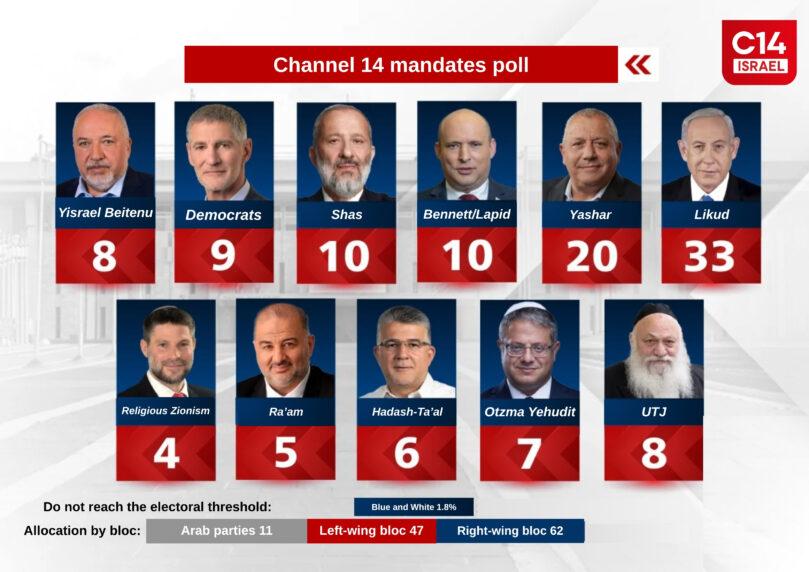

A new Channel 14 poll broadcast Thursday evening points to stability at the top of the political map alongside dramatic shifts within the opposition camp. According to data collected by Shlomo Filber and NEXT DATA, Likud remains Israel’s largest party with 33 seats.
The poll’s central drama unfolds in the center-left bloc, where Gadi Eisenkot’s Yashar party surges to 20 seats, making it the second-largest party in the Knesset. Meanwhile, Naftali Bennett’s Yachad continues its weakening trend and drops to just 10 seats—opening a ten-seat gap with Eisenkot.
In the overall seat distribution, Shas receives 10 seats, the Democrats 9, Yisrael Beiteinu 8, and United Torah Judaism 8. Jewish Power wins 7 seats, the Joint List 6, Ra’am 5, and Religious Zionism 4 seats. Blue and White continues to remain below the electoral threshold with just 1.8% support.
In the bloc breakdown, the right-wing bloc maintains its lead with 62 seats. The left-wing bloc stands at 47 seats, while the Arab parties hold 11 seats. The data proves that even in a scenario where Naftali Bennett runs in elections, the right-wing bloc continues to enjoy a solid majority.
On the question of suitability for prime minister, Netanyahu continues to lead by a significant margin with 45% support. Gadi Eisenkot places second with 34%, a figure that strengthens his position as the most prominent candidate in the opposition camp. Naftali Bennett receives just 12% on the prime minister suitability question, while Avigdor Lieberman gets 8% and Benny Gantz just 1%.
Disclaimer: The poll was conducted by NEXT DATA with participation from 1,552 adults from the general population on June 18, 2026. Data analysis: Shlomo Filber.